A cosmic-ray proton in interstellar space has an energy of 15.5 MeV and executes a circular...
A cosmic-ray proton in interstellar space has an energy of 15.5 MeV and executes a circular orbit having a radius equal to that of Mars' orbit around the Sun (2.28 1011 m). What is the magnetic field in that region of space?
Homework Answers
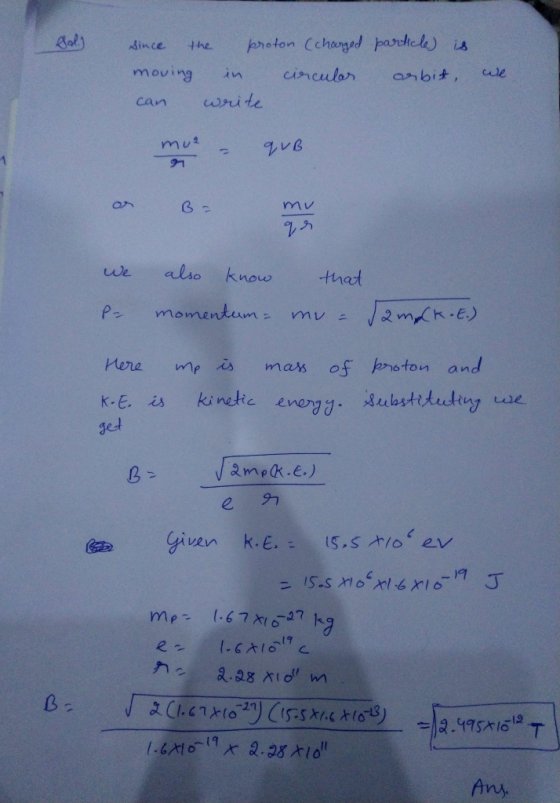
Hope it helps...
Please comment for any clarification or doubts or if you are unable to understand anything....
And please do rate
Add Answer to:
A cosmic-ray proton in interstellar space has an energy of 15.5
MeV and executes a circular...
A cosmic-ray proton in interstellar space has an energy of 23.0 MeV and executes a circular...
A cosmic-ray proton in interstellar space has an energy of 23.0 MeV and executes a circular orbit having a radius equal to that of Mars' orbit around the Sun (2.28 1011 m). What is the magnetic field in that region of space? T
1. A cosmic-ray proton in interstellar space has an energy of 20.0 MeV and executes a...
 1. A cosmic-ray proton in interstellar space has an energy of 20.0 MeV and executes a circular orbit having a radius equal 5.80x10¹⁰ m. What is the magnetic field in that region of space? 2. The ammeter shown in figure I reads 4.00 A. Determine the values of the currents across the 32 and 7 12 also the voltage of €. 522 712 AO w +25 V Figure 1 10123
A proton in space has an energy of 15 MeV and has a circular path of...
A proton in space has an energy of 15 MeV and has a circular path of 5.8 X 10^10 m. Determine the existing magnetic field in that region of space.
In a nuclear experiment a proton with kinetic energy 5.0 MeV moves in a circular path...
In a nuclear experiment a proton with kinetic energy 5.0 MeV moves in a circular path in a uniform magnetic field. If the magnetic field is B = 2.2 T what is the radius of the orbit? What energy must an alpha particle (q = +2e, m = 4.0 u) and a deuteron (q = +e, m = 2.0 u) have if they are to circulate in the same orbit? Energy of the alpha?(MeV) Energy of the deuteron?
(8c28p20) In a nuclear experiment a proton with kinetic energy 7.5 MeV moves in a circular...
 (8c28p20) In a nuclear experiment a proton with kinetic energy 7.5 MeV moves in a circular path in a uniform magnetic field. If the magnetic field is B = 0.4 T what is the radius of the orbit? Submit Answer Tries 0/10 What energy must an alpha particle (g = +2e, m = 4.0 u) and a deuteron (q = te, m = 2.0 u) have if they are to circulate in the same orbit? Energy of the alpha? (MeV)...
A cosmic-ray proton moves at 2.8 × 10⁷ m/s perpendicular to Earth’s magnetic field at an...
A cosmic-ray proton moves at 2.8 × 10⁷ m/s perpendicular to Earth’s magnetic field at an altitude where the field strength is 1.75 × 10⁻⁵ T. What is the radius of the circular path the proton follows? Draw a diagram to explain your answer.
The galactic magnetic field in some region of the interstellar space has a magnitude of 1.00...
The galactic magnetic field in some region of the interstellar space has a magnitude of 1.00 10-9 T. A particle of interstellar dust has a mass of 13.0 µg and a total charge of 0.360 nC. How many years does it take for the particle to complete a revolution of the circular orbit caused by its interaction with the magnetic field? years
8. A cosmic-ray proton traveling at half the speed of light (speed of light c 3x10...
 8. A cosmic-ray proton traveling at half the speed of light (speed of light c 3x10 m/sec) is heading directly towards the center of the Earth in the plane of the Earth's equator. Assume that the Earth's magnetic field is uniform over the planet's equatorial plan with a magnitude of IBI-50.0x10⁻⁶ T, extending out a distance d 1.3x10⁷m from the surface of the Earth. Assume that the field is zero at greater distances. Will the cosmic-ray proton hit the Earth?...
1. A cosmic ray proton moving toward the Earth at 3.5 × 10⁷ m/s experiences a...
1. A cosmic ray proton moving toward the Earth at 3.5 × 10⁷ m/s experiences a magnetic force of 1.9 × 10⁻¹⁶ N . What is the strength of the magnetic field if there is a 45º angle between it and the proton’s velocity? 2. An electron moving at 4.25 × 10³ m/s in a 1.45 T magnetic field experiences a magnetic force of 1.7 × 10⁻¹⁶ N. What angle (in degrees, between 0 and 90°) does the velocity of...
A cosmic ray proton moving toward the Earth at 4.30×10^7 m/s experiences a magnetic force of...
A cosmic ray proton moving toward the Earth at 4.30×10^7 m/s experiences a magnetic force of 1.70×10⁻¹⁶ N . What is the strength of the magnetic field if there is a 38.0 degree angle between it and the protons velocity?
 1. A cosmic-ray proton in interstellar space has an energy of 20.0 MeV and executes a circular orbit having a radius equal 5.80x10¹⁰ m. What is the magnetic field in that region of space? 2. The ammeter shown in figure I reads 4.00 A. Determine the values of the currents across the 32 and 7 12 also the voltage of €. 522 712 AO w +25 V Figure 1 10123
 (8c28p20) In a nuclear experiment a proton with kinetic energy 7.5 MeV moves in a circular path in a uniform magnetic field. If the magnetic field is B = 0.4 T what is the radius of the orbit? Submit Answer Tries 0/10 What energy must an alpha particle (g = +2e, m = 4.0 u) and a deuteron (q = te, m = 2.0 u) have if they are to circulate in the same orbit? Energy of the alpha? (MeV)...
 8. A cosmic-ray proton traveling at half the speed of light (speed of light c 3x10 m/sec) is heading directly towards the center of the Earth in the plane of the Earth's equator. Assume that the Earth's magnetic field is uniform over the planet's equatorial plan with a magnitude of IBI-50.0x10⁻⁶ T, extending out a distance d 1.3x10⁷m from the surface of the Earth. Assume that the field is zero at greater distances. Will the cosmic-ray proton hit the Earth?...
Most questions answered within 3 hours.
-
Where is the error in this code sequence?
String s1 = "Hello";
String s2 = "ello";...
asked 10 months ago -
Financial data for Joel de Paris, Inc., for last year
follow:
Joel de Paris, Inc.
Balance...
asked 10 months ago -
Consider this reaction:
Al2(SO4)3 (aq)+ BaCl3
(aq) Al2Cl6 (aq)- +
3BaSO4(s) . What is the...
asked 10 months ago -
Suppose that Savneet is considering increasing her
recent random sample from 20 car rentals to 40...
asked 10 months ago -
Trucks arrive at an unloading terminal at an average rate of 120
per hour.
Trucks arrive...
asked 10 months ago -
Why are methanol and ethanol completely soluble in water while
octanol is not very little soluble....
asked 10 months ago -
A facilities manager at a university reads in a research report
that the mean amount of...
asked 10 months ago -
When the CuSO4 is rehydrated by adding water to the anhydrous
compound, is this an endothermic...
asked 10 months ago -
A ray of sunlight is passing from diamond into crown glass; the
angle of incidence is...
asked 10 months ago -
A block of mass 0.249 kg is placed on top of a light, vertical
spring of...
asked 10 months ago -
how do the kidneys compensate in the presences of acidosis
a) trigger hyperventilate
b) reserve acid...
asked 10 months ago -
Question 501 pts
The rental rate of capital to the firm increases. Which of the
following...
asked 10 months ago