Which of the following is either slave or master and can you please define each one!...
Homework Answers
Firstly lets understand what are these 4 Interfaces i.e IDE,SCSI,SATA,ST-506 :--
1- Integrated Drive Electronics, IDE is more commonly known as ATA or PATA (parallel ATA). It is a standard interface for IBM computers that was first developed by Western Digital and Compaq in 1986 for compatible hard drives and CD or DVD drives. IDE is different than Small Computer System Interface (SCSI) because its controllers are on each drive, meaning that drive can connect directly to motherboard or controller and Each IDE channel can support two drives. one IDE ribbon cable has three connection. One connect to motherboard and other two connections are available for two drives.IDE grew out of the ST506 and ESDI standards in the 1980s.
DE drives are slower because they did not have big cache like SCSI drives, and they could not write directly to RAM
2-- Small Computer System Interface (SCSI) --- It ia s high performance parallel peripheral interface that can independently distribute data among peripherals attached to the PC. Unlike PATA, SCSI incorporates those instructions needed for communication with the host PC. Freeing the host computer from this job makes it more efficient in performing its user-oriented activities. SCSI drives are usually more suitable for high-end computer systems, which require maximum possible performance. SCSI provides for high data transfer rates and less CPU load than PATA . it can connect a wide range of other devices, including scanners and CD drives, although not all controllers can handle all devices. So SCSI is popular on high-performance workstations, servers, and storage appliances. Almost all RAID subsystems on servers have used some kind of SCSI hard disk drives .
Serial ATA (SATA) i.e Serial Advanced Technology Attachment-->
Benits of SATA OVER PATA --> It is an interface used to connect ATA hard drives to a computer's motherboard. SATA transfer rates start at 150MBps, which is significantly faster than even the fastest 100MBps ATA/100 drives.and where SATA cables can be as long as one meter, while PATA cables max out at 40cm. the main diffrence is that where Serial ATA uses only 7 conductors, while Parallel ATA uses 40.which means there is less electromagnetic interference with SATA devices.
• Lower pin count • Higher performance • Simple drive configuration • Better cables/connectors • Greater reliability • Low voltage support • Migration to more server implementations .
For these reasons Serial ATA is likely to replace the previous standard, Parallel ATA (PATA), which has been around since the 1980s.
4-ST-506--> IN ST-506 interface, the drive connects to a
controller card with two ribbon cables carrying signals, while a
third cable provides power. The ST-506/412 disc drive is
a random access storage device utilizing two non-removable 5% inch
discs as storage media. Each disc surface employs one movable head
to service 153/306 data tracks. The total formatted capacity of the
four heads and surfaces is 5/10 megabytes (32 sectors per track,
256 bytes per sector, 612/1224 tracks).
A second port in the filter assembly allows pressure equalization
with ambient air without chance of contamination. A patented
spindle pump assures adequate air flow and uniform temperature
distribution throughout head and disc area. SO BY ST-506 ST-506 it
is possible for personal computer manufacturers to easily offer
upgrades in storage capacity and access time.The ST-506 disk drive
lacked buffered seek capability and averaged a seek time of only
170 ms,
it was an old standard interface for connecting hard disk drives to PCs.
SO NOW LETs KNOW ABOUT MASTER AND SLAVE --->
A single IDE interface can support two devices. Most of the motherboards come with dual IDE interfaces (primary and secondary) for up to four IDE devices. Because the controller is integrated with the drive.
To allow for two drives on the same cable, IDE uses a special configuration called master and slave. This configuration allows one drive's controller to tell the other drive when it can transfer data to or from the computer. When a slave drive makes request to master drive, which checks to see if it is currently communicating with computer. If master drive is idle, it tells slave drive to go ahead. If master drive is communicating with the computer, it tells slave drive to wait and then informs it when it can go ahead.
computer determines if there is a (slave) drive attached through use of Pin on connector. and that Pin carries a special signal, called Drive Active/Slave Present (DASP), that checks to see if a slave drive is present.
Many drives feature an option called Cable Select (CS). With the correct type of IDE ribbon cable, these drives can be auto configured as master or slave. lets know how CS works : A jumper on each drive is set to CS option. The cable itself is just like a normal IDE cable except for one difference -- that Pin only connects to the master drive connector. When your computer is powered up, the IDE interface sends a signal along the wire for Pin . Only the drive attached to the master connector receives the signal.
ATA's cables have had 40 wires for most of its history (44 conductors for the smaller form-factor version used for 2.5" drives—the extra four for power) IDE subsystem allows 20 disks (10 controllers each with 1 master and 1 slave) which can have up to 63 partitions each.The primary drive (drive 0) is called the master, and the secondary drive (drive 1) is called the slave. containing CABLE SELECT AND Drive Active/Slave Present (DASP) with three differently colored connectors (blue, black, and gray for controller, master drive, and slave drive respectively) as opposed to uniformly colored 40-wire cable's connectors (commonly all gray).
There is no "masters" and "slaves" in SCSI. All devices on a bus are assigned an ID.
SATA is a point to point connection, not a bus connection , so ATA's master and slave strapping disappears. sATA cabling is less bulky and the form factor of its plugs and sockets are smaller than parallel ATA (and the SCSI Parallel interface).
Unlike older IDE drives, SATA disks have no jumpers and it's not necessary to configure a master/slave relationship between the
now the PC industry has not used ATA master/slave terminology from many years.
*_* UPVOTE THIS ANSWER IF YOU FIND IT USEFUL WHICH U WILL *_*
Add Answer to:
Which of the following is either slave or master and can you please
define each one!...
Which of the following statements is correct regarding the difference between Enhanced IDE and SCSI devices?...
Which of the following statements is correct regarding the difference between Enhanced IDE and SCSI devices? A. EIDE controllers are much faster than SCSI devices because they have to handle a maximum of four devices. B. The number of EIDE devices is limited to four, but there can be up to 31 SCSI devices in a system. C. EIDE devices are connected in a daisy-chain fashion, but the SCSI devices have to be configured as the master and slave. D....
Master Slave D Flip Flop on Breadboard Hello, I need major help on how to construct...
 Master Slave D Flip Flop on Breadboard
Hello, I need major help on how to construct a MASTER-SLAVE D
flip flop on a breadboard (Preferably a virtual one like
tinkerCAD.com).
If you could upload a screenshot or picture of the final
breadboard, that would help.
It can only use the following ICs: NOT (7404), 2-Input NAND
(7400) or 2-Input NOR (7402).
It needs to be connected to a power supply, and LED's with
resistors to test it out, thank you....
Master Slave D Flip Flop on Breadboard
Hello, I need major help on how to construct a MASTER-SLAVE D
flip flop on a breadboard (Preferably a virtual one like
tinkerCAD.com).
If you could upload a screenshot or picture of the final
breadboard, that would help.
It can only use the following ICs: NOT (7404), 2-Input NAND
(7400) or 2-Input NOR (7402).
It needs to be connected to a power supply, and LED's with
resistors to test it out, thank you....
Below you find a timing diagram for an 12C communication stream. Please an following What slave...
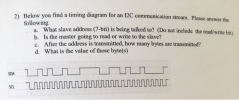 Below you find a timing diagram for an 12C communication stream. Please an following What slave address (7-bit) is being talked to? (Do not include the read/write bit) b. Is the master going to read or write to the slave? c. After the address is transmitted, how many bytes are transmitted? d. What is the value of those byte(s) SDA unnen sa um mns
Algorithms: Please explain each step! Thanks! (20 points) Use the Master Theorem to solve the following...
 Algorithms:
Please explain each step! Thanks!
(20 points) Use the Master Theorem to solve the following recurrence relations. For each recurrence, either give the asympotic solution using the Master Theorem (state which case), or else state the Master Theorem doesn't apply (d) T(n) T() + T (4) + n2
(20 points) Use the Master Theorem to solve the following recurrence relations. For each recurrence, either give the asympotic solution using the Master Theorem (state which case), or else state the...
Algorithms:
Please explain each step! Thanks!
(20 points) Use the Master Theorem to solve the following recurrence relations. For each recurrence, either give the asympotic solution using the Master Theorem (state which case), or else state the Master Theorem doesn't apply (d) T(n) T() + T (4) + n2
(20 points) Use the Master Theorem to solve the following recurrence relations. For each recurrence, either give the asympotic solution using the Master Theorem (state which case), or else state the...
Which of the following statements regarding slave life is true? Select one: a. Slaves had to...
Which of the following statements regarding slave life is true? Select one: a. Slaves had to grow all of their own food. b. Slaves were not given medical care except by their own efforts. c. Slave children did no work until they turned twelve years old. d. It was uncommon to divide slave families for long periods of time. e. After 1808, the proportion of blacks to whites in the nation steadily declined.
Define LIFO and FIFO and state the tax benefits of each. Also, can either LIFO or...
Define LIFO and FIFO and state the tax benefits of each. Also, can either LIFO or FIFO be used to massage the numbers in any way?
5) For each of the following recurrences state whether the Master theorem can be applied to...
 5) For each of the following recurrences state whether the Master theorem can be applied to solve the recurrence or not. If the Master theorem can be used, then use it to determine running time for the recurrence. If the Master theorem cannot be applied, then specify the reason (you don't need to solve the recurrence). a) T(n) = 4T(n/3)+n2
can you please help me with this homework? Define each of the 10 plagiarism examples in...
can you please help me with this homework? Define each of the 10 plagiarism examples in your won words with a minimum of 3 sentences each. REMIX: ... RECYCLE: ... HYBRID: ... MASHUP CLONE CTRL-C FIND-REPLACE 404 ERROR AGGREGATOR RETWEET
Please explain also PROBLEMS For each of the problems below, determine which arows violate either one...
 Please explain also
PROBLEMS For each of the problems below, determine which arows violate either one of the two commandments, and explain why. (Don't forget to count all hydrogen atoms and all lone pairs You must do this to solve these problems.) A. Does not violeto 2. ろ F11 | F12 PrtSc Insert
Please explain also
PROBLEMS For each of the problems below, determine which arows violate either one of the two commandments, and explain why. (Don't forget to count all hydrogen atoms and all lone pairs You must do this to solve these problems.) A. Does not violeto 2. ろ F11 | F12 PrtSc Insert
I am having trouble with this assignment. Please help. For this assignment, you will select either...
 I am having trouble with this assignment. Please help.
For this assignment, you will select either the Cat or Dog Java
class from the UML diagram provided in Project One and implement
it. Open the Virtual Lab by clicking on the link in the Virtual Lab
Access module. Then open your IDE and create a new class. Use the
Eclipse IDE and Downloading Files From Eclipse tutorials to help
you with this project.
Review the UML Class Diagram, paying special...
I am having trouble with this assignment. Please help.
For this assignment, you will select either the Cat or Dog Java
class from the UML diagram provided in Project One and implement
it. Open the Virtual Lab by clicking on the link in the Virtual Lab
Access module. Then open your IDE and create a new class. Use the
Eclipse IDE and Downloading Files From Eclipse tutorials to help
you with this project.
Review the UML Class Diagram, paying special...
 Master Slave D Flip Flop on Breadboard
Hello, I need major help on how to construct a MASTER-SLAVE D
flip flop on a breadboard (Preferably a virtual one like
tinkerCAD.com).
If you could upload a screenshot or picture of the final
breadboard, that would help.
It can only use the following ICs: NOT (7404), 2-Input NAND
(7400) or 2-Input NOR (7402).
It needs to be connected to a power supply, and LED's with
resistors to test it out, thank you....
Master Slave D Flip Flop on Breadboard
Hello, I need major help on how to construct a MASTER-SLAVE D
flip flop on a breadboard (Preferably a virtual one like
tinkerCAD.com).
If you could upload a screenshot or picture of the final
breadboard, that would help.
It can only use the following ICs: NOT (7404), 2-Input NAND
(7400) or 2-Input NOR (7402).
It needs to be connected to a power supply, and LED's with
resistors to test it out, thank you....
 Below you find a timing diagram for an 12C communication stream. Please an following What slave address (7-bit) is being talked to? (Do not include the read/write bit) b. Is the master going to read or write to the slave? c. After the address is transmitted, how many bytes are transmitted? d. What is the value of those byte(s) SDA unnen sa um mns
 Algorithms:
Please explain each step! Thanks!
(20 points) Use the Master Theorem to solve the following recurrence relations. For each recurrence, either give the asympotic solution using the Master Theorem (state which case), or else state the Master Theorem doesn't apply (d) T(n) T() + T (4) + n2
(20 points) Use the Master Theorem to solve the following recurrence relations. For each recurrence, either give the asympotic solution using the Master Theorem (state which case), or else state the...
Algorithms:
Please explain each step! Thanks!
(20 points) Use the Master Theorem to solve the following recurrence relations. For each recurrence, either give the asympotic solution using the Master Theorem (state which case), or else state the Master Theorem doesn't apply (d) T(n) T() + T (4) + n2
(20 points) Use the Master Theorem to solve the following recurrence relations. For each recurrence, either give the asympotic solution using the Master Theorem (state which case), or else state the...
 5) For each of the following recurrences state whether the Master theorem can be applied to solve the recurrence or not. If the Master theorem can be used, then use it to determine running time for the recurrence. If the Master theorem cannot be applied, then specify the reason (you don't need to solve the recurrence). a) T(n) = 4T(n/3)+n2
 Please explain also
PROBLEMS For each of the problems below, determine which arows violate either one of the two commandments, and explain why. (Don't forget to count all hydrogen atoms and all lone pairs You must do this to solve these problems.) A. Does not violeto 2. ろ F11 | F12 PrtSc Insert
Please explain also
PROBLEMS For each of the problems below, determine which arows violate either one of the two commandments, and explain why. (Don't forget to count all hydrogen atoms and all lone pairs You must do this to solve these problems.) A. Does not violeto 2. ろ F11 | F12 PrtSc Insert
 I am having trouble with this assignment. Please help.
For this assignment, you will select either the Cat or Dog Java
class from the UML diagram provided in Project One and implement
it. Open the Virtual Lab by clicking on the link in the Virtual Lab
Access module. Then open your IDE and create a new class. Use the
Eclipse IDE and Downloading Files From Eclipse tutorials to help
you with this project.
Review the UML Class Diagram, paying special...
I am having trouble with this assignment. Please help.
For this assignment, you will select either the Cat or Dog Java
class from the UML diagram provided in Project One and implement
it. Open the Virtual Lab by clicking on the link in the Virtual Lab
Access module. Then open your IDE and create a new class. Use the
Eclipse IDE and Downloading Files From Eclipse tutorials to help
you with this project.
Review the UML Class Diagram, paying special...
Most questions answered within 3 hours.
-
Where is the error in this code sequence?
String s1 = "Hello";
String s2 = "ello";...
asked 11 months ago -
Financial data for Joel de Paris, Inc., for last year
follow:
Joel de Paris, Inc.
Balance...
asked 11 months ago -
Consider this reaction:
Al2(SO4)3 (aq)+ BaCl3
(aq) Al2Cl6 (aq)- +
3BaSO4(s) . What is the...
asked 11 months ago -
Suppose that Savneet is considering increasing her
recent random sample from 20 car rentals to 40...
asked 11 months ago -
Trucks arrive at an unloading terminal at an average rate of 120
per hour.
Trucks arrive...
asked 11 months ago -
Why are methanol and ethanol completely soluble in water while
octanol is not very little soluble....
asked 11 months ago -
A facilities manager at a university reads in a research report
that the mean amount of...
asked 11 months ago -
When the CuSO4 is rehydrated by adding water to the anhydrous
compound, is this an endothermic...
asked 11 months ago -
A ray of sunlight is passing from diamond into crown glass; the
angle of incidence is...
asked 11 months ago -
A block of mass 0.249 kg is placed on top of a light, vertical
spring of...
asked 11 months ago -
how do the kidneys compensate in the presences of acidosis
a) trigger hyperventilate
b) reserve acid...
asked 11 months ago -
Question 501 pts
The rental rate of capital to the firm increases. Which of the
following...
asked 11 months ago