The following questions are from a copper content in brass experiment in my Chem 1 lab...
The following questions are from a copper content in brass experiment in my Chem 1 lab class. These are the discussion questions, I would like a little bit of background knowledge on how I may get the answers so I could fully understand. Thank you!
The equation for your line has a nonzero y intercept. Beer’s law does not have an analogous term. Explain the discrepancy between your experimental best fit equation and
the theoretical Beer’s law equation.
2. Consider the experimental procedure. What were the most likely sources of error?
Remember that experimental error is not the same thing as a calculation mistake or incorrectly following the procedure.
3. In a previous experiment we used the λ max to determine the absorbances to use for the
calibration graph. Why did we other criteria (not λmax) in this experiment? Is Beer’s law valid at other wavelengths? Explain.
4. Based the absorbance vs. wavelength spectrum of the dissolved brass solution, is there evidence of the presence of elements other than copper and zinc in the brass sample?
Explain your answer.
Homework Answers
Pre Requisite:
Beer-Lambert's Law
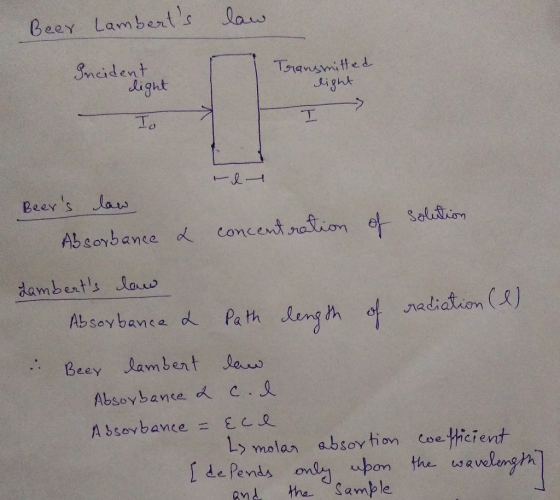
- Therefore the absorption at two different wavelength will not be same as the molar absorption coefficient is different for different wavelength.
- Also, the absorption values for two different samples are not same. Which answeres your Question No. 4 as if any other element is present, it will show Absorption Peaks at different wavelengths.
Beer-Lambert's Law is highly sensitive to concentration as the Beer-Lambert Plot doesnt follow linearity when the high concentrations are taken into account.
Answer 3: As I showed above that the  max
is different for different wavelength and hence we must stick to
One single wavelength for whole experiment. and we can do the same
experiment with different wavelegth also but that wavelength value
must be used for all measurements and also it must not be
interfered with other elements or impurities peak so that the
calculation error does not occur.
max
is different for different wavelength and hence we must stick to
One single wavelength for whole experiment. and we can do the same
experiment with different wavelegth also but that wavelength value
must be used for all measurements and also it must not be
interfered with other elements or impurities peak so that the
calculation error does not occur.
As the Brass contains Zinc and Copper mainly, it's called as alloy
of Copper and is available commercially in many forms where the
percentage of Copper and Zinc are altered and its determination is
necessary in order to identify or check for the Product
quality.
So in this experiment, the Brass is dissolved in Nitric Acid so as
to dissolve the the solid cooper to make Copper(II) Solution.
This part must be done carefully as Nitric Acid is used here
and dissolving Brass may spill the acid and also the
NO,NO2 are evolved which are very
toxic and must be handled carefully.

This equation is followed during dissolving process and the
Cu2+ is formed. as you asked for getting the background
knowledge, Suppose you want to know the concentration of one
unknown sample of Cu2+, Then what you should do is that
you should make 3-4 known concentrations of Cu2+ Samples
and then make a Concentration v/s absorbance curve(remember to keep
only one value for all
samples) and then measure the absorbance of unknown conc sample.
and then plot the absorbance value of unknown in the previous Conc
V/s Absorbance Curve.
By this method you can easily find out the concentration of unknown
sample.
The same method is followed here in this case.
Possible cause of errors
1. Low concentrations of sample must be used as beer lambert law
fails at high concentration.
2. UV-Spectrophotometer must be properly calibrated before use, incorrectly calibrated spectrophotometer causes errors in data.
3. Deionised Water must be used for experiment as Tap water already contains some Cu2+, which will cause inaccuracy.
Hope I answered
Add Answer to:
The following questions are from a copper content in brass
experiment in my Chem 1 lab...
Chem 162 Experiment 2 Spectrophotometric Determination of Ion Concentration by Beer's Law Pre-Lab Questions a. A...
 Chem 162 Experiment 2 Spectrophotometric Determination of Ion Concentration by Beer's Law Pre-Lab Questions a. A sample absorbs 80% of the light passed through it at a certain wavelength. What is the absorbance of the sample at this wavelength? b. What would the absorbance be at the same wavelength if the sample were diluted by half? Assume the same size sample cell was used. 2, A 0.070 M solution has an absorbance ofA = 0.689. If a 1.00 cm path...
Chemistry Lab Need help with the questions Experiment 1
Chemistry Lab Need help with the questions Experiment 1 Trial 1 Trial 2 Trial 3 a) Mass of copper (g) 10g 15g 20g b) Moles of copper (mol) 0.157 mol 0.236 mol 0.314 mol c) Mass of copper and crucible (g) 98.000g 103.000g 108.000g d) Mass of copper oxide and the crucible (g) 100.518g 106.777g 113.035g e) Mass of oxygen gained from reaction (g) 2.518g 3.777g 15.035g f) Moles of oxygen...
Beer’s Law Objective : We will explore an application of absorption spectroscopy using calibration curves and...
Beer’s Law Objective : We will explore an application of absorption spectroscopy using calibration curves and Beer’s Law. Use the “LAB : HOW TO…” link from the class website if you need help with how to use balance, Bunsen burner… and such. Introduction: You may write this information in your lab notebook for your own reference. It can’t be cut and pasted. Different solutions have different spectral properties. In this portion of the experiment those properties will be utilized to...
Name: Pavi kaur Partner: Alyssa Instructor initials, Week 1 Instructor initials, Week 2: CHEM 121 Lab...
 Name: Pavi kaur Partner: Alyssa Instructor initials, Week 1 Instructor initials, Week 2: CHEM 121 Lab Clark College Experiment 7: Reaction of Magnesium Metal with Hydrochloric Acid Adapted from Bassow by Mermil Parry & Content Goals: Write and balance chemical equations. Determine which gas law(s) are necessary in problem-solving situations Use gas laws and experimental data to solve experimental problems. Process Goals Read and follow complex instructions. Construct and organize a data table. Accurately measure volumes Solve problems that combine...
1. These questions are referring to the Boyle's law experiment only. a. Analyzing the shape of...
 1. These questions are referring to the Boyle's law experiment only. a. Analyzing the shape of the curve in the plot of pressure versus volume, do you think the relationship between the pressure and volume of a confined gas is direct or inverse? Explain your answer. b. What experimental factors are assumed to be constant in this experiment? c. Using P. V, and k, write an equation representing Boyle's law AND write a verbal statement that correctly expresses Boyle's law,...
Please help me answer questions from pre-lab homework Aspirin Analysis Lab 1) Calculate the molar concentration...
 Please help me answer questions from pre-lab homework
Aspirin Analysis Lab
1) Calculate the molar concentration (molarity) of a 250 mL stock solution prepared from 0.5 g of pure acetylsalicylic acid. 2) Calculate the molar concentration (molarity) of a 50 mL solution prepared from 2.5 mL of the acetylsalicylic acid stock solution from question 1. This will be labeled as Standard Solution A. 3) Simlarly, calculate the molar concentrations (molarities) of 50 mL the four individual solutions prepared from 2,...
Please help me answer questions from pre-lab homework
Aspirin Analysis Lab
1) Calculate the molar concentration (molarity) of a 250 mL stock solution prepared from 0.5 g of pure acetylsalicylic acid. 2) Calculate the molar concentration (molarity) of a 50 mL solution prepared from 2.5 mL of the acetylsalicylic acid stock solution from question 1. This will be labeled as Standard Solution A. 3) Simlarly, calculate the molar concentrations (molarities) of 50 mL the four individual solutions prepared from 2,...
Need help with conclusion questions please 1. The objectives of this lab are (1) to determine...
 Need help with conclusion questions please
1. The objectives of this lab are (1) to determine the actual (A) total resistance of three resistors connected in series and compare it with the experimental (E ) value of total resistance (2) to determine the actual (A) total resistance of three resistors connected in parallel and compare it with the experimental(E ) value of total resistance II. Apparatus(Equipment): Voltage source, ammeter that measures current , voltmeter that measures voltage. II. Procedure: Three...
Need help with conclusion questions please
1. The objectives of this lab are (1) to determine the actual (A) total resistance of three resistors connected in series and compare it with the experimental (E ) value of total resistance (2) to determine the actual (A) total resistance of three resistors connected in parallel and compare it with the experimental(E ) value of total resistance II. Apparatus(Equipment): Voltage source, ammeter that measures current , voltmeter that measures voltage. II. Procedure: Three...
DISCUSSION QUESTIONS 1. If the liquid did not completely vaporize in the experiment, would the ap-...
 DISCUSSION QUESTIONS 1. If the liquid did not completely vaporize in the experiment, would the ap- parent molecular weight be larger, smaller, or unchanged compared to that determined if the experiment had been properly performed? Would the error in part (1) have a larger, smaller, or the same effect as the errors that might be made in measuring the temperature of the water in the flask, the barometric pressure, or the volume of the flask? Explain your answer. 2. What...
Experiment Lab Questions: Distillation of Alcohol Reagents: (1) Ethanol (C2H5OH) [ MW = 46.07 g/m...
Experiment Lab Questions: Distillation of Alcohol Reagents: (1) Ethanol (C2H5OH) [ MW = 46.07 g/mol density = 0.789g/mL boiling point = 78.37 C ] (2) Red food dye (non-volatile) Questions: 1. What is the theoretical Yield 2. How can we improve the efficiency of this distilation experiment? 3. What is the reason for a sharp increase in temperature at one point? 4. What is the reason we can assume that distillation is completed when the temperature drops? 5. a. Discuss...
I need helppp with my AP chem lab
Purpose: To calculate the amount of AgNO3 present in an unknown solution of water through the process of gravimetric analysis with NaCl. Background: Have you ever had difficulty lathering soap or find that the scum in your shower constantly needs to be removed? These are signs of “hard water.” Soap does not lather well in hard water because metal ions, such as Ca2+, form precipitates, creating “soap scum.” A precipitate is an insoluble compound that forms when soluble ions in...
 Chem 162 Experiment 2 Spectrophotometric Determination of Ion Concentration by Beer's Law Pre-Lab Questions a. A sample absorbs 80% of the light passed through it at a certain wavelength. What is the absorbance of the sample at this wavelength? b. What would the absorbance be at the same wavelength if the sample were diluted by half? Assume the same size sample cell was used. 2, A 0.070 M solution has an absorbance ofA = 0.689. If a 1.00 cm path...
 Name: Pavi kaur Partner: Alyssa Instructor initials, Week 1 Instructor initials, Week 2: CHEM 121 Lab Clark College Experiment 7: Reaction of Magnesium Metal with Hydrochloric Acid Adapted from Bassow by Mermil Parry & Content Goals: Write and balance chemical equations. Determine which gas law(s) are necessary in problem-solving situations Use gas laws and experimental data to solve experimental problems. Process Goals Read and follow complex instructions. Construct and organize a data table. Accurately measure volumes Solve problems that combine...
 1. These questions are referring to the Boyle's law experiment only. a. Analyzing the shape of the curve in the plot of pressure versus volume, do you think the relationship between the pressure and volume of a confined gas is direct or inverse? Explain your answer. b. What experimental factors are assumed to be constant in this experiment? c. Using P. V, and k, write an equation representing Boyle's law AND write a verbal statement that correctly expresses Boyle's law,...
 Please help me answer questions from pre-lab homework
Aspirin Analysis Lab
1) Calculate the molar concentration (molarity) of a 250 mL stock solution prepared from 0.5 g of pure acetylsalicylic acid. 2) Calculate the molar concentration (molarity) of a 50 mL solution prepared from 2.5 mL of the acetylsalicylic acid stock solution from question 1. This will be labeled as Standard Solution A. 3) Simlarly, calculate the molar concentrations (molarities) of 50 mL the four individual solutions prepared from 2,...
Please help me answer questions from pre-lab homework
Aspirin Analysis Lab
1) Calculate the molar concentration (molarity) of a 250 mL stock solution prepared from 0.5 g of pure acetylsalicylic acid. 2) Calculate the molar concentration (molarity) of a 50 mL solution prepared from 2.5 mL of the acetylsalicylic acid stock solution from question 1. This will be labeled as Standard Solution A. 3) Simlarly, calculate the molar concentrations (molarities) of 50 mL the four individual solutions prepared from 2,...
 Need help with conclusion questions please
1. The objectives of this lab are (1) to determine the actual (A) total resistance of three resistors connected in series and compare it with the experimental (E ) value of total resistance (2) to determine the actual (A) total resistance of three resistors connected in parallel and compare it with the experimental(E ) value of total resistance II. Apparatus(Equipment): Voltage source, ammeter that measures current , voltmeter that measures voltage. II. Procedure: Three...
Need help with conclusion questions please
1. The objectives of this lab are (1) to determine the actual (A) total resistance of three resistors connected in series and compare it with the experimental (E ) value of total resistance (2) to determine the actual (A) total resistance of three resistors connected in parallel and compare it with the experimental(E ) value of total resistance II. Apparatus(Equipment): Voltage source, ammeter that measures current , voltmeter that measures voltage. II. Procedure: Three...
 DISCUSSION QUESTIONS 1. If the liquid did not completely vaporize in the experiment, would the ap- parent molecular weight be larger, smaller, or unchanged compared to that determined if the experiment had been properly performed? Would the error in part (1) have a larger, smaller, or the same effect as the errors that might be made in measuring the temperature of the water in the flask, the barometric pressure, or the volume of the flask? Explain your answer. 2. What...
Most questions answered within 3 hours.
-
Where is the error in this code sequence?
String s1 = "Hello";
String s2 = "ello";...
asked 10 months ago -
Financial data for Joel de Paris, Inc., for last year
follow:
Joel de Paris, Inc.
Balance...
asked 10 months ago -
Consider this reaction:
Al2(SO4)3 (aq)+ BaCl3
(aq) Al2Cl6 (aq)- +
3BaSO4(s) . What is the...
asked 10 months ago -
Suppose that Savneet is considering increasing her
recent random sample from 20 car rentals to 40...
asked 10 months ago -
Trucks arrive at an unloading terminal at an average rate of 120
per hour.
Trucks arrive...
asked 10 months ago -
Why are methanol and ethanol completely soluble in water while
octanol is not very little soluble....
asked 10 months ago -
A facilities manager at a university reads in a research report
that the mean amount of...
asked 10 months ago -
When the CuSO4 is rehydrated by adding water to the anhydrous
compound, is this an endothermic...
asked 10 months ago -
A ray of sunlight is passing from diamond into crown glass; the
angle of incidence is...
asked 10 months ago -
A block of mass 0.249 kg is placed on top of a light, vertical
spring of...
asked 10 months ago -
how do the kidneys compensate in the presences of acidosis
a) trigger hyperventilate
b) reserve acid...
asked 10 months ago -
Question 501 pts
The rental rate of capital to the firm increases. Which of the
following...
asked 10 months ago