the surface of earth is 71% covered by water according to the USGS, there is 24,064,000...
the surface of earth is 71% covered by water according to the USGS, there is 24,064,000 km^3 of water in ice caps, glaciers and snow. If all the ice and snow were to melt and flow into the oceans, calculate how much the average sea level rise.
Homework Answers
Calculation of Sea Level Rise from Melting Ice
Given:
Total ice volume =
Earth’s surface area =
Ocean coverage = → Ocean area =
Formula:
Calculation:
Answer:
If all ice melted, the average sea level would rise by ~66.4 meters.
Add Answer to:
the surface of earth is 71% covered by water according to the
USGS, there is 24,064,000...
Concern has been expressed that warming of the atmosphere, resulting from industrial pollution, could cause the...
Concern has been expressed that warming of the atmosphere, resulting from industrial pollution, could cause the polar ice caps to melt. If the polar ice caps of the earth were to melt and the water returned to the oceans, the oceans would be made deeper by about 44.7 m. This will effect the earth's rotation. Make an estimate of the resulting change in the length of the day, assuming that all of the earth's surface is covered with oceans. Assume...
how much would the sea level rise if the entire Greenland Ice Sheet were to melt?...
how much would the sea level rise if the entire Greenland Ice Sheet were to melt? you may use 2.9x10⁶ km3 as the volume of the Greenland Ice Sheet, and you may use 3.6x10⁸ km2 as the surface area of Earth's oceans. a) using these given numbers, compute the answer in meters b) let's say that by the end of this century, only 5% of that ice actually melts. What sea level rise would that be in feet? c) What...
Between 1955 and 1995, the ocean temperature (Atlantic, Pacific, and Indian) increased by 0.06 C. The...
Between 1955 and 1995, the ocean temperature (Atlantic, Pacific, and Indian) increased by 0.06 C. The circumference of the Earth is 40 million meters. 71% of the Earth’s surface is covered with water. The average ocean depth is 3000 m. The heat capacity and density of sea water is 3850 J/kg-C and 1040 kg/m3, respectively. The average solar power on the Earth is 173 x 1015 W. Estimate how much energy was absorbed by the ocean [EJ] and determine the...
P2D.1' According to the Intergovernmental Panel on Climate Change (IPCC) the global average temperature may rise...
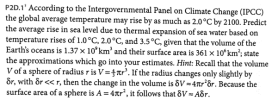 P2D.1' According to the Intergovernmental Panel on Climate Change (IPCC) the global average temperature may rise by as much as 2.0 °C by 2100. Predict the average rise in sea level due to thermal expansion of sea water based on temperature rises of 1.0 °C, 2.0°C, and 3.5 °C, given that the volume of the Earth's oceans is 1.37 x 10°km3 and their surface area is 361 x 10 kmt; state the approximations which go into your estimates. Hint: Recall...
Use Figure 8.1, The Water Cycle (hydrologie cycle) to answer the following questions. - Label on...
 Use Figure 8.1, The Water Cycle (hydrologie cycle) to answer the following questions. - Label on the diagram all the forms of water shown: ice and snow, freshwater lake, river, seawater, clouds, rain, and fog. b. What forms of water might also be found in the environment shown in Figure 8.1 (forms that are too small to be depicted in the diagram)? c. Label all the arrows in Figure 8.1 that represent the processes involved in the water cycle: evaporation,...
2. Melting Water-Ice. You have 250 grams of water frozen at 0 deg C. How much...
2. Melting Water-Ice. You have 250 grams of water frozen at 0 deg C. How much heat is required to melt the ice, at 0 deg C? (The Heat of Fusion for water is 320 Joules / gram.) 3. Heating Liquid Water. Take the amount of heat from Problem 2 above and calculate the final temperature to which the water will rise.
Weight on Earth (lbs.) : 600N or 132lb Calculate the gravitational force you feel at the following places. Show your work. (a)500 km above the surface of Europa. (b)At the surface of Europa. (c)Insid...
 Weight on Earth (lbs.) : 600N or 132lb
Calculate the gravitational force you feel at the
following places. Show your work.
(a)500 km above the surface of Europa.
(b)At the surface of Europa.
(c)Inside the tunnel, half-way through the ocean
layer.
(d)At the bottom of the tunnel.
(e)Evaluate the prediction you made earlier. Did the
gravitational force change as you expected? Explain.
You get back in your space shuttle to continue on your trip. Your next stop is Jupiter you've...
Weight on Earth (lbs.) : 600N or 132lb
Calculate the gravitational force you feel at the
following places. Show your work.
(a)500 km above the surface of Europa.
(b)At the surface of Europa.
(c)Inside the tunnel, half-way through the ocean
layer.
(d)At the bottom of the tunnel.
(e)Evaluate the prediction you made earlier. Did the
gravitational force change as you expected? Explain.
You get back in your space shuttle to continue on your trip. Your next stop is Jupiter you've...
[Extra point]A typical comet contains 1013 kg of water ice. How many comets would be needed...
[Extra point]A typical comet contains 1013 kg of water ice. How many comets would be needed to account for the 2 × 10²¹ kg of water presently found on our planet? If this amount of water accumulated over a period of 0.5 billion years, how frequently must Earth have been struck by comets during that time? Chapter 5 (10) Because of tidal forces, the Moon is in a synchronous orbit around Earth True False (11) Explain how the Moon produces...
Suppose that the average surface temperature of Earth is 300K. Assume this is uniform over its...
Suppose that the average surface temperature of Earth is 300K. Assume this is uniform over its entire surface and determine the total energy radiated by Earth in one year in the form of blackbody radiation. (Earth’s radius is 6370 km). According to Wikipedia, the total energy consumption by humans in all forms (hydroelectric, burning of fossil fuels, etc.), is about 5.7x10 20 Joules in one year. How does your answer to the first part of the question compare with this?
(11) If an area having 35 km thick crust is thickened by thrusting a 10 km...
(11) If an area having 35 km thick crust is thickened by thrusting a 10 km thick slab of crust on top, how will the surface elevation change? 2 points (1) Surface elevation will increase by ~ 1 km (2) Surface elevation will increase by ~2 km (3) Surface elevation will increase by ~3 km (4) Surface elevation will decrease by ~1 km (5) Surface elevation will decrease by ~2 km (12) If an area having 35 km thick crust...
 P2D.1' According to the Intergovernmental Panel on Climate Change (IPCC) the global average temperature may rise by as much as 2.0 °C by 2100. Predict the average rise in sea level due to thermal expansion of sea water based on temperature rises of 1.0 °C, 2.0°C, and 3.5 °C, given that the volume of the Earth's oceans is 1.37 x 10°km3 and their surface area is 361 x 10 kmt; state the approximations which go into your estimates. Hint: Recall...
 Use Figure 8.1, The Water Cycle (hydrologie cycle) to answer the following questions. - Label on the diagram all the forms of water shown: ice and snow, freshwater lake, river, seawater, clouds, rain, and fog. b. What forms of water might also be found in the environment shown in Figure 8.1 (forms that are too small to be depicted in the diagram)? c. Label all the arrows in Figure 8.1 that represent the processes involved in the water cycle: evaporation,...
 Weight on Earth (lbs.) : 600N or 132lb
Calculate the gravitational force you feel at the
following places. Show your work.
(a)500 km above the surface of Europa.
(b)At the surface of Europa.
(c)Inside the tunnel, half-way through the ocean
layer.
(d)At the bottom of the tunnel.
(e)Evaluate the prediction you made earlier. Did the
gravitational force change as you expected? Explain.
You get back in your space shuttle to continue on your trip. Your next stop is Jupiter you've...
Weight on Earth (lbs.) : 600N or 132lb
Calculate the gravitational force you feel at the
following places. Show your work.
(a)500 km above the surface of Europa.
(b)At the surface of Europa.
(c)Inside the tunnel, half-way through the ocean
layer.
(d)At the bottom of the tunnel.
(e)Evaluate the prediction you made earlier. Did the
gravitational force change as you expected? Explain.
You get back in your space shuttle to continue on your trip. Your next stop is Jupiter you've...
Most questions answered within 3 hours.
-
Where is the error in this code sequence?
String s1 = "Hello";
String s2 = "ello";...
asked 11 months ago -
Financial data for Joel de Paris, Inc., for last year
follow:
Joel de Paris, Inc.
Balance...
asked 11 months ago -
Consider this reaction:
Al2(SO4)3 (aq)+ BaCl3
(aq) Al2Cl6 (aq)- +
3BaSO4(s) . What is the...
asked 11 months ago -
Suppose that Savneet is considering increasing her
recent random sample from 20 car rentals to 40...
asked 11 months ago -
Trucks arrive at an unloading terminal at an average rate of 120
per hour.
Trucks arrive...
asked 11 months ago -
Why are methanol and ethanol completely soluble in water while
octanol is not very little soluble....
asked 11 months ago -
A facilities manager at a university reads in a research report
that the mean amount of...
asked 11 months ago -
When the CuSO4 is rehydrated by adding water to the anhydrous
compound, is this an endothermic...
asked 11 months ago -
A ray of sunlight is passing from diamond into crown glass; the
angle of incidence is...
asked 11 months ago -
A block of mass 0.249 kg is placed on top of a light, vertical
spring of...
asked 11 months ago -
how do the kidneys compensate in the presences of acidosis
a) trigger hyperventilate
b) reserve acid...
asked 11 months ago -
Question 501 pts
The rental rate of capital to the firm increases. Which of the
following...
asked 11 months ago