Imagine a potential monopolist is trying to monopolize an otherwise competitive industry. The firm wants to...
Imagine a potential monopolist is trying to monopolize an otherwise competitive industry. The firm wants to spend money lobbying and otherwise persuading the legislature to grant it a monopoly. How much, at most, would the firm be willing to spend in order to monopolize the industry?
Homework Answers
The potential monopolist will spend the amount upon the lobbying that will be equal to the economic profit that will be earned by the firm after the monopolization. At this level of spending, firm will cover all of its cost and additional profit in the form of economic profit, will be spent to lobby law makers. Here, the output level will be produced, when MR = MC.
Explanation :-
Current (Competitive) vs. Monopoly Profits:
In a competitive market, firms earn zero economic profit (just enough to stay in business).
As a monopolist, the firm can charge higher prices and earn large profits due to no competition.
Willingness to Pay for Monopoly Power:
The firm would not spend more than what it expects to gain from being a monopolist.
Why?
Spending more than future profits would make the deal a loss.
Rational firms aim to maximize net gains (monopoly profits minus lobbying costs).
Real-World Insight:
This explains why companies lobby heavily for patents, licenses, or regulations that block competitors—they’re investing in future monopoly earnings.
Bottom Line: The firm’s max spending = lifetime monopoly profits it can capture.
Note: Exact numbers depend on the industry’s profitability, but the logic is universal
Answer:
The firm would be willing to spend up to the total future profits it expects to earn as a monopolist.
Add Answer to:
Imagine a potential monopolist is trying to monopolize an
otherwise competitive industry. The firm wants to...
A representative firm in a perfectly competitive, constant cost industry has a cost function T C...
A representative firm in a perfectly competitive, constant cost industry has a cost function T C = 100+4Q 2+ 100Q. (a) What are this firm fixed cost, variable cost and marginal cost? (b) What is the long-run equilibrium price for this industry? (c) If the market demand is Q = 1000 − P , how many firms will operate in this long-run equilibrium? (d) What is the most that this firm would be willing to pay for the exclusive right...
1.) What is the main difference between a competitive firm and a monopoly? a. A competitive...
1.) What is the main difference between a competitive firm and a monopoly? a. A competitive firm owns a key resource, but a monopoly firm does not. b. A competitive firm is a price taker, and a monopoly is a price maker. c. A competitive firm produces output at a lower cost than a monopoly firm. d. A competitive firm is subject to government regulations, but a monopoly firm is not. 2.) What is the main social problem caused by...
1. Sources of monopoly power A monopolist, unlike a competitive firm, has some market power. It...
1. Sources of monopoly power A monopolist, unlike a competitive firm, has some market power. It can raise its price, within limits, without the quantity demanded falling to zero. The main way it retains its market power is through barriers to entry—that is, other companies cannot enter the market to create competition in that particular industry. Complete the following table by indicating which barrier to entry appropriately explains why a monopoly exists in each scenario. Scenario Barriers to Entry Exclusive...
15. Use the following figure for a firm in a perfectly competitive market. a What is the output that maximizes...
 15. Use the following figure for a firm in a perfectly competitive market. a What is the output that maximizes the firm's profit? b. At the profit-maximizing output, calculate total revenue and total cost. C. If the firm maximizes profit, how much profit does it earn? d. What will likely happen to market demand or market supply in the long run? e. What will likely happen to the market price in the long run? Price (s) d = P =...
Imagine a firm operating in competitive labor and product markets. The market price of Q is...
 Imagine a firm operating in competitive labor and product markets. The market price of Q is $2 per unit and the market price of labor, L, is $14 per unit. The firm's short-run production function is given by the following equation: Q = 14L - .35L2 How much labor should this firm hire in order to maximize profits?
THIS IS ALL ONE QUESTION Assume the firm is a monopolist: Demand for labor is VMP...
THIS IS ALL ONE QUESTION Assume the firm is a monopolist: Demand for labor is VMP = 35 – 0.004E, supply of labor is w = 5 + 0.01E, and Marginal cost of hiring workers is MC = 5 + 0.02E a. How much labor does the firm hire and at what wage when there is no minimum wage? b. How much labor would be employed if this was a perfectly competitive market? c. Draw the diagram and show the...
Exercise 5. Dayna's Doorstops, Inc. (DD) is a monopolist in the doorstop industry. Its cost is...
 Exercise 5. Dayna's Doorstops, Inc. (DD) is a monopolist in the doorstop industry. Its cost is C 100 - 5Q+ Q, and inverse demand is P 55 - 2Q a. What price should DD set to maximize profit? What output does the firm produce? How much profit and consumer surplus does DD generate? b. What would output be if DD acted as a perfect competitor and set MC P? What profit and consumer surplus would then be generated? c. What...
Exercise 5. Dayna's Doorstops, Inc. (DD) is a monopolist in the doorstop industry. Its cost is...
 Exercise 5. Dayna's Doorstops, Inc. (DD) is a monopolist in the doorstop industry. Its cost is C = 100 –5Q+Q?, and inverse demand is P= 55 – 20. a. What price should DD set to maximize profit? What output does the firm produce? How much profit and consumer surplus does DD generate? b. What would output be if DD acted as a perfect competitor and set MC = P? What profit and consumer surplus would then be generated? c. What...
A refrigerator monopolist charges a price of 60 and sells40 refrigerators. Its average cost is 20....
A refrigerator monopolist charges a price of 60 and sells40 refrigerators. Its average cost is 20. An antitrust authority decided that if there are five refrigerator suppliers, then price would be equal to average cost. With five suppliers, the price is 30, average cost is also 30, and the number of refrigerators produced is 70. Notice that the average cost of five firms is higher than the average cost of one firm. This is because of the economies of scale....
Problem 5: Policy Analysis. A refrigerator monopolist charges a price of 60 and sells 40 refrigerators....
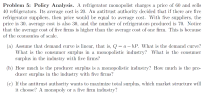 Problem 5: Policy Analysis. A refrigerator monopolist charges a price of 60 and sells 40 refrigerators. Its average cost is 20. An antitrust authority decided that if there are five refrigerator suppliers, then price would be equal to average cost. With five suppliers, the price is 30, average cost is also 30, and the number of refrigerators produced is 70. Notice that the average cost of five firms is higher than the average cost of one firm. This is because...
 15. Use the following figure for a firm in a perfectly competitive market. a What is the output that maximizes the firm's profit? b. At the profit-maximizing output, calculate total revenue and total cost. C. If the firm maximizes profit, how much profit does it earn? d. What will likely happen to market demand or market supply in the long run? e. What will likely happen to the market price in the long run? Price (s) d = P =...
 Imagine a firm operating in competitive labor and product markets. The market price of Q is $2 per unit and the market price of labor, L, is $14 per unit. The firm's short-run production function is given by the following equation: Q = 14L - .35L2 How much labor should this firm hire in order to maximize profits?
 Exercise 5. Dayna's Doorstops, Inc. (DD) is a monopolist in the doorstop industry. Its cost is C 100 - 5Q+ Q, and inverse demand is P 55 - 2Q a. What price should DD set to maximize profit? What output does the firm produce? How much profit and consumer surplus does DD generate? b. What would output be if DD acted as a perfect competitor and set MC P? What profit and consumer surplus would then be generated? c. What...
 Exercise 5. Dayna's Doorstops, Inc. (DD) is a monopolist in the doorstop industry. Its cost is C = 100 –5Q+Q?, and inverse demand is P= 55 – 20. a. What price should DD set to maximize profit? What output does the firm produce? How much profit and consumer surplus does DD generate? b. What would output be if DD acted as a perfect competitor and set MC = P? What profit and consumer surplus would then be generated? c. What...
 Problem 5: Policy Analysis. A refrigerator monopolist charges a price of 60 and sells 40 refrigerators. Its average cost is 20. An antitrust authority decided that if there are five refrigerator suppliers, then price would be equal to average cost. With five suppliers, the price is 30, average cost is also 30, and the number of refrigerators produced is 70. Notice that the average cost of five firms is higher than the average cost of one firm. This is because...
Most questions answered within 3 hours.
-
Where is the error in this code sequence?
String s1 = "Hello";
String s2 = "ello";...
asked 10 months ago -
Financial data for Joel de Paris, Inc., for last year
follow:
Joel de Paris, Inc.
Balance...
asked 10 months ago -
Consider this reaction:
Al2(SO4)3 (aq)+ BaCl3
(aq) Al2Cl6 (aq)- +
3BaSO4(s) . What is the...
asked 10 months ago -
Suppose that Savneet is considering increasing her
recent random sample from 20 car rentals to 40...
asked 10 months ago -
Trucks arrive at an unloading terminal at an average rate of 120
per hour.
Trucks arrive...
asked 10 months ago -
Why are methanol and ethanol completely soluble in water while
octanol is not very little soluble....
asked 10 months ago -
A facilities manager at a university reads in a research report
that the mean amount of...
asked 10 months ago -
When the CuSO4 is rehydrated by adding water to the anhydrous
compound, is this an endothermic...
asked 10 months ago -
A ray of sunlight is passing from diamond into crown glass; the
angle of incidence is...
asked 10 months ago -
A block of mass 0.249 kg is placed on top of a light, vertical
spring of...
asked 10 months ago -
how do the kidneys compensate in the presences of acidosis
a) trigger hyperventilate
b) reserve acid...
asked 10 months ago -
Question 501 pts
The rental rate of capital to the firm increases. Which of the
following...
asked 10 months ago