Consider an airless, non-rotating planet of mass M and radius R. An electromagnetic launcher standing on...
Consider an airless, non-rotating planet of mass M and radius R. An electromagnetic launcher standing on the surface of this planet shoots a projectile with initial velocity v0 directed straight up. Unfortunately, due to some error, v0 is less than the planet’s escape velocity ve; specifically, v0 = 0.701 ve. Unable to escape the planet’s gravitational pull, the projectile rises to a maximal height h above the ground, then falls back to the ground. Calculate the ratio h R of the projectile’s maximum height to the planet’s radius.
Homework Answers

1. Recall Key Formulas:
Escape velocity ():
Given initial velocity ():
2. Energy Conservation Approach:
At launch (surface) and max height , total mechanical energy is conserved:
3. Simplify the Equation:
Divide both sides by and substitute :
Factor out :
Cancel negatives and :
4. Solve for :
5. Final Ratio:
Add Answer to:
Consider an airless, non-rotating planet of mass M and radius R.
An electromagnetic launcher standing on...
Take the mass of a planet is M and the radius is R. Find the minimum...
 Take the mass of a planet is M and the radius is R. Find the
minimum speed required by a projectile so that it can reach a
height of 2R abover the surface of the planet. Neglect the effect
of the atmosphere.
4GM 3R B. SGM 5R C. 8GM 5R 1. 5GM 3R O E. GM 3R
Take the mass of a planet is M and the radius is R. Find the
minimum speed required by a projectile so that it can reach a
height of 2R abover the surface of the planet. Neglect the effect
of the atmosphere.
4GM 3R B. SGM 5R C. 8GM 5R 1. 5GM 3R O E. GM 3R
2. What is the escape speed from m? a planet of mass M and radius R...
 2. What is the escape speed from m? a planet of mass M and radius R if M-3.2x 10²³ kg and R 2.4 x 100 3. Two satellites are placed in geosynchronous orbits, orbits with a period of 24 hours, where each satellite hovers over a spot on the Earth's equator. Satellite B has three times the mass of satellite A. Wh is the relationship between the magnitudes of the gravitational forces FA and FB of the Earth on the...
Cart mr 6- A planet of mass m and radius r orbits a star at a...
 Cart mr 6- A planet of mass m and radius r orbits a star at a distance R (between their centres) with an angular velocity Wort = 2 rad/s. The planet also rotates around its own axis with an angular velocity of spin = 10 rad/s. The mass of the star is M-1000m. The moment of Star -R 00 inertia of a solid sphere is I = 2 mr 2- Calculate the total angular momentum L of the planet in...
A wheel of mass M has radius R. It is standing vertically on the floor, and...
 A wheel of mass M has radius R. It is standing
vertically on the floor, and we want to exert a horizontal force
F at its axle so that it will climb a step against which
it rests (the figure (Figure 1) ). The step has height h,
where h<R.
Part A
What minimum force F is needed?
Express your answer in terms of the variables M,
R, h, and the constant g
A wheel of mass M has radius R. It is standing
vertically on the floor, and we want to exert a horizontal force
F at its axle so that it will climb a step against which
it rests (the figure (Figure 1) ). The step has height h,
where h<R.
Part A
What minimum force F is needed?
Express your answer in terms of the variables M,
R, h, and the constant g
On the surface of a planet of mass M and radius R, the gravitational potential energy of a molecule of mass m is
 (c) (i) On the surface of a planet of mass \(\mathrm{M}\) and radius \(\mathrm{R}\), the gravitational potential energy of a molecule of mass \(\mathrm{m}\) is \(-\frac{G M m}{R}\). Show that the escape speed of a molecule from the surface is \(\sqrt{\frac{2 G M}{R}}\).(ii) The rms thermal speed of a molecule of mass \(m\) is given by \(v_{\text {th }}=\left(\frac{3 k T}{m}\right)^{1 / 2}\) where \(k\) is Boltzmann's constant . Using the appropriate temperature value from part (b) calculate the \(\mathrm{rms}\)...
A non-uniform cylinder of mass M, Radius r and moment of Inertia Iem = 2 Mr2...
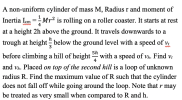 A non-uniform cylinder of mass M, Radius r and moment of Inertia Iem = 2 Mr2 is rolling on a roller coaster. It starts at rest at a height 2h above the ground. It travels downwards to a trough at height below the ground level with a speed of vi before climbing a hill of height with a speed of vh. Find v and Vh. Placed on top of the second hill is a loop of unknown radius R. Find...
81. A uniform disk with a mass of m and a radius of r rolls without...
 81. A uniform disk with a mass of m and a radius of r rolls without slipping along a horizontal surface and ramp, as shown above. The disk has an initial velocity of v. What is the maximum height h to which the center of mass of the disk rises? u2 2g 3u (A) hU (B) h=- u2 (C) h-U 2g
A cylinder with moment of inertia I about its center of mass, mass m, and radius r has a string wrapped around it whi...
 A cylinder with moment of inertia I about its center of mass, mass
m, and radius r has a string wrapped around it which is tied to the
ceiling (Figure 1) . The cylinder's vertical position as a function
of time is y(t).At time t=0 the cylinder is released from rest at a height h above
the ground.Part
BIn similar problems involving rotating bodies, you will often also
need the relationship between angular acceleration, ?, and linear acceleration, a. Find...
A cylinder with moment of inertia I about its center of mass, mass
m, and radius r has a string wrapped around it which is tied to the
ceiling (Figure 1) . The cylinder's vertical position as a function
of time is y(t).At time t=0 the cylinder is released from rest at a height h above
the ground.Part
BIn similar problems involving rotating bodies, you will often also
need the relationship between angular acceleration, ?, and linear acceleration, a. Find...
Consider a solid sphere of mass m and radius r being released from a height h...
 Consider a solid sphere of mass m and radius r being released
from a height h (i.e., its center of mass is initially a height h
above the ground). It rolls without slipping and passes through a
vertical loop of radius R.
a. Use energy conservation to determine the tangential and
angular velocities of the sphere when it reaches the top of the
loop.
b. Draw a force diagram for the sphere at the top of the loop
and write...
Consider a solid sphere of mass m and radius r being released
from a height h (i.e., its center of mass is initially a height h
above the ground). It rolls without slipping and passes through a
vertical loop of radius R.
a. Use energy conservation to determine the tangential and
angular velocities of the sphere when it reaches the top of the
loop.
b. Draw a force diagram for the sphere at the top of the loop
and write...
A thin ring of radius R and mass M rolls without slipping along a level track....
 A thin ring of radius R and mass M rolls without slipping along a level track. It has an initial linear, or translational velocity (of the center of gravity) of 3.50 m/s. The ring rolls to the end of the track, where the track curves upward. The center of gravity of the ring rises to a maximum height h above its initial level. Note that V is the symbol for the linear, or translational velocity (of the center of gravity)...
 Take the mass of a planet is M and the radius is R. Find the
minimum speed required by a projectile so that it can reach a
height of 2R abover the surface of the planet. Neglect the effect
of the atmosphere.
4GM 3R B. SGM 5R C. 8GM 5R 1. 5GM 3R O E. GM 3R
Take the mass of a planet is M and the radius is R. Find the
minimum speed required by a projectile so that it can reach a
height of 2R abover the surface of the planet. Neglect the effect
of the atmosphere.
4GM 3R B. SGM 5R C. 8GM 5R 1. 5GM 3R O E. GM 3R
 2. What is the escape speed from m? a planet of mass M and radius R if M-3.2x 10²³ kg and R 2.4 x 100 3. Two satellites are placed in geosynchronous orbits, orbits with a period of 24 hours, where each satellite hovers over a spot on the Earth's equator. Satellite B has three times the mass of satellite A. Wh is the relationship between the magnitudes of the gravitational forces FA and FB of the Earth on the...
 Cart mr 6- A planet of mass m and radius r orbits a star at a distance R (between their centres) with an angular velocity Wort = 2 rad/s. The planet also rotates around its own axis with an angular velocity of spin = 10 rad/s. The mass of the star is M-1000m. The moment of Star -R 00 inertia of a solid sphere is I = 2 mr 2- Calculate the total angular momentum L of the planet in...
 A wheel of mass M has radius R. It is standing
vertically on the floor, and we want to exert a horizontal force
F at its axle so that it will climb a step against which
it rests (the figure (Figure 1) ). The step has height h,
where h<R.
Part A
What minimum force F is needed?
Express your answer in terms of the variables M,
R, h, and the constant g
A wheel of mass M has radius R. It is standing
vertically on the floor, and we want to exert a horizontal force
F at its axle so that it will climb a step against which
it rests (the figure (Figure 1) ). The step has height h,
where h<R.
Part A
What minimum force F is needed?
Express your answer in terms of the variables M,
R, h, and the constant g
 (c) (i) On the surface of a planet of mass \(\mathrm{M}\) and radius \(\mathrm{R}\), the gravitational potential energy of a molecule of mass \(\mathrm{m}\) is \(-\frac{G M m}{R}\). Show that the escape speed of a molecule from the surface is \(\sqrt{\frac{2 G M}{R}}\).(ii) The rms thermal speed of a molecule of mass \(m\) is given by \(v_{\text {th }}=\left(\frac{3 k T}{m}\right)^{1 / 2}\) where \(k\) is Boltzmann's constant . Using the appropriate temperature value from part (b) calculate the \(\mathrm{rms}\)...
 A non-uniform cylinder of mass M, Radius r and moment of Inertia Iem = 2 Mr2 is rolling on a roller coaster. It starts at rest at a height 2h above the ground. It travels downwards to a trough at height below the ground level with a speed of vi before climbing a hill of height with a speed of vh. Find v and Vh. Placed on top of the second hill is a loop of unknown radius R. Find...
 81. A uniform disk with a mass of m and a radius of r rolls without slipping along a horizontal surface and ramp, as shown above. The disk has an initial velocity of v. What is the maximum height h to which the center of mass of the disk rises? u2 2g 3u (A) hU (B) h=- u2 (C) h-U 2g
 A cylinder with moment of inertia I about its center of mass, mass
m, and radius r has a string wrapped around it which is tied to the
ceiling (Figure 1) . The cylinder's vertical position as a function
of time is y(t).At time t=0 the cylinder is released from rest at a height h above
the ground.Part
BIn similar problems involving rotating bodies, you will often also
need the relationship between angular acceleration, ?, and linear acceleration, a. Find...
A cylinder with moment of inertia I about its center of mass, mass
m, and radius r has a string wrapped around it which is tied to the
ceiling (Figure 1) . The cylinder's vertical position as a function
of time is y(t).At time t=0 the cylinder is released from rest at a height h above
the ground.Part
BIn similar problems involving rotating bodies, you will often also
need the relationship between angular acceleration, ?, and linear acceleration, a. Find...
 Consider a solid sphere of mass m and radius r being released
from a height h (i.e., its center of mass is initially a height h
above the ground). It rolls without slipping and passes through a
vertical loop of radius R.
a. Use energy conservation to determine the tangential and
angular velocities of the sphere when it reaches the top of the
loop.
b. Draw a force diagram for the sphere at the top of the loop
and write...
Consider a solid sphere of mass m and radius r being released
from a height h (i.e., its center of mass is initially a height h
above the ground). It rolls without slipping and passes through a
vertical loop of radius R.
a. Use energy conservation to determine the tangential and
angular velocities of the sphere when it reaches the top of the
loop.
b. Draw a force diagram for the sphere at the top of the loop
and write...
 A thin ring of radius R and mass M rolls without slipping along a level track. It has an initial linear, or translational velocity (of the center of gravity) of 3.50 m/s. The ring rolls to the end of the track, where the track curves upward. The center of gravity of the ring rises to a maximum height h above its initial level. Note that V is the symbol for the linear, or translational velocity (of the center of gravity)...
Most questions answered within 3 hours.
-
Where is the error in this code sequence?
String s1 = "Hello";
String s2 = "ello";...
asked 11 months ago -
Financial data for Joel de Paris, Inc., for last year
follow:
Joel de Paris, Inc.
Balance...
asked 11 months ago -
Consider this reaction:
Al2(SO4)3 (aq)+ BaCl3
(aq) Al2Cl6 (aq)- +
3BaSO4(s) . What is the...
asked 11 months ago -
Suppose that Savneet is considering increasing her
recent random sample from 20 car rentals to 40...
asked 11 months ago -
Trucks arrive at an unloading terminal at an average rate of 120
per hour.
Trucks arrive...
asked 11 months ago -
Why are methanol and ethanol completely soluble in water while
octanol is not very little soluble....
asked 11 months ago -
A facilities manager at a university reads in a research report
that the mean amount of...
asked 11 months ago -
When the CuSO4 is rehydrated by adding water to the anhydrous
compound, is this an endothermic...
asked 11 months ago -
A ray of sunlight is passing from diamond into crown glass; the
angle of incidence is...
asked 11 months ago -
A block of mass 0.249 kg is placed on top of a light, vertical
spring of...
asked 11 months ago -
how do the kidneys compensate in the presences of acidosis
a) trigger hyperventilate
b) reserve acid...
asked 11 months ago -
Question 501 pts
The rental rate of capital to the firm increases. Which of the
following...
asked 11 months ago