trial xo xi xL do ho di hi m=hi/ho di/do 1 0.1 1.1 0.2145 0.1145 0.01...
| trial | xo | xi | xL | do | ho | di | hi | m=hi/ho | di/do |
| 1 | 0.1 | 1.1 | 0.2145 | 0.1145 | 0.01 | 0.8855 | 0.076 | 7.6 | 7.733624 |
| 2 | 0.1 | 1 | 0.2125 | 0.1125 | 0.01 | 0.7875 | 0.066 | 6.6 | 7 |
| 3 | 0.1 | 0.9 | 0.22 | 0.12 | 0.01 | 0.68 | 0.056 | 5.6 | 5.666667 |
| 4 | 0.1 | 0.8 | 0.224 | 0.124 | 0.01 | 0.576 | 0.046 | 4.6 | 4.645161 |
| 5 | 0.1 | 0.7 | 0.228 | 0.128 | 0.01 | 0.472 | 0.036 | 3.6 | 3.6875 |
| 6 | 0.1 | 0.6 | 0.24 | 0.14 | 0.01 | 0.36 | 0.026 | 2.6 | 2.571429 |
Hello! I am confused about where I went wrong or if I did make a mistake, why di/do > 0 and hi/ho >0 ? since m = hi/ho = -di/do these values do not agree
above is my experimental data
an optical rail was used and an object was placed at xo = 0.1m. The image was projected onto a screen and the location of the image/screen xi was changed each trial. The lens was placed at xL and adjusted at each trial to produce a clear image. all values are in meters, a convex lens was used.
do = xL - xo , di = xi - xL
maybe do should be do = xo - xL , but then the calculations for focal length f do not make sense if substituted into 1/f = 1/di + 1/do (f = 100mm)
The image produced was larger than the object, therefore M > 0.
Please help!!! Im very confused about the positive / negatives
sorry so much data i wanted to include all relevant information
Homework Answers
I think you are using a convex lens. Since the image is being formed on the screen, which means that the image is real. A real image formed by a convex lens is always inverted. Therefore, clearly you should have
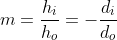
. Therefore, magnification is negative, which is expected because the image is inverted. Let me see if it clarifies.
Add Answer to:
trial
xo
xi
xL
do
ho
di
hi
m=hi/ho
di/do
1
0.1
1.1
0.2145
0.1145
0.01...
Experiment Lenses Equation: 1/f=1/do+1/di f=10 Do (m) Di measured (m) Di expected Percent Error M=hi/ho 79...
Experiment Lenses Equation: 1/f=1/do+1/di f=10 Do (m) Di measured (m) Di expected Percent Error M=hi/ho 79 14 11.4 .04 54 13 12.3 .19 23.5 19.5 .67 14 40 2.3 13 51 3.1 44 15 0.3
Could someone please help complet Table 1 and Table 2 Lab 12 Concave and Convex Lenses...
 Could someone please help complet Table 1 and Table 2
Lab 12 Concave and Convex Lenses PHYS 1110L Conceptual Physics Lab Name: Date: Results:-- -(90 pts max) OBJECTIVES To demonstrate the formation of images from convex and concave lenses. To identify the type of image formed by convex and concave lenses. - To confirm the lens equations. PART 1 CONVEX LENS 1. Open GOOGLE CHROME or other compatible browser and DISABLE all BROWSER POP-UP BLOCKERS 2. Go to PhET Simulations...
Could someone please help complet Table 1 and Table 2
Lab 12 Concave and Convex Lenses PHYS 1110L Conceptual Physics Lab Name: Date: Results:-- -(90 pts max) OBJECTIVES To demonstrate the formation of images from convex and concave lenses. To identify the type of image formed by convex and concave lenses. - To confirm the lens equations. PART 1 CONVEX LENS 1. Open GOOGLE CHROME or other compatible browser and DISABLE all BROWSER POP-UP BLOCKERS 2. Go to PhET Simulations...
(10%) Problem 6: left of the lens A candle (ho-0.27 m) is placed to the left...
 (10%) Problem 6: left of the lens A candle (ho-0.27 m) is placed to the left of a diverging lens (f=-0.053 m). The candle is do-0.32 m to the 33% Part (a) Numerically, what is the image distance, di in meters? Grade Summary Deductions Potential 0% 100% Submissions 78 9 4 5 6 12 3 sinO tan Attempts remaining: 3 cotan)asin) acosO % per attempt) detailed view atanOacotan) sinhO cosh0 anh0 cotanh0 0 END Degrees O Radians CLEAR Submit I...
 Could someone please help complet Table 1 and Table 2
Lab 12 Concave and Convex Lenses PHYS 1110L Conceptual Physics Lab Name: Date: Results:-- -(90 pts max) OBJECTIVES To demonstrate the formation of images from convex and concave lenses. To identify the type of image formed by convex and concave lenses. - To confirm the lens equations. PART 1 CONVEX LENS 1. Open GOOGLE CHROME or other compatible browser and DISABLE all BROWSER POP-UP BLOCKERS 2. Go to PhET Simulations...
Could someone please help complet Table 1 and Table 2
Lab 12 Concave and Convex Lenses PHYS 1110L Conceptual Physics Lab Name: Date: Results:-- -(90 pts max) OBJECTIVES To demonstrate the formation of images from convex and concave lenses. To identify the type of image formed by convex and concave lenses. - To confirm the lens equations. PART 1 CONVEX LENS 1. Open GOOGLE CHROME or other compatible browser and DISABLE all BROWSER POP-UP BLOCKERS 2. Go to PhET Simulations...
 (10%) Problem 6: left of the lens A candle (ho-0.27 m) is placed to the left of a diverging lens (f=-0.053 m). The candle is do-0.32 m to the 33% Part (a) Numerically, what is the image distance, di in meters? Grade Summary Deductions Potential 0% 100% Submissions 78 9 4 5 6 12 3 sinO tan Attempts remaining: 3 cotan)asin) acosO % per attempt) detailed view atanOacotan) sinhO cosh0 anh0 cotanh0 0 END Degrees O Radians CLEAR Submit I...
Most questions answered within 3 hours.
-
Where is the error in this code sequence?
String s1 = "Hello";
String s2 = "ello";...
asked 11 months ago -
Financial data for Joel de Paris, Inc., for last year
follow:
Joel de Paris, Inc.
Balance...
asked 11 months ago -
Consider this reaction:
Al2(SO4)3 (aq)+ BaCl3
(aq) Al2Cl6 (aq)- +
3BaSO4(s) . What is the...
asked 11 months ago -
Suppose that Savneet is considering increasing her
recent random sample from 20 car rentals to 40...
asked 11 months ago -
Trucks arrive at an unloading terminal at an average rate of 120
per hour.
Trucks arrive...
asked 11 months ago -
Why are methanol and ethanol completely soluble in water while
octanol is not very little soluble....
asked 11 months ago -
A facilities manager at a university reads in a research report
that the mean amount of...
asked 11 months ago -
When the CuSO4 is rehydrated by adding water to the anhydrous
compound, is this an endothermic...
asked 11 months ago -
A ray of sunlight is passing from diamond into crown glass; the
angle of incidence is...
asked 11 months ago -
A block of mass 0.249 kg is placed on top of a light, vertical
spring of...
asked 11 months ago -
how do the kidneys compensate in the presences of acidosis
a) trigger hyperventilate
b) reserve acid...
asked 11 months ago -
Question 501 pts
The rental rate of capital to the firm increases. Which of the
following...
asked 11 months ago