Calculate the concentration of each standard in terms of ppm iron. FW= 55.845 g/mol. Please show...
Calculate the concentration of each standard in terms of ppm iron. FW= 55.845 g/mol. Please show your work. First prepare standard solution from a standard Fe stock of 0.13 M. Make 100x dilution (1 mL of stock into 100 mL of water) Then, using a pipet deliver the following volumes of your Fe standard diluted solution into 10 mL volumetric flasks: 0 microliters, 150 micro liters, 300 microliters, 450 microliters, and 600 microliters.
Homework Answers
Concentration of each standard in terms of ppm of iron is calculated as follows:
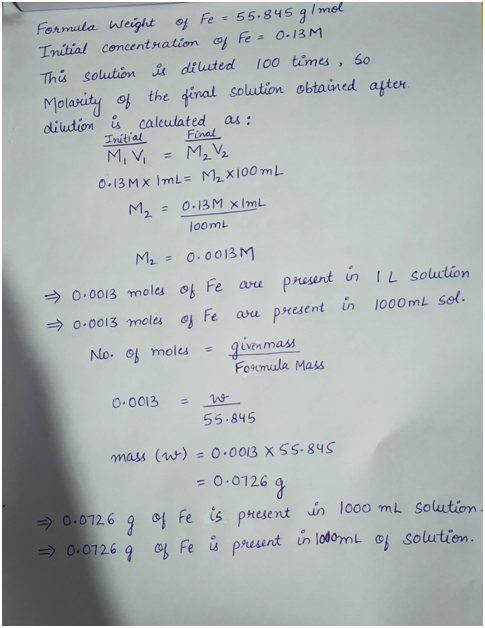
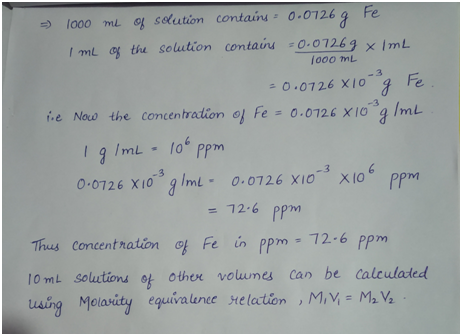
Given:
Stock Fe solution concentration: 0.13 M
Dilution: 1 mL stock → 100 mL (100x dilution)
Final volumes: 10 mL (in volumetric flasks)
Volumes of diluted standard added: 0 µL, 150 µL, 300 µL, 450 µL, 600 µL
Molar mass of Fe (FW): 55.845 g/mol
Step 1: Prepare the Diluted Standard Solution
Diluted Fe concentration (100x dilution):
Convert to ppm (mg/L):
Step 2: Calculate Fe Concentration in Each 10 mL Flask
General Formula:
(Since 10 mL = 10,000 µL)
| Volume Added (µL) | Calculation | Final Concentration (ppm Fe) |
|---|---|---|
| 0 | 0.00 | |
| 150 | 1.09 | |
| 300 | 2.18 | |
| 450 | 3.27 | |
| 600 | 4.36 |
Answer:
| Standard | Fe Concentration (ppm) |
|---|---|
| Blank | 0.00 |
| 150 µL | 1.09 |
| 300 µL | 2.18 |
| 450 µL | 3.27 |
| 600 µL | 4.36 |
Add Answer to:
Calculate the concentration of each standard in terms of ppm
iron. FW= 55.845 g/mol. Please show...
Calculate the initial concentration of iron(III) in solution #1, #2, #3. Beaker (mL) Table 1. Reagent...
 Calculate the initial concentration of iron(III) in
solution #1, #2, #3.
Beaker (mL) Table 1. Reagent Solutions Provided by the Stockroom Solution Name Reagent [Reagent] (M) Volume (mL) Standard iron Fe(NO3)3 2.50 x 10 in 0.10 M HNO3 nitric acid HNO3 0.10 120 35 50 250 conc. SCN KSCN 0.50 30 50 dilute SCN KSCN 2.50 x 10⁻³ 30 50 Worksheet 1 #1 5.00 #2 10.00 #3 15.00 Dilute iron (mL) [Fe**] (M) [Fe(SCN)?*] (M) %T 480 58.9 35.8 21.5...
Calculate the initial concentration of iron(III) in
solution #1, #2, #3.
Beaker (mL) Table 1. Reagent Solutions Provided by the Stockroom Solution Name Reagent [Reagent] (M) Volume (mL) Standard iron Fe(NO3)3 2.50 x 10 in 0.10 M HNO3 nitric acid HNO3 0.10 120 35 50 250 conc. SCN KSCN 0.50 30 50 dilute SCN KSCN 2.50 x 10⁻³ 30 50 Worksheet 1 #1 5.00 #2 10.00 #3 15.00 Dilute iron (mL) [Fe**] (M) [Fe(SCN)?*] (M) %T 480 58.9 35.8 21.5...
Question 2 Compound "Y" (molar mass = 480.5 g moll) used as a food coloring. Following...
 Question 2 Compound "Y" (molar mass = 480.5 g moll) used as a food coloring. Following experiment was carried out to find the concentration of "Y" in a beverage. A stock solution of compound "Y" (concentration = 7.50 0 10-4 mol L-) was used to prepare a series of standard solutions. Calibrated pipets and 100.0 mL volumetric flasks were used for these preparations. Then, absorbance of these solutions were measured at 460 nm using 1-cm cuvettes. A dilution was carried...
Calculate the concentration of the standard HCl solution you prepared. Determine this concentration for each trial...
 Calculate the concentration of the standard HCl solution you
prepared. Determine this
concentration for each trial and the average and standard
deviation for all three trials.
Part B-Preparation and standardization of an HCl Solution 1. Before you can titrate your saturated Ca(oH)a solutions, you must prepare and standardize a dilute solution of Hcl. With a graduated cylinder measure at least 6 mL of the stock Hcl lution, transfer it to a 125 mL Erlenmeyer, and dilute to approximately 100 mL...
Calculate the concentration of the standard HCl solution you
prepared. Determine this
concentration for each trial and the average and standard
deviation for all three trials.
Part B-Preparation and standardization of an HCl Solution 1. Before you can titrate your saturated Ca(oH)a solutions, you must prepare and standardize a dilute solution of Hcl. With a graduated cylinder measure at least 6 mL of the stock Hcl lution, transfer it to a 125 mL Erlenmeyer, and dilute to approximately 100 mL...
A student prepares a caffeine standard solution that has a concentration of 1858 ppm. To prepare...
A student prepares a caffeine standard solution that has a concentration of 1858 ppm. To prepare a calibration curve, the student pipets various volumes of the standard solution into 50.0 mL volumetric flasks and dilutes to the fill line with water. The absorbance of each solution is measured in a 1.00 cm cuvette using the spectrophotometer and is shown in the table below. Calculate the concentration of each solution and create a calibration curve using the absorbance data provided. Based...
You will calculate the concentration of NaF in the beaker corresponding to each of the four...
 You will calculate the concentration of NaF in the beaker corresponding to each of the four aliquots of standard in the next four questions. See illustration on page 47 in the lab manual for a demonstration of this procedure. Calculate the concentration (M) of NaF in the beaker initially filled with 20 mL TISAB/DIW after the first aliquot of standard stock is added (following 1:1 dilution with TISAB). Standard stock solution concentration (before dilution with TISAB): 0.11 M Total volume...
show calculations please 3. A standard solution of Fe(II) [10.0 ppm) was prepared, the appropriate reagents...
 show calculations please
3. A standard solution of Fe(II) [10.0 ppm) was prepared, the appropriate reagents were added, and a series of standard solutions were prepared and the transmittance of the solutions were read out as follows: Vol. of std solution (ml) Final vol. (mL) %T 0.00 100.0 100.0 5.00 100.0 77.7 25.00 100.0 30.2 50.00 100.0 10.4 (a) (3 pts) plot a calibration curve and find out the slope and y-intercept for the linearly related Absorbance with concentration. (b)...
show calculations please
3. A standard solution of Fe(II) [10.0 ppm) was prepared, the appropriate reagents were added, and a series of standard solutions were prepared and the transmittance of the solutions were read out as follows: Vol. of std solution (ml) Final vol. (mL) %T 0.00 100.0 100.0 5.00 100.0 77.7 25.00 100.0 30.2 50.00 100.0 10.4 (a) (3 pts) plot a calibration curve and find out the slope and y-intercept for the linearly related Absorbance with concentration. (b)...
Calculate the initial concentration of Fe3+ in test tubes 1-4. (you will need to take the...
 Calculate the initial concentration of Fe3+ in test tubes 1-4. (you will need to take the dilution in to account) Calculate the initial concentration of SCN-in each of test tubes 1-4. (you will need to take the dilution in to account) 2. Label four 20 x 150 mm test tubes 1-4. Pour about 30 mL of 0.0020 M Fe(NO3)3 into a clean, dry 100-ml beaker. Pipet 5.0 mL of this solution into each of the four labeled test tubes. Use...
Calculate initial concentration of Fe+3 for tubes 1-3. Show your work. Procedure A. Determination of B...
 Calculate initial concentration of Fe+3 for tubes 1-3. Show your
work.
Procedure A. Determination of B for Beer's Law 1. Using a buret, add 4.00 mL of 0.0025 M Fe(NO3)s (which is in 0.1 M HNOs) to a 100- mL volumetric flask. Add enough deionized water to bring the total volume to the mark on the neck of the flask. Stopper and shake the flask. Label this flask “Diluted Fe.” spectrophotometer tubes (cuvettes), they are too small to use at...
Calculate initial concentration of Fe+3 for tubes 1-3. Show your
work.
Procedure A. Determination of B for Beer's Law 1. Using a buret, add 4.00 mL of 0.0025 M Fe(NO3)s (which is in 0.1 M HNOs) to a 100- mL volumetric flask. Add enough deionized water to bring the total volume to the mark on the neck of the flask. Stopper and shake the flask. Label this flask “Diluted Fe.” spectrophotometer tubes (cuvettes), they are too small to use at...
Part 2. UV-Visible Spectroscopy Cut2 concentration Absorbance (mol/L) 0.0010 0.053 0.0025 0.128 0.0050 0.251 0.0075 0.378...
 Part 2. UV-Visible Spectroscopy Cut2 concentration Absorbance (mol/L) 0.0010 0.053 0.0025 0.128 0.0050 0.251 0.0075 0.378 0.0100 0.510 Diluted unknown, Trial 1 0.079 For your lab notebook: C. Sketch how you could make each of the the 5 standards for Part 2 from a 0.100 mol/L Cu2+ stock solution, 1.25 mol/L NH3 solution, and Dl water. The procedure is referenced in step 2b. Assume you would use 10-mL volumetric flasks to make the solutions. d. Sketch also how you would...
I need it right now, please help me?? PROCEDURE PART I: DILUTING THE VINEGAR SOLUTION The...
 I
need it right now, please help me??
PROCEDURE PART I: DILUTING THE VINEGAR SOLUTION The vinegar solution must be diluted by a factor of 5 to be suitable for titration. 1. Obtain - 20 ml of the stock vinegar solution from the fume hood. 2. Using the 10-ml. pipet, pipet" 10 mL of the stock solution to a 50-ml volumetric flask. 3. Fill the volumetric flask to the calibration line with distilled water. Be sure not to go over...
I
need it right now, please help me??
PROCEDURE PART I: DILUTING THE VINEGAR SOLUTION The vinegar solution must be diluted by a factor of 5 to be suitable for titration. 1. Obtain - 20 ml of the stock vinegar solution from the fume hood. 2. Using the 10-ml. pipet, pipet" 10 mL of the stock solution to a 50-ml volumetric flask. 3. Fill the volumetric flask to the calibration line with distilled water. Be sure not to go over...
 Calculate the initial concentration of iron(III) in
solution #1, #2, #3.
Beaker (mL) Table 1. Reagent Solutions Provided by the Stockroom Solution Name Reagent [Reagent] (M) Volume (mL) Standard iron Fe(NO3)3 2.50 x 10 in 0.10 M HNO3 nitric acid HNO3 0.10 120 35 50 250 conc. SCN KSCN 0.50 30 50 dilute SCN KSCN 2.50 x 10⁻³ 30 50 Worksheet 1 #1 5.00 #2 10.00 #3 15.00 Dilute iron (mL) [Fe**] (M) [Fe(SCN)?*] (M) %T 480 58.9 35.8 21.5...
Calculate the initial concentration of iron(III) in
solution #1, #2, #3.
Beaker (mL) Table 1. Reagent Solutions Provided by the Stockroom Solution Name Reagent [Reagent] (M) Volume (mL) Standard iron Fe(NO3)3 2.50 x 10 in 0.10 M HNO3 nitric acid HNO3 0.10 120 35 50 250 conc. SCN KSCN 0.50 30 50 dilute SCN KSCN 2.50 x 10⁻³ 30 50 Worksheet 1 #1 5.00 #2 10.00 #3 15.00 Dilute iron (mL) [Fe**] (M) [Fe(SCN)?*] (M) %T 480 58.9 35.8 21.5...
 Question 2 Compound "Y" (molar mass = 480.5 g moll) used as a food coloring. Following experiment was carried out to find the concentration of "Y" in a beverage. A stock solution of compound "Y" (concentration = 7.50 0 10-4 mol L-) was used to prepare a series of standard solutions. Calibrated pipets and 100.0 mL volumetric flasks were used for these preparations. Then, absorbance of these solutions were measured at 460 nm using 1-cm cuvettes. A dilution was carried...
 Calculate the concentration of the standard HCl solution you
prepared. Determine this
concentration for each trial and the average and standard
deviation for all three trials.
Part B-Preparation and standardization of an HCl Solution 1. Before you can titrate your saturated Ca(oH)a solutions, you must prepare and standardize a dilute solution of Hcl. With a graduated cylinder measure at least 6 mL of the stock Hcl lution, transfer it to a 125 mL Erlenmeyer, and dilute to approximately 100 mL...
Calculate the concentration of the standard HCl solution you
prepared. Determine this
concentration for each trial and the average and standard
deviation for all three trials.
Part B-Preparation and standardization of an HCl Solution 1. Before you can titrate your saturated Ca(oH)a solutions, you must prepare and standardize a dilute solution of Hcl. With a graduated cylinder measure at least 6 mL of the stock Hcl lution, transfer it to a 125 mL Erlenmeyer, and dilute to approximately 100 mL...
 You will calculate the concentration of NaF in the beaker corresponding to each of the four aliquots of standard in the next four questions. See illustration on page 47 in the lab manual for a demonstration of this procedure. Calculate the concentration (M) of NaF in the beaker initially filled with 20 mL TISAB/DIW after the first aliquot of standard stock is added (following 1:1 dilution with TISAB). Standard stock solution concentration (before dilution with TISAB): 0.11 M Total volume...
 show calculations please
3. A standard solution of Fe(II) [10.0 ppm) was prepared, the appropriate reagents were added, and a series of standard solutions were prepared and the transmittance of the solutions were read out as follows: Vol. of std solution (ml) Final vol. (mL) %T 0.00 100.0 100.0 5.00 100.0 77.7 25.00 100.0 30.2 50.00 100.0 10.4 (a) (3 pts) plot a calibration curve and find out the slope and y-intercept for the linearly related Absorbance with concentration. (b)...
show calculations please
3. A standard solution of Fe(II) [10.0 ppm) was prepared, the appropriate reagents were added, and a series of standard solutions were prepared and the transmittance of the solutions were read out as follows: Vol. of std solution (ml) Final vol. (mL) %T 0.00 100.0 100.0 5.00 100.0 77.7 25.00 100.0 30.2 50.00 100.0 10.4 (a) (3 pts) plot a calibration curve and find out the slope and y-intercept for the linearly related Absorbance with concentration. (b)...
 Calculate the initial concentration of Fe3+ in test tubes 1-4. (you will need to take the dilution in to account) Calculate the initial concentration of SCN-in each of test tubes 1-4. (you will need to take the dilution in to account) 2. Label four 20 x 150 mm test tubes 1-4. Pour about 30 mL of 0.0020 M Fe(NO3)3 into a clean, dry 100-ml beaker. Pipet 5.0 mL of this solution into each of the four labeled test tubes. Use...
 Calculate initial concentration of Fe+3 for tubes 1-3. Show your
work.
Procedure A. Determination of B for Beer's Law 1. Using a buret, add 4.00 mL of 0.0025 M Fe(NO3)s (which is in 0.1 M HNOs) to a 100- mL volumetric flask. Add enough deionized water to bring the total volume to the mark on the neck of the flask. Stopper and shake the flask. Label this flask “Diluted Fe.” spectrophotometer tubes (cuvettes), they are too small to use at...
Calculate initial concentration of Fe+3 for tubes 1-3. Show your
work.
Procedure A. Determination of B for Beer's Law 1. Using a buret, add 4.00 mL of 0.0025 M Fe(NO3)s (which is in 0.1 M HNOs) to a 100- mL volumetric flask. Add enough deionized water to bring the total volume to the mark on the neck of the flask. Stopper and shake the flask. Label this flask “Diluted Fe.” spectrophotometer tubes (cuvettes), they are too small to use at...
 Part 2. UV-Visible Spectroscopy Cut2 concentration Absorbance (mol/L) 0.0010 0.053 0.0025 0.128 0.0050 0.251 0.0075 0.378 0.0100 0.510 Diluted unknown, Trial 1 0.079 For your lab notebook: C. Sketch how you could make each of the the 5 standards for Part 2 from a 0.100 mol/L Cu2+ stock solution, 1.25 mol/L NH3 solution, and Dl water. The procedure is referenced in step 2b. Assume you would use 10-mL volumetric flasks to make the solutions. d. Sketch also how you would...
 I
need it right now, please help me??
PROCEDURE PART I: DILUTING THE VINEGAR SOLUTION The vinegar solution must be diluted by a factor of 5 to be suitable for titration. 1. Obtain - 20 ml of the stock vinegar solution from the fume hood. 2. Using the 10-ml. pipet, pipet" 10 mL of the stock solution to a 50-ml volumetric flask. 3. Fill the volumetric flask to the calibration line with distilled water. Be sure not to go over...
I
need it right now, please help me??
PROCEDURE PART I: DILUTING THE VINEGAR SOLUTION The vinegar solution must be diluted by a factor of 5 to be suitable for titration. 1. Obtain - 20 ml of the stock vinegar solution from the fume hood. 2. Using the 10-ml. pipet, pipet" 10 mL of the stock solution to a 50-ml volumetric flask. 3. Fill the volumetric flask to the calibration line with distilled water. Be sure not to go over...
Most questions answered within 3 hours.
-
Where is the error in this code sequence?
String s1 = "Hello";
String s2 = "ello";...
asked 11 months ago -
Financial data for Joel de Paris, Inc., for last year
follow:
Joel de Paris, Inc.
Balance...
asked 11 months ago -
Consider this reaction:
Al2(SO4)3 (aq)+ BaCl3
(aq) Al2Cl6 (aq)- +
3BaSO4(s) . What is the...
asked 11 months ago -
Suppose that Savneet is considering increasing her
recent random sample from 20 car rentals to 40...
asked 11 months ago -
Trucks arrive at an unloading terminal at an average rate of 120
per hour.
Trucks arrive...
asked 11 months ago -
Why are methanol and ethanol completely soluble in water while
octanol is not very little soluble....
asked 11 months ago -
A facilities manager at a university reads in a research report
that the mean amount of...
asked 11 months ago -
When the CuSO4 is rehydrated by adding water to the anhydrous
compound, is this an endothermic...
asked 11 months ago -
A ray of sunlight is passing from diamond into crown glass; the
angle of incidence is...
asked 11 months ago -
A block of mass 0.249 kg is placed on top of a light, vertical
spring of...
asked 11 months ago -
how do the kidneys compensate in the presences of acidosis
a) trigger hyperventilate
b) reserve acid...
asked 11 months ago -
Question 501 pts
The rental rate of capital to the firm increases. Which of the
following...
asked 11 months ago