Question 3: (10 marks total - 2.5 marks each part) (a) Illustrate and explain with diagrams...
Question 3:
(10 marks total - 2.5 marks each part)
(a) Illustrate and explain with diagrams the difference between
demand-pull and cost-push inflation; (2.5 marks for the diagram and
2.5 marks for the explanation);
(b) Provide (describe) two (2) causes of each type of
inflation
(2.5 marks for 2 demand-pull causes and 2.5 marks for 2 cost-push
causes)
Homework Answers
Ans
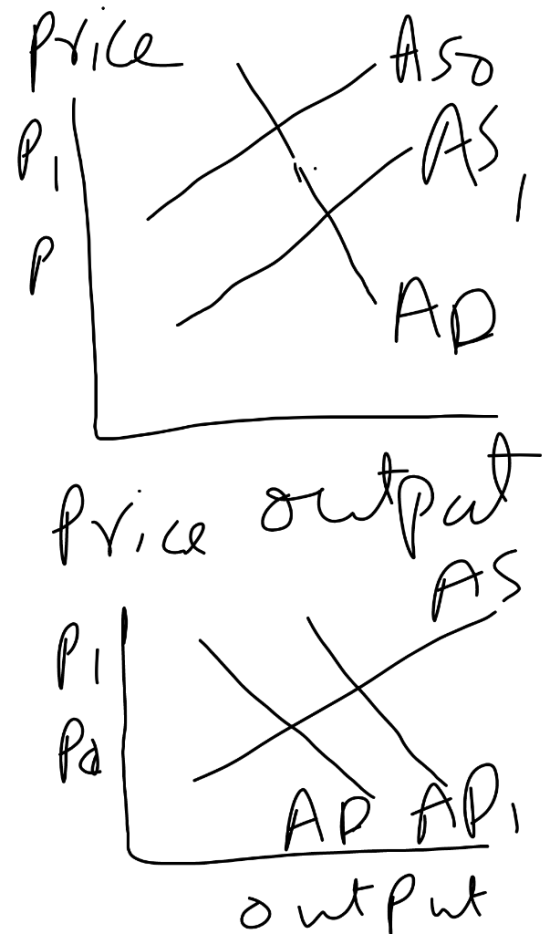
In figure 1 AS and AD are initial Aggregate supply and Aggregate demand respectively. Now an increase in cost of production shifts short run Aggregate supply to SRASo. As a result prices rise from p to p1. Since it happens due to cost increase this type of inflation is called cost push inflation
Demand pull inflation is shown in figure 2.Here prices rise from po to p1 because Aggregate demand rises from AD to AD1.
2 Cosh push inflation occurs due to increase in taxes or increase in prices of some inputs like crude oil
Demand pull inflation occurs due to higher wages of labour which thus demand more goods and services, increase in Govt expenditure
Demand-Pull vs. Cost-Push Inflation
(a) Diagram and Explanation
1. Demand-Pull Inflation:
Diagram:
Copy
Price Level (P) ▲
               │
         SRAS  │
P2 ────────╱   │
           │   │
P1 ────────┼───┤
           │   │
           │   └───────────►
                           Real GDP (Y)
Shift: AD curve shifts right (e.g., due to higher consumer spending).
Result: Higher price level (P1 → P2) and increased output (Y1 → Y2).
Explanation:
Occurs when aggregate demand (AD) outpaces aggregate supply (AS), driving up prices.
2. Cost-Push Inflation:
Diagram:
Copy
Price Level (P) ▲
               │
         SRAS' │
P2 ────────╲   │
           │   │
P1 ────────┼───┤
           │   │
           │   └───────────►
                           Real GDP (Y)
Shift: SRAS curve shifts left (e.g., due to higher oil prices).
Result: Higher price level (P1 → P2) but lower output (Y1 → Y2).
Explanation:
Caused by rising production costs, reducing AS and increasing prices.
(b) Causes of Each Inflation Type
Demand-Pull Causes (2.5 marks):
Increased Consumer Spending:
Example: Economic boom raises disposable income.
Expansionary Fiscal/Monetary Policy:
Example: Government stimulus checks or lower interest rates.
Cost-Push Causes (2.5 marks):
Rising Input Costs:
Example: Surge in oil prices increases transportation/production costs.
Supply Chain Disruptions:
Example: Natural disasters reducing raw material availability.
Key Takeaways:
Demand-pull: "Too much money chasing too few goods."
Cost-push: "Higher costs force prices up."
Add Answer to:
Question 3:
(10 marks total - 2.5 marks each part)
(a) Illustrate and explain with diagrams...
Illustrate and explain using diagrams, the difference between long run supply in a constant cost individual...
Illustrate and explain using diagrams, the difference between long run supply in a constant cost individual firm and industry and an increasing cost firm and industry. (Firm level diagrams 2.5 marks; industry level diagrams 2.5 marks, firm level explanation 2.5 marks, industry level explanation 2.5 diagrams)
Part III (20 marks) In the space below, use a supply and demand diagrams to illustrate...
 Part III (20 marks) In the space below, use a supply and demand diagrams to illustrate the situation where demand increasesand supply increases. Indicate what the model predicts about the change in equilibrium price and quantity. Carefully label your diagr explain it.
This is a two‑part question. In the first part, label each graph according to the type...
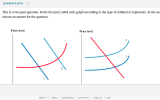 This is a two‑part question. In the first
part, label each graph according to the type of inflation it
represents. In the second part, choose an answer for the
question.
Answer Bank
cost‑push inflation
inflation
demand‑pull inflation
If a low‑level inflation policy is announced, but the central
banking authority is not credible, what are the results?
Private agents expect low inflation due to the announcement.
Paradoxically, high inflation occurs.
Private agents expect high inflation due to the announcement. As
a...
This is a two‑part question. In the first
part, label each graph according to the type of inflation it
represents. In the second part, choose an answer for the
question.
Answer Bank
cost‑push inflation
inflation
demand‑pull inflation
If a low‑level inflation policy is announced, but the central
banking authority is not credible, what are the results?
Private agents expect low inflation due to the announcement.
Paradoxically, high inflation occurs.
Private agents expect high inflation due to the announcement. As
a...
Illustrate and briefly explain the beginning of a demand-pull inflation. 3. When answering parts a and b,...
Illustrate and briefly explain the beginning of a demand-pull inflation. 3. When answering parts a and b, draw the relevant Phillips curve. Using a short-run Phillips curve, what is the effect on the unemployment rate if the inflation rate unexpectedly rises. Using a long-run Phillips curve, what is the effect on the unemployment rate if the inflation rate rises and people expect the rise. Explain how your answer to part a about the unexpected rise in the inflation rate changes in...
Question 22 (15 marks) (a) Explain the difference between the demand for domestic goods and the...
 Question 22 (15 marks) (a) Explain the difference between the demand for domestic goods and the domestic demand for goods. Explain why the demand for domestic goods curve (ZZ) has a different shape from the domestic demand curve (DD). (6 marks) (b) Using the open economy goods market diagram, illustrate graphically and explain what effect a decrease in foreign output (Y*) will have on output, exports, imports, and net exports. Clearly label all curves and the initial and new equilibria....
For this question, you are to use a graph to illustrate the change(s) and then explain...
For this question, you are to use a graph to illustrate the change(s) and then explain the situation in one or two sentences. You may have to go back to earlier material to find some of the answers. You may assume that the economy is in a long-run macroeconomic equilibrium at the beginning of each part. Draw the aggregate demand and aggregate supply model. Illustrate long-run macroeconomic equilibrium. (2.0 marks) There is a decrease in the money wages paid to...
Part A- Answer all questions (Total Marks for Part A: 120) Part A- Question 1 (Total...
 Part A- Answer all questions (Total Marks for Part A: 120) Part A- Question 1 (Total Marks for Part A - Question 1: 24) A 140mm thick concrete slab is supported by a series of parallel 460UB82.1 steel beams at 2400mm centres. Assume there is sufficient bond between the steel beam and the concrete slab to enable the materials to act together as a composite unit Assume for steel E 200 GPa ? 280 MPa for concrete E-25 GPa ?...
Question (10 marks) Using appropriate diagrams, explain the likely impact of drought on macroeconomic equilibrium in...
Question (10 marks) Using appropriate diagrams, explain the likely impact of drought on macroeconomic equilibrium in Australia. Use evidence drawn from media reports to illustrate you answer. How might government policy response to the drought modify the macroeconomic impact of the drought? Approx 2,000 words.
Question 1 Explain four functions of the control process. Question 2 Using a diagram illustrate the...
 Question 1 Explain four functions of the control process. Question 2 Using a diagram illustrate the control process. Question 3 Describe the characteristics of an effective control system. (10) Question 4 What are the main areas on which we focus control? Provide an example of a control method for each. Question 5 List and briefly describe the four levels of ethical questions in a business.
Question 4 (20 marks) Part A (10 marks) Explain the difference between financial accounting and management...
 Question 4 (20 marks) Part A (10 marks) Explain the difference between financial accounting and management accounting with reference to the following characteristics. (10 marks) Characteristie Financial Accounting Management Accounting General definition Types of reports produced and relevant regulations Users of reports produced One example of a typical accounting task undertaken in the area
 Part III (20 marks) In the space below, use a supply and demand diagrams to illustrate the situation where demand increasesand supply increases. Indicate what the model predicts about the change in equilibrium price and quantity. Carefully label your diagr explain it.
 This is a two‑part question. In the first
part, label each graph according to the type of inflation it
represents. In the second part, choose an answer for the
question.
Answer Bank
cost‑push inflation
inflation
demand‑pull inflation
If a low‑level inflation policy is announced, but the central
banking authority is not credible, what are the results?
Private agents expect low inflation due to the announcement.
Paradoxically, high inflation occurs.
Private agents expect high inflation due to the announcement. As
a...
This is a two‑part question. In the first
part, label each graph according to the type of inflation it
represents. In the second part, choose an answer for the
question.
Answer Bank
cost‑push inflation
inflation
demand‑pull inflation
If a low‑level inflation policy is announced, but the central
banking authority is not credible, what are the results?
Private agents expect low inflation due to the announcement.
Paradoxically, high inflation occurs.
Private agents expect high inflation due to the announcement. As
a...
 Question 22 (15 marks) (a) Explain the difference between the demand for domestic goods and the domestic demand for goods. Explain why the demand for domestic goods curve (ZZ) has a different shape from the domestic demand curve (DD). (6 marks) (b) Using the open economy goods market diagram, illustrate graphically and explain what effect a decrease in foreign output (Y*) will have on output, exports, imports, and net exports. Clearly label all curves and the initial and new equilibria....
 Part A- Answer all questions (Total Marks for Part A: 120) Part A- Question 1 (Total Marks for Part A - Question 1: 24) A 140mm thick concrete slab is supported by a series of parallel 460UB82.1 steel beams at 2400mm centres. Assume there is sufficient bond between the steel beam and the concrete slab to enable the materials to act together as a composite unit Assume for steel E 200 GPa ? 280 MPa for concrete E-25 GPa ?...
 Question 1 Explain four functions of the control process. Question 2 Using a diagram illustrate the control process. Question 3 Describe the characteristics of an effective control system. (10) Question 4 What are the main areas on which we focus control? Provide an example of a control method for each. Question 5 List and briefly describe the four levels of ethical questions in a business.
 Question 4 (20 marks) Part A (10 marks) Explain the difference between financial accounting and management accounting with reference to the following characteristics. (10 marks) Characteristie Financial Accounting Management Accounting General definition Types of reports produced and relevant regulations Users of reports produced One example of a typical accounting task undertaken in the area
Most questions answered within 3 hours.
-
Where is the error in this code sequence?
String s1 = "Hello";
String s2 = "ello";...
asked 10 months ago -
Financial data for Joel de Paris, Inc., for last year
follow:
Joel de Paris, Inc.
Balance...
asked 10 months ago -
Consider this reaction:
Al2(SO4)3 (aq)+ BaCl3
(aq) Al2Cl6 (aq)- +
3BaSO4(s) . What is the...
asked 10 months ago -
Suppose that Savneet is considering increasing her
recent random sample from 20 car rentals to 40...
asked 10 months ago -
Trucks arrive at an unloading terminal at an average rate of 120
per hour.
Trucks arrive...
asked 10 months ago -
Why are methanol and ethanol completely soluble in water while
octanol is not very little soluble....
asked 10 months ago -
A facilities manager at a university reads in a research report
that the mean amount of...
asked 10 months ago -
When the CuSO4 is rehydrated by adding water to the anhydrous
compound, is this an endothermic...
asked 10 months ago -
A ray of sunlight is passing from diamond into crown glass; the
angle of incidence is...
asked 10 months ago -
A block of mass 0.249 kg is placed on top of a light, vertical
spring of...
asked 10 months ago -
how do the kidneys compensate in the presences of acidosis
a) trigger hyperventilate
b) reserve acid...
asked 10 months ago -
Question 501 pts
The rental rate of capital to the firm increases. Which of the
following...
asked 10 months ago