1) Explain the process of calculating the future value of an ordinary annuity using both Excel...
1) Explain the process of calculating the future value of an ordinary annuity using both Excel and a financial calculator, and provide an example.
2) Explain the process of calculating the present value of an ordinary annuity using both Excel and a financial calculator, and provide an example.
3) Explain the terms annual percentage rate (APR) or nominal interest rate, and effective annual interest rate (EFF% or EAR).
4) Explain what an amortization schedule is and how it is calculated.
Homework Answers
Answer 1.
Calculating Future Value of an Ordinary Annuity using Excel:
=FV(RATE, NPER, PMT, PV)
TIME=NPER
Calculating Future Value of an Ordinary Annuity using Financial Calculator:
Type and figure and click on:
N = number of years.
1/Y = Interest rate.
PMT= periodic payments.
FV= future value (=0).
Then Press, CPT+PV in order to arrive at the final result.
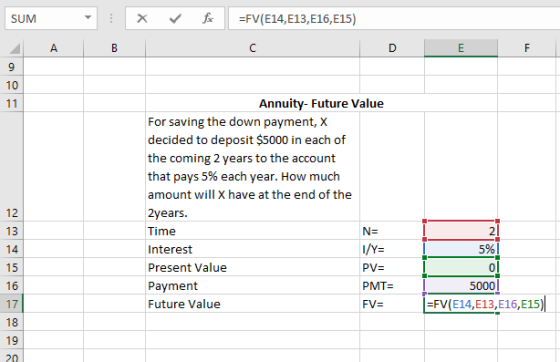
Example of Annuity Future Value:
Answer 2.
Calculating Present Value of an Ordinary Annuity using Excel:
=PV(RATE, NPER, PMT)
TIME=NPER
Calculating Future Value of an Ordinary Annuity using Financial Calculator:
Type and figure and click on:
N = number of years.
1/Y = Interest rate.
PMT= periodic payments.
FV= future value (=0).
Then Press, CPT+PV in order to arrive at the final result.
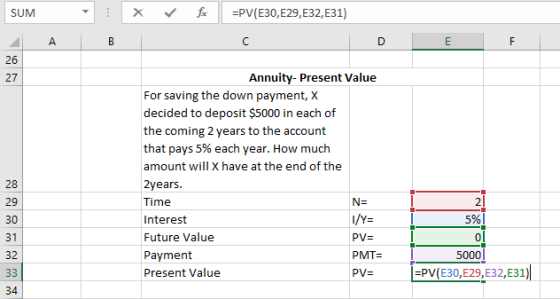
Example of Annuity Present Value:
Answer 3.
Annual percentage rate (APR) or nominal interest rate:
An annual percentage rate (APR) or nominal interest rate refers to the annual rate charged for an amount borrowed or earned by way of an investment. APR is expressed in terms of percentage that shows the actual yearly funds' cost over the loan period. This may include any fees, additional costs associated with transaction however, it does not consider compounding into account.
APR is caculated using the following formula:
APR= ((((Fees+Interest)/Principal)/n)* 365) * 100
where:Interest=Total interest paid over life of the loan
Principal=amount of loan
n=Number of days in loan term
Borrowers evaluates the APR figure at the time of comparing credit cards or mortgage rates.
Effective Annual Interest Rate (EFF% or EAR):
Effective annual interest rate refers to the rate of interest that is actually earned or paid on any loan, investment, or some other financial product as a result of compounding over a given period of time. It is also known as effective interest rate, effective rate or annual equivalent rate.
EAR is caculated using the following formula:
Effective Annual Interest Rate= ((1+(i/n))^n)- 1
where,
i=Nominal interest rate
n=Number of periods
Effective annual interest rate is a major financial concept as it is employed to carry out comparison between different product which includes lines of credits, loans, or investment products like deposit certificates which computes compounded interest differently.
Answer 4.
Amortization is the term used for paying off a particular debt with fixed regular installments on a fixed repayment schedule over set period of time.
Each and every entry made in the amortization table is one and single payment against the loan. These payments are broken down into two parts first, the amount going towards the principal payment of loan and second, the amount going towards interest. At the starting phase of loan’s term, when remaining principal is still high, most part of monthly payments go towards interest. However with the decrease in principal, the percentage of every payment going towards interest gradually decreases, and percentage going towards principal rises or increases.
Calculation of Amortization Schedule:
We need the following information to construct Amortization Schedule:
1. Borrowed sum
2. Loan term
3. Monthly payment
4. Monthly rate of interest
For the payment of first month, multiply balance of loan by the monthly rate of interest. It results in the interest amount for the payment of first month. Subtract this amount from monthly payment to know about the amount of first payment went toward paying the balance of loan. Subtract this amount of principal payment from loan balance to arrive at new loan balance for the second month and then repeat this entire process for the life of mortgage.
Example of Amortization Schedule:
X is buying a house for $200,000. He made 20 percent down payment of $40,000 and required to take out mortgage for $160,000. He wants 30-year mortgage (360 months) at 4 % rate of interest. His estimated monthly payment would be $763.86 and first lines of his amortization schedule will appear as follows:
Amortization Schedule
| Date | Payment | Principal | Interest | Total Interest | Balance |
| Month 1 | $763.86 | $230.53 | $533.33 | $533.33 | $159769.47 |
| Month 2 | $763.86 | $231.30 | $532.56 | $1,065.90 | $159,538.17 |
| Month 3 | $763.86 | $232.07 | $531.79 | $1,597.69 | $159,306.10 |
| Month 4 | $763.86 | $232.84 | $531.02 | $2,128.71 | $159,073.25 |
| Month 5 | $763.86 | $233.62 | $530.24 | $2,658.96 | $158,839.63 |
1) Future Value of an Ordinary Annuity
Definition: The future value (FV) of an ordinary annuity calculates how much a series of equal periodic payments will be worth in the future, given a fixed interest rate.
Using Excel:
Formula:
=FV(rate, nper, pmt, [pv], [type])
rate= interest rate per periodnper= number of periodspmt= payment per period[pv]= present value (optional, default = 0)[type]= 0 (ordinary annuity, payments at end of period)
Example:
$1,000 annual payment for 5 years at 5% interest:
excel
=FV(5%, 5, -1000) →
Using a Financial Calculator:
Clear all previous entries.
Input:
N = 5(years)I/Y = 5(interest rate)PMT = -1000(payment, negative for outflow)PV = 0(no initial lump sum)Press CPT → FV → $5,525.63
2) Present Value of an Ordinary Annuity
Definition: The present value (PV) calculates what a series of future annuity payments is worth today.
Using Excel:
Formula:
excel
=PV(rate, nper, pmt, [fv], [type])
fv= future value (optional, default = 0)
Example:
$1,000 annual payment for 5 years at 5% interest:
excel
=PV(5%, 5, -1000) →
Using a Financial Calculator:
Clear all entries.
Input:
N = 5I/Y = 5PMT = -1000FV = 0Press CPT → PV → $4,329.48
3) APR vs. EAR
Annual Percentage Rate (APR):
The nominal interest rate per year, ignoring compounding.
Example: A 12% APR compounded monthly = 1% monthly rate.
Effective Annual Rate (EAR or EFF%):
The actual annual rate including compounding.
Formula:
Where = compounding periods per year.
Example: 12% APR compounded monthly →
4) Amortization Schedule
Definition: A table showing the breakdown of each loan payment into principal and interest over time.
Calculation Steps:
Monthly Payment (PMT):
Use Excel (
=PMT(rate, nper, pv)) or a financial calculator.Example: 599.55/month**.
Interest & Principal Breakdown:
Interest = (Remaining Balance × Monthly Rate)
Principal = (PMT − Interest)
Update Balance:
New Balance = Previous Balance − Principal
Repeat for all periods.
Example (First 3 Months):
| Month | Payment | Interest | Principal | Remaining Balance |
|---|---|---|---|---|
| 1 | $599.55 | $500.00 | $99.55 | $99,900.45 |
| 2 | $599.55 | $499.50 | $100.05 | $99,800.40 |
| 3 | $599.55 | $499.00 | $100.55 | $99,699.85 |
Key Takeaway: Early payments are mostly interest; later payments shift to principal.
Add Answer to:
1) Explain the process of calculating the future value of an
ordinary annuity using both Excel...
1.Future Value: Ordinary Annuity versus Annuity Due What is the future value of a 3%, 5-year...
1.Future Value: Ordinary Annuity versus Annuity Due What is the future value of a 3%, 5-year ordinary annuity that pays $250 each year? Round your answer to the nearest cent. $ If this were an annuity due, what would its future value be? Round your answer to the nearest cent. $ 2. Present and Future Value of an Uneven Cash Flow Stream An investment will pay $100 at the end of each of the next 3 years, $400 at the...
what is the future value of a 3 - year, $200 ordinary annuity if the annual...
 what is the future value of a 3 - year, $200 ordinary annuity
if the annual interest rate is 4%? please draw the time line and
list the inputs of your financial calculator.
F. (1) What is the future value of a 3-year, $200 ordinary annuity if the annual interest rate is 4%? Please draw the time line and list the inputs of your financial calculator.(3 points)
what is the future value of a 3 - year, $200 ordinary annuity
if the annual interest rate is 4%? please draw the time line and
list the inputs of your financial calculator.
F. (1) What is the future value of a 3-year, $200 ordinary annuity if the annual interest rate is 4%? Please draw the time line and list the inputs of your financial calculator.(3 points)
Explain what is annuity & the diff between ordinary annuity and annuity due. What are the...
Explain what is annuity & the diff between ordinary annuity and annuity due. What are the relationship of the present value and future value calculation of these two types of annuities? Imagine you buy a car using a bank loan that requires an annual payment of $500 for 10years at the end of each year. If the annual interest rate is 3%, what are the present value of this car? What is the Excel function used for this calculation? What...
(a) What are the relationships of the present value and future value calculation of ordinary annuity...
(a) What are the relationships of the present value and future value calculation of ordinary annuity and annuity due? (b) Suppose you would like to buy a car using a loan that requires an annual payment of $1,000 for 20 years at the end of each year. If the annual interest rate is 3%, what are the present value of this car? What is the Excel function used for this calculation? What would the present value be if the loan...
7. What is the future value of a 25-year ordinary annuity with annual payments of $6,000,...
 7. What is the future value of a 25-year ordinary annuity with annual payments of $6,000, evaluated at a 10 percent interest rate? (Annuity, saving for your retirement) 8. Prepare the loan amortization schedule ($15) You borrow $1,000, and the loan is to be repaid in three equal payments at the end of cach of the next three years. The lender charges a 6 percent interest rate on the loan balance that is outstanding at the beginning of each year....
a) What is the future value of a 5-year ordinary annuity with annual payments of $273,...
a) What is the future value of a 5-year ordinary annuity with annual payments of $273, evaluated at a 7 percent interest rate? (Do not include the dollar sign ($), and round your answer to 2 decimal places: for example, 536.34) b) What is the present value of a 8-year ordinary annuity with annual payments of $584, evaluated at a 8 percent interest rate? Round your answer to 2 decimal places; for example 2345.25.
(Calculating the future value of an ordinary annuity) Calculate the future value of each of the...
 (Calculating the future value of an ordinary annuity) Calculate the future value of each of the following streams of payments. a. £430 a year for 12 years compounded annually at 6 percent. b. €56 a year for 8 years compounded annually at 8 percent. c. $75 a year for 5 years compounded annually at 3 percent. d. £120 a year for 3 years compounded annually at 10 percent.
Please answer K and L i. What is the present value of the following uneven cash...
 Please answer K and L
i. What is the present value of the following uneven cash flow stream? The annual interest rate is 496. 04% 100 $300 $300 $50 j. 1. Wll the future value be larger or smaller is we compound an initial amount more often than annually (e-g., semiannually, holding the stated (nominal) rate constant)? Why? 2. Define a. the stated (or quoted or nominal) rate b. the periodic rate C, the effective annual rate (EAR or EFF%)...
Please answer K and L
i. What is the present value of the following uneven cash flow stream? The annual interest rate is 496. 04% 100 $300 $300 $50 j. 1. Wll the future value be larger or smaller is we compound an initial amount more often than annually (e-g., semiannually, holding the stated (nominal) rate constant)? Why? 2. Define a. the stated (or quoted or nominal) rate b. the periodic rate C, the effective annual rate (EAR or EFF%)...
6-1. (Calculating the future value of an ordinary annuity) Calculate the future value of each of...
 6-1. (Calculating the future value of an ordinary annuity) Calculate the future value of each of the following streams of payments. a. £430 a year for 12 years compounded annually at 6 percent. b. €56 a year for 8 years compounded annually at 8 percent. e. $75 a year for 5 years compounded annually at 3 percent. d. £120 a year for 3 years compounded annually at 10 percent.
You are the beneficiary of a trust that pays you $25,000 per year for the next...
You are the beneficiary of a trust that pays you $25,000 per year for the next 15 years and assumes a 7.5% required rate of return. Use this information to answer the following questions using Excel formulas in the space provided. pmt $25,000 Present Value for Ordinary Annuity per 15 Present Value for Annuity Due rate 7.50% Future Value for Ordinary Annuity fv $652,959 Future Value for Annuity Due If the interest rate is quoted and compounds monthly, what are...
 what is the future value of a 3 - year, $200 ordinary annuity
if the annual interest rate is 4%? please draw the time line and
list the inputs of your financial calculator.
F. (1) What is the future value of a 3-year, $200 ordinary annuity if the annual interest rate is 4%? Please draw the time line and list the inputs of your financial calculator.(3 points)
what is the future value of a 3 - year, $200 ordinary annuity
if the annual interest rate is 4%? please draw the time line and
list the inputs of your financial calculator.
F. (1) What is the future value of a 3-year, $200 ordinary annuity if the annual interest rate is 4%? Please draw the time line and list the inputs of your financial calculator.(3 points)
 7. What is the future value of a 25-year ordinary annuity with annual payments of $6,000, evaluated at a 10 percent interest rate? (Annuity, saving for your retirement) 8. Prepare the loan amortization schedule ($15) You borrow $1,000, and the loan is to be repaid in three equal payments at the end of cach of the next three years. The lender charges a 6 percent interest rate on the loan balance that is outstanding at the beginning of each year....
 (Calculating the future value of an ordinary annuity) Calculate the future value of each of the following streams of payments. a. £430 a year for 12 years compounded annually at 6 percent. b. €56 a year for 8 years compounded annually at 8 percent. c. $75 a year for 5 years compounded annually at 3 percent. d. £120 a year for 3 years compounded annually at 10 percent.
 Please answer K and L
i. What is the present value of the following uneven cash flow stream? The annual interest rate is 496. 04% 100 $300 $300 $50 j. 1. Wll the future value be larger or smaller is we compound an initial amount more often than annually (e-g., semiannually, holding the stated (nominal) rate constant)? Why? 2. Define a. the stated (or quoted or nominal) rate b. the periodic rate C, the effective annual rate (EAR or EFF%)...
Please answer K and L
i. What is the present value of the following uneven cash flow stream? The annual interest rate is 496. 04% 100 $300 $300 $50 j. 1. Wll the future value be larger or smaller is we compound an initial amount more often than annually (e-g., semiannually, holding the stated (nominal) rate constant)? Why? 2. Define a. the stated (or quoted or nominal) rate b. the periodic rate C, the effective annual rate (EAR or EFF%)...
 6-1. (Calculating the future value of an ordinary annuity) Calculate the future value of each of the following streams of payments. a. £430 a year for 12 years compounded annually at 6 percent. b. €56 a year for 8 years compounded annually at 8 percent. e. $75 a year for 5 years compounded annually at 3 percent. d. £120 a year for 3 years compounded annually at 10 percent.
Most questions answered within 3 hours.
-
Where is the error in this code sequence?
String s1 = "Hello";
String s2 = "ello";...
asked 10 months ago -
Financial data for Joel de Paris, Inc., for last year
follow:
Joel de Paris, Inc.
Balance...
asked 10 months ago -
Consider this reaction:
Al2(SO4)3 (aq)+ BaCl3
(aq) Al2Cl6 (aq)- +
3BaSO4(s) . What is the...
asked 10 months ago -
Suppose that Savneet is considering increasing her
recent random sample from 20 car rentals to 40...
asked 10 months ago -
Trucks arrive at an unloading terminal at an average rate of 120
per hour.
Trucks arrive...
asked 10 months ago -
Why are methanol and ethanol completely soluble in water while
octanol is not very little soluble....
asked 10 months ago -
A facilities manager at a university reads in a research report
that the mean amount of...
asked 10 months ago -
When the CuSO4 is rehydrated by adding water to the anhydrous
compound, is this an endothermic...
asked 10 months ago -
A ray of sunlight is passing from diamond into crown glass; the
angle of incidence is...
asked 10 months ago -
A block of mass 0.249 kg is placed on top of a light, vertical
spring of...
asked 10 months ago -
how do the kidneys compensate in the presences of acidosis
a) trigger hyperventilate
b) reserve acid...
asked 10 months ago -
Question 501 pts
The rental rate of capital to the firm increases. Which of the
following...
asked 10 months ago