Within the AD-AS model, from a situation of medium-run equilibrium in all markets, the central bank...
Within the AD-AS model, from a situation of medium-run equilibrium in all markets, the central bank decreases the monetary base. Analyse the short-run and medium-run effects on the relevant macroeconomic variables, describing in detail the adjustment process in the economy.
Homework Answers
Monetary base is the money in hands of people and deposits with
public. When central bank reduces monetary base, there is reduction
in circulation of money in economy which will reduce the
willingness to pay of individuals and results in fall in aggregate
demand in the economy. Thus, in short run it will shift the demand
curve to its left while keeping the aggregate supply curve to same
level. It will reduce the prices from P to P1 and output level from
Y to Y1. In medium run when producers
get to know that there is less demand for there products, they will
reduce the supply of them rather than building inventories of their
products when there is less demand. It will also shift the supply
curve to its left from AS to AS1. It will shift the economy from
point A to B to C and raises the price to P and reduces the output
level further to Y2.
In medium run when producers
get to know that there is less demand for there products, they will
reduce the supply of them rather than building inventories of their
products when there is less demand. It will also shift the supply
curve to its left from AS to AS1. It will shift the economy from
point A to B to C and raises the price to P and reduces the output
level further to Y2.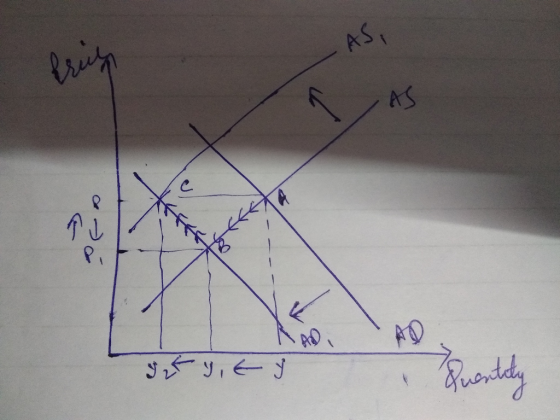
Add Answer to:
Within the AD-AS model, from a situation of medium-run
equilibrium in all markets, the central bank...
2. Suppose the economy is in long-run equilibrium, with real GDP at $19 trillion and the unemployment rate at 5%. Now assume that the central bank unexpectedly decreases money supply by 6%. a) Illust...
 2. Suppose the economy is in long-run equilibrium, with real GDP at $19 trillion and the unemployment rate at 5%. Now assume that the central bank unexpectedly decreases money supply by 6%. a) Illustrate the short-run effects of the monetary policy by using aggregate demand-aggregate supply model. Be sure to indicate the direction of change in real GDP, the price level and the unemployment rate. b) Illustrate the long-run effects of the monetary policy by using aggregate demand-aggregate supply model....
what is the difference between the short run and the long run equilibrium in the AD-AS...
 what is the difference between the short run and the long run equilibrium in the AD-AS 6. The economy is in a deep recession. In order to close the output gap, the government is planning on sending a cheque (money) to all households. Explain the short-run and the long run impact of this intervention using the ADAS model. 7. Explain in plain words how the impact of the fiscal policy described above depends on the slope of the AS curve....
one big problem. thank you!! Problem 3: AS-AD Relation Part II (20pts) AS-AD model can be used to explain how the economy transitions from the short-run to the medium-run 3a. (1pt) Can price be hi...
 one big problem. thank you!!
Problem 3: AS-AD Relation Part II (20pts) AS-AD model can be used to explain how the economy transitions from the short-run to the medium-run 3a. (1pt) Can price be higher than expected price in the short run? 3b. (1pt) if P> Pe in the short run, what happens to Pe when we go from short-run to medium-run? 3c. (2pt) If Pe increases, would AD curve shift or would AS curve shift? How would it shift?...
one big problem. thank you!!
Problem 3: AS-AD Relation Part II (20pts) AS-AD model can be used to explain how the economy transitions from the short-run to the medium-run 3a. (1pt) Can price be higher than expected price in the short run? 3b. (1pt) if P> Pe in the short run, what happens to Pe when we go from short-run to medium-run? 3c. (2pt) If Pe increases, would AD curve shift or would AS curve shift? How would it shift?...
The following graphs show the state of an economy that is currently in long-run equilibrium.
 3. The long-run effects of monetary policy The following graphs show the state of an economy that is currently in long-run equilibrium. The first graph shows the aggregate demand (AD) and long-run aggregate supply (LRAS) curves. The second shows the long-run and short-run Phillips curves (LRPC and SRPC).Which of the following statements are true based on these graphs? Check all that apply The natural level of output is $3 trillion. The unemployment rate is currently 6% higher than the natural rate of unemployment. The...
Assume the economy is in short-run equilibrium with significant unemployment. The Central Bank policymakers do not...
Assume the economy is in short-run equilibrium with significant unemployment. The Central Bank policymakers do not want the interest rates to fall, and there is no current threat of inflation. What course of action can the policymakers follow to move the economy toward full employment? Should they use monetary policy? Explain how they should do that.
plz emergency thanks 13. Suppose the economy is currently in long run macroeconomic equilibrium, with actual...
 plz
emergency thanks
13. Suppose the economy is currently in long run macroeconomic equilibrium, with actual GDP equal to potential GDP. (a) Depict this situation using AD-AS, being sure to label all curves and axes. 5 points. The government invests significant resources in building new schools and universities. (b) Depict the effect on prices and output this will have on AD-AS model and the new short run equilibrium (You can use the same graph as in (a) as long as...
plz
emergency thanks
13. Suppose the economy is currently in long run macroeconomic equilibrium, with actual GDP equal to potential GDP. (a) Depict this situation using AD-AS, being sure to label all curves and axes. 5 points. The government invests significant resources in building new schools and universities. (b) Depict the effect on prices and output this will have on AD-AS model and the new short run equilibrium (You can use the same graph as in (a) as long as...
Q.1 Figure 1 AD and AS Model of Macroeconomics a. Label both axes and all the...
 Q.1 Figure 1 AD and AS Model of Macroeconomics a. Label both axes and all the lines on the graph and indicate Long Run equilibrium in the economy with the existing letters A, b. If the economy starts at C, explain how Trump's tax cut w move on the graph in terms the relevant line(s), equilibrium and variables in the short run. c. Explain the type d. Is the equilibriur why not. What would happen to this equilibrium in the...
Economics: 1) Why is it possible to change real economic factors in the short run simply...
Economics: 1) Why is it possible to change real economic factors in the short run simply by printing and distributing more money? 2) Explain why a stable 5% inflation rate can be preferable to one that averages 4% but varies between 1-7% regularly. 3) Explain the difference between active and passive monetary policy. 4) Suppose the economy is in long-run equilibrium, with real GDP at $16 trillion and the unemployment rate at 5%, Now assume that the central bank unexpectedly...
solve using attached graphs if neccesary (2) 140 points Use the standard short-run AD-AS model to...
 solve using attached graphs if neccesary
(2) 140 points Use the standard short-run AD-AS model to answer this question. (Assume that all the taxes in this model are income taxes.) Economists do not agree on the cause of the 1991-92 recession in the U.S. The two most promising explanations are: (A) the "oil price shock" explanation, and (B) the "credit crunch" explanation. The oil price shock explanation says that when Iraq invaded Kuwait in the summer of 1990, this created...
solve using attached graphs if neccesary
(2) 140 points Use the standard short-run AD-AS model to answer this question. (Assume that all the taxes in this model are income taxes.) Economists do not agree on the cause of the 1991-92 recession in the U.S. The two most promising explanations are: (A) the "oil price shock" explanation, and (B) the "credit crunch" explanation. The oil price shock explanation says that when Iraq invaded Kuwait in the summer of 1990, this created...
Suppose the central bank, instead of following the rule r = r(Y,π), has a target level...
 Suppose the central bank, instead of following the rule r =
r(Y,π), has a target level of inflation. Specifically, it sets r
according to r = rLR + b[π − π*]. Here rLR is the real interest
rate when the economy is in long-run equilibrium; that is, it is
the real interest rate that causes the loan market to be in
equilibrium when Y = �Y. In addition, π* is the central bank’s
target level of inflation, and b is...
Suppose the central bank, instead of following the rule r =
r(Y,π), has a target level of inflation. Specifically, it sets r
according to r = rLR + b[π − π*]. Here rLR is the real interest
rate when the economy is in long-run equilibrium; that is, it is
the real interest rate that causes the loan market to be in
equilibrium when Y = �Y. In addition, π* is the central bank’s
target level of inflation, and b is...
 2. Suppose the economy is in long-run equilibrium, with real GDP at $19 trillion and the unemployment rate at 5%. Now assume that the central bank unexpectedly decreases money supply by 6%. a) Illustrate the short-run effects of the monetary policy by using aggregate demand-aggregate supply model. Be sure to indicate the direction of change in real GDP, the price level and the unemployment rate. b) Illustrate the long-run effects of the monetary policy by using aggregate demand-aggregate supply model....
 what is the difference between the short run and the long run equilibrium in the AD-AS 6. The economy is in a deep recession. In order to close the output gap, the government is planning on sending a cheque (money) to all households. Explain the short-run and the long run impact of this intervention using the ADAS model. 7. Explain in plain words how the impact of the fiscal policy described above depends on the slope of the AS curve....
 one big problem. thank you!!
Problem 3: AS-AD Relation Part II (20pts) AS-AD model can be used to explain how the economy transitions from the short-run to the medium-run 3a. (1pt) Can price be higher than expected price in the short run? 3b. (1pt) if P> Pe in the short run, what happens to Pe when we go from short-run to medium-run? 3c. (2pt) If Pe increases, would AD curve shift or would AS curve shift? How would it shift?...
one big problem. thank you!!
Problem 3: AS-AD Relation Part II (20pts) AS-AD model can be used to explain how the economy transitions from the short-run to the medium-run 3a. (1pt) Can price be higher than expected price in the short run? 3b. (1pt) if P> Pe in the short run, what happens to Pe when we go from short-run to medium-run? 3c. (2pt) If Pe increases, would AD curve shift or would AS curve shift? How would it shift?...
 plz
emergency thanks
13. Suppose the economy is currently in long run macroeconomic equilibrium, with actual GDP equal to potential GDP. (a) Depict this situation using AD-AS, being sure to label all curves and axes. 5 points. The government invests significant resources in building new schools and universities. (b) Depict the effect on prices and output this will have on AD-AS model and the new short run equilibrium (You can use the same graph as in (a) as long as...
plz
emergency thanks
13. Suppose the economy is currently in long run macroeconomic equilibrium, with actual GDP equal to potential GDP. (a) Depict this situation using AD-AS, being sure to label all curves and axes. 5 points. The government invests significant resources in building new schools and universities. (b) Depict the effect on prices and output this will have on AD-AS model and the new short run equilibrium (You can use the same graph as in (a) as long as...
 Q.1 Figure 1 AD and AS Model of Macroeconomics a. Label both axes and all the lines on the graph and indicate Long Run equilibrium in the economy with the existing letters A, b. If the economy starts at C, explain how Trump's tax cut w move on the graph in terms the relevant line(s), equilibrium and variables in the short run. c. Explain the type d. Is the equilibriur why not. What would happen to this equilibrium in the...
 solve using attached graphs if neccesary
(2) 140 points Use the standard short-run AD-AS model to answer this question. (Assume that all the taxes in this model are income taxes.) Economists do not agree on the cause of the 1991-92 recession in the U.S. The two most promising explanations are: (A) the "oil price shock" explanation, and (B) the "credit crunch" explanation. The oil price shock explanation says that when Iraq invaded Kuwait in the summer of 1990, this created...
solve using attached graphs if neccesary
(2) 140 points Use the standard short-run AD-AS model to answer this question. (Assume that all the taxes in this model are income taxes.) Economists do not agree on the cause of the 1991-92 recession in the U.S. The two most promising explanations are: (A) the "oil price shock" explanation, and (B) the "credit crunch" explanation. The oil price shock explanation says that when Iraq invaded Kuwait in the summer of 1990, this created...
 Suppose the central bank, instead of following the rule r =
r(Y,π), has a target level of inflation. Specifically, it sets r
according to r = rLR + b[π − π*]. Here rLR is the real interest
rate when the economy is in long-run equilibrium; that is, it is
the real interest rate that causes the loan market to be in
equilibrium when Y = �Y. In addition, π* is the central bank’s
target level of inflation, and b is...
Suppose the central bank, instead of following the rule r =
r(Y,π), has a target level of inflation. Specifically, it sets r
according to r = rLR + b[π − π*]. Here rLR is the real interest
rate when the economy is in long-run equilibrium; that is, it is
the real interest rate that causes the loan market to be in
equilibrium when Y = �Y. In addition, π* is the central bank’s
target level of inflation, and b is...
Most questions answered within 3 hours.
-
Where is the error in this code sequence?
String s1 = "Hello";
String s2 = "ello";...
asked 10 months ago -
Financial data for Joel de Paris, Inc., for last year
follow:
Joel de Paris, Inc.
Balance...
asked 10 months ago -
Consider this reaction:
Al2(SO4)3 (aq)+ BaCl3
(aq) Al2Cl6 (aq)- +
3BaSO4(s) . What is the...
asked 10 months ago -
Suppose that Savneet is considering increasing her
recent random sample from 20 car rentals to 40...
asked 10 months ago -
Trucks arrive at an unloading terminal at an average rate of 120
per hour.
Trucks arrive...
asked 10 months ago -
Why are methanol and ethanol completely soluble in water while
octanol is not very little soluble....
asked 10 months ago -
A facilities manager at a university reads in a research report
that the mean amount of...
asked 10 months ago -
When the CuSO4 is rehydrated by adding water to the anhydrous
compound, is this an endothermic...
asked 10 months ago -
A ray of sunlight is passing from diamond into crown glass; the
angle of incidence is...
asked 10 months ago -
A block of mass 0.249 kg is placed on top of a light, vertical
spring of...
asked 10 months ago -
how do the kidneys compensate in the presences of acidosis
a) trigger hyperventilate
b) reserve acid...
asked 10 months ago -
Question 501 pts
The rental rate of capital to the firm increases. Which of the
following...
asked 10 months ago