Match the following molecules with the types of bonds in the space provided. (_____) a. (Answer_____)...
Match the following molecules with the types of bonds in the space provided. (_____)
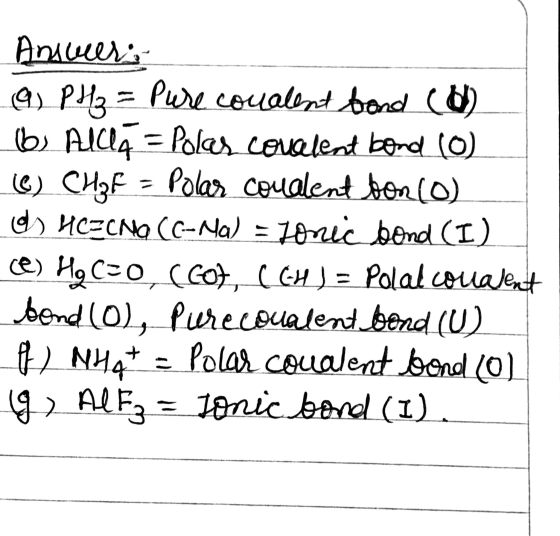
a. (Answer_____) PH3
b. (Answer_____) AlCl4-
c. (Answer_____) CH3F
d. (Answer_____) HC=CNa (C-Na) Triple bond
e. (Answer_____, _____) H2C=O (C-O) & (C-H)
f. (Answer_____) NH4+
g. (Answer_____) AlF3
(O) Polar Covalent Bond (U) Pure Covalent Bond (I) Ionic Bond
**Could you explain the process and not just the answers**
Homework Answers
Answer:-
This question is solved by using the simple concept of molecular bonding.
The answer is given in the image,
Add Answer to:
Match the following molecules with the types of bonds in the
space provided. (_____)
a. (Answer_____)...
Match the following molecules with the types of bonds in the space provided. (_____) a. (Answer_____)...
Match the following molecules with the types of bonds in the space provided. (_____) a. (Answer_____) PH3 b. (Answer_____) AlCl4- c. (Answer_____) CH3F d. (Answer_____) HC≡CNa (C-Na) e. (Answer_____, _____) H2C=O (C-O) & (C-H) f. (Answer_____) NH4+ g. (Answer_____) AlF3 (O) Polar Covalent Bond (U) Pure Covalent Bond (I) Ionic Bond **Could you explain the process and not just the answers**
Using the electronegativity table, determine whether the following bonds are pure covalent bond (nonpolar), polar covalent...
Using the electronegativity table, determine whether the following bonds are pure covalent bond (nonpolar), polar covalent bond, or ionic bond. Question Selected Match O-H H-Cl N-H C-C K-Cl N-Cl C-O H-H Cs-F C-S
For the bonds in these molecules: LiCl, Br2, NaF, CO2, BCl3 Which has the most ionic...
 For the bonds in these molecules:
LiCl, Br2, NaF, CO2, BCl3
Which has the most ionic character? Which has the most
covalent character? Which two bonds have the same ionic
character?
Are my answers correct? Please use electronegavitiy to explain
why. I'm mostly confused on the third question, which two bonds
have the same ionic character, because the homework is telling me
I'm both correct and incorrect for that question? Thank you for
your assistance.
Lici Br2 NaF CO, BCI...
For the bonds in these molecules:
LiCl, Br2, NaF, CO2, BCl3
Which has the most ionic character? Which has the most
covalent character? Which two bonds have the same ionic
character?
Are my answers correct? Please use electronegavitiy to explain
why. I'm mostly confused on the third question, which two bonds
have the same ionic character, because the homework is telling me
I'm both correct and incorrect for that question? Thank you for
your assistance.
Lici Br2 NaF CO, BCI...
NAme SAnIRA ID 05100 9 Worksheet-Polarity of Bonds III. Using the table of electronegativities from your...
 NAme SAnIRA ID 05100 9 Worksheet-Polarity of Bonds III. Using the table of electronegativities from your Periodic table calculate the EN difference for the atoms that are bonded in the I. Determine the type of bond (ionic, polar covalent, or non-polar covalent) that will form between atoms of the following elements and show the polarity of the bond if it is polar covalent. following molecules. Then tell whether the bond is nonpolar covalent, polar covalent, or ionic. Tell which atom...
Classify the following bonds as pure covalent, polar covalent or ionic. If polar covalent, indicate the...
 Classify the following bonds as pure covalent, polar covalent or ionic. If polar covalent, indicate the polarity of the bond with 8- and 8+. The element with the lower electronegativity is labeled with a 8+. (A) H-CI (E) C-C (B) N-Br (F) S-0 (C) H-C (G) 1- Br (D) K-CI (H) S-B
Classify each of the following as ionic or molecular.
 Part 1)Classify each of the following as ionic or molecular. Drag the appropriate items to their respective bins.Identify which of the following molecules can exhibit hydrogen bonding as a pure liquid. Check all that apply.The hydrides of group 5A are NH3, PH3, AsH3, and SbH3. Arrange them from highest to lowest boiling point. Rank the molecules from highest to lowest boiling point. To rank items as equivalent, overlap them.Indicate the major type of intermolecular forces that occurs between particles of the following: Drag the...
ChemActivity 22 Polar, Nonpolar, and lonic Bonds 135 Exercises infog molecules (or ions) as nonpolar, polar...
 ChemActivity 22 Polar, Nonpolar, and lonic Bonds 135 Exercises infog molecules (or ions) as nonpolar, polar ionic. Clasity each of the following bonds as nonpolar, polar, or ionic. C inC O-H in Ho: Si-Cl in Sicla : C-H in benzene (CoHo) Al-O in AlbO, Na-F in NaF: K-c in KCI N-O in NOj H-S in H2s: НН H-N-C-c-o-H C-O in H tot 3. Excluding the inert gases, which element in the periodic table has the largest electronegativity? Which has the...
Part A Review Constants Periodic Table Learning Goal: Consider the following element combinations. Classify the bonds...
 Part A Review Constants Periodic Table Learning Goal: Consider the following element combinations. Classify the bonds formed between each pair as ionic, polar covalent, or nonpolar covalent qualitatively based solely on each element's position on the periodic table. To use electronegativity or metal versus nonmetal classifications to distinguish covalent polar covalent, and ionic bonds. not conduct calculations. Drag the appropriate items to their respective bins. When two bonded atoms attract electrons with View Available Hint(s) equal strength, the result is...
9. Draw all of the possible hydrogen bonds between the following molecule and water molecules. Indicate...
 9. Draw all of the possible hydrogen bonds between the following molecule and water molecules. Indicate the hydrogen bonds with dotted lines. :N-CEN: H 10. Polar molecules can contain more than one type of attractive force. Fill in the following table answering the question "Is this attractive force present between molecules of the given compound?" Write yes or no for each force. Molecule Ionic Attraction H-Bond Dipole-Dipole London CHCl3 CH3OH NH2 65- *NH3-C-COO 11. For each of the following pairs...
10. Name the two strong bonds and two weak bonds? 11. What is an ion? Name...
10. Name the two strong bonds and two weak bonds? 11. What is an ion? Name both types of ions and their charges? 12. Which ions form NaCl? Give full form of Na and Cl 13. Draw the structures of C,H,O and N. 14. Give examples of ionic bond and covalent bond 15. Give examples for a molecule and a compound
 For the bonds in these molecules:
LiCl, Br2, NaF, CO2, BCl3
Which has the most ionic character? Which has the most
covalent character? Which two bonds have the same ionic
character?
Are my answers correct? Please use electronegavitiy to explain
why. I'm mostly confused on the third question, which two bonds
have the same ionic character, because the homework is telling me
I'm both correct and incorrect for that question? Thank you for
your assistance.
Lici Br2 NaF CO, BCI...
For the bonds in these molecules:
LiCl, Br2, NaF, CO2, BCl3
Which has the most ionic character? Which has the most
covalent character? Which two bonds have the same ionic
character?
Are my answers correct? Please use electronegavitiy to explain
why. I'm mostly confused on the third question, which two bonds
have the same ionic character, because the homework is telling me
I'm both correct and incorrect for that question? Thank you for
your assistance.
Lici Br2 NaF CO, BCI...
 NAme SAnIRA ID 05100 9 Worksheet-Polarity of Bonds III. Using the table of electronegativities from your Periodic table calculate the EN difference for the atoms that are bonded in the I. Determine the type of bond (ionic, polar covalent, or non-polar covalent) that will form between atoms of the following elements and show the polarity of the bond if it is polar covalent. following molecules. Then tell whether the bond is nonpolar covalent, polar covalent, or ionic. Tell which atom...
 Classify the following bonds as pure covalent, polar covalent or ionic. If polar covalent, indicate the polarity of the bond with 8- and 8+. The element with the lower electronegativity is labeled with a 8+. (A) H-CI (E) C-C (B) N-Br (F) S-0 (C) H-C (G) 1- Br (D) K-CI (H) S-B
 ChemActivity 22 Polar, Nonpolar, and lonic Bonds 135 Exercises infog molecules (or ions) as nonpolar, polar ionic. Clasity each of the following bonds as nonpolar, polar, or ionic. C inC O-H in Ho: Si-Cl in Sicla : C-H in benzene (CoHo) Al-O in AlbO, Na-F in NaF: K-c in KCI N-O in NOj H-S in H2s: НН H-N-C-c-o-H C-O in H tot 3. Excluding the inert gases, which element in the periodic table has the largest electronegativity? Which has the...
 Part A Review Constants Periodic Table Learning Goal: Consider the following element combinations. Classify the bonds formed between each pair as ionic, polar covalent, or nonpolar covalent qualitatively based solely on each element's position on the periodic table. To use electronegativity or metal versus nonmetal classifications to distinguish covalent polar covalent, and ionic bonds. not conduct calculations. Drag the appropriate items to their respective bins. When two bonded atoms attract electrons with View Available Hint(s) equal strength, the result is...
 9. Draw all of the possible hydrogen bonds between the following molecule and water molecules. Indicate the hydrogen bonds with dotted lines. :N-CEN: H 10. Polar molecules can contain more than one type of attractive force. Fill in the following table answering the question "Is this attractive force present between molecules of the given compound?" Write yes or no for each force. Molecule Ionic Attraction H-Bond Dipole-Dipole London CHCl3 CH3OH NH2 65- *NH3-C-COO 11. For each of the following pairs...
Most questions answered within 3 hours.
-
Where is the error in this code sequence?
String s1 = "Hello";
String s2 = "ello";...
asked 10 months ago -
Financial data for Joel de Paris, Inc., for last year
follow:
Joel de Paris, Inc.
Balance...
asked 10 months ago -
Consider this reaction:
Al2(SO4)3 (aq)+ BaCl3
(aq) Al2Cl6 (aq)- +
3BaSO4(s) . What is the...
asked 10 months ago -
Suppose that Savneet is considering increasing her
recent random sample from 20 car rentals to 40...
asked 10 months ago -
Trucks arrive at an unloading terminal at an average rate of 120
per hour.
Trucks arrive...
asked 10 months ago -
Why are methanol and ethanol completely soluble in water while
octanol is not very little soluble....
asked 10 months ago -
A facilities manager at a university reads in a research report
that the mean amount of...
asked 10 months ago -
When the CuSO4 is rehydrated by adding water to the anhydrous
compound, is this an endothermic...
asked 10 months ago -
A ray of sunlight is passing from diamond into crown glass; the
angle of incidence is...
asked 10 months ago -
A block of mass 0.249 kg is placed on top of a light, vertical
spring of...
asked 10 months ago -
how do the kidneys compensate in the presences of acidosis
a) trigger hyperventilate
b) reserve acid...
asked 10 months ago -
Question 501 pts
The rental rate of capital to the firm increases. Which of the
following...
asked 10 months ago