(computability and complexity): prove well: if language A belongs to class BPP - then A ≤P#SAT
(computability and complexity): prove well: if language A belongs to class BPP - then A ≤P#SAT
Homework Answers
#
A language A reduces to B in randomized polynomial-time, A ≤r B if there exists a polynomial-time probabilistic turing-machine M such that for all x ∈ {0, 1} ∗ :
Pr[B(M(x)) = A(x)] ≥ 2 3
Recall the reduction of P H to ⊕SAT.
#
A polynomial-time probabilistic turing-machine M works in space S(n) if for all input x ∈ {0, 1} ∗ and random strings r ∈ {0, 1} ∗ M(x, r) need work-space ≤ S(∣x∣).
A language L ∈ BP L if there exists a O(log(n))-space probabilistic turingmachine M such that ∀x:
Pr[M(x) = L(x)] ≥ 2 3
A language L ∈ RL if there exists a O(log(n))-space probabilistic turingmachine M such that ∀x:
x ∈ L ⇒ Pr[M(x) = 1] ≥ 2/3
x ≠ L ⇒ Pr[M(x) = 1] = 0
#
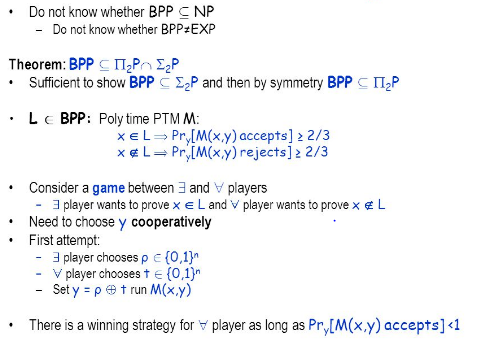
This is what i got fto prove from the Above Query.
Add Answer to:
(computability and complexity): prove well: if language A
belongs to class BPP - then A ≤P#SAT
(computability and complexity - reductions): PLEASE ONLY ANSWER IF YOU CAN PROVIDE A FULL PROOF IN...
(computability and complexity - reductions): PLEASE ONLY ANSWER IF YOU CAN PROVIDE A FULL PROOF IN ACADEMIC LEVEL Defining a new kind of reduction: a reduction in log-logarithmic space. for it, let's define a log-logarithmic transformer that is identical to a logarithmic transformer, but it's working tape can hold O(log(logn) symbols and not O(logn) symbols. We'll say a language A can be reduced in a log-logarithmic space to language B and denote A ≤LLB, if exists a transformer with log-logarithmic...
Theory of Computation 2. (a) Show that the language B e,1, 11,1100 is in complexity class TIME ) b) Show that the language B e, 1,11,1100 is in complexity class P. Theory of Computation 2. (a) S...
 Theory of Computation 2. (a) Show that the language B e,1, 11,1100 is in complexity class TIME ) b) Show that the language B e, 1,11,1100 is in complexity class P.
Theory of Computation 2. (a) Show that the language B e,1, 11,1100 is in complexity class TIME ) b) Show that the language B e, 1,11,1100 is in complexity class P.
Theory of Computation 2. (a) Show that the language B e,1, 11,1100 is in complexity class TIME ) b) Show that the language B e, 1,11,1100 is in complexity class P.
(complexity): prove: if A is a Regular language then A∈DSPACE(O(1)) explanation:prove that the c...
(complexity): prove: if A is a Regular language then A∈DSPACE(O(1)) explanation:prove that the complexity class of a regular languages is DSPACE(O(1))
(complexity) prove: if P=NP, then there's an algorithm with a polynomial running time for the fol...
(complexity) prove: if P=NP, then there's an algorithm with a polynomial running time for the following problem: input: a boolean formula φ output: a satisfying assignment of φ if φ satisfiable. if φ not satisfiable, a "no" will be returned. explanation: the algorithm accepts φ as an input (boolean formula). if φ doesn't have a satisfiable assignment, a "no" is returned. if φ does have a satisfiable assignment, one of the satisfying assignment is returned,. so we assign 0 or...
Match each problem to the time complexity class it likely belongs to: 1. O(1): Constant 2....
Match each problem to the time complexity class it likely belongs to: 1. O(1): Constant 2. O(n): Linear 3. O(n!): Factorial 4. O(logn): Logarithmic 5.O(n2): Quadratic 6. O(n3): Cubic OPTIONS: a. Find an element in an unsorted array b. Shortest path between two nodes in a graph c. Matrix multiplication d. Generate permutations of a string e. Add an element to the front of a linked list f. Find an element in a binary search tree
Prove that each of the problems below is in the NP class. 4-SAT problem Instance: A...
Prove that each of the problems below is in the NP class. 4-SAT problem Instance: A Boolean expression E in FNC (normal connective forms), Question: Are there at least four different solutions that make E satisfactory?
Suppose that L is a regular language. Prove that the language p r e f i...
 Suppose that L is a regular language. Prove that the language p
r e f i x (L )={w |
x, wx
L } is regular. (For example, if L = {abc, def}, prefix(L) = {?,
a, ab, abc, d, de, def}.)
Suppose that L is a regular language. Prove that the language p
r e f i x (L )={w |
x, wx
L } is regular. (For example, if L = {abc, def}, prefix(L) = {?,
a, ab, abc, d, de, def}.)
1. Îs the language Li = {aPble" | p,q,r > 1 and r = pg) a context-free language? Prove your answer. 1. Îs t...
 1. Îs the language Li = {aPble" | p,q,r > 1 and r = pg) a context-free language? Prove your answer.
1. Îs the language Li = {aPble" | p,q,r > 1 and r = pg) a context-free language? Prove your answer.
1. Îs the language Li = {aPble" | p,q,r > 1 and r = pg) a context-free language? Prove your answer.
5. Use Rice's Theorem to prove the undecidablity of the following language. P = {< M...
 5. Use Rice's Theorem to prove the undecidablity of the following language. P = {< M > M is a TM and 1011 E L(M)}.
Define each of the following for a language L. a) L is in the class P....
Define each of the following for a language L. a) L is in the class P. b) L is in the class NP. c) L is reducible to another language L' in polynomial time d) L is NP-complete
 Theory of Computation 2. (a) Show that the language B e,1, 11,1100 is in complexity class TIME ) b) Show that the language B e, 1,11,1100 is in complexity class P.
Theory of Computation 2. (a) Show that the language B e,1, 11,1100 is in complexity class TIME ) b) Show that the language B e, 1,11,1100 is in complexity class P.
Theory of Computation 2. (a) Show that the language B e,1, 11,1100 is in complexity class TIME ) b) Show that the language B e, 1,11,1100 is in complexity class P.
 Suppose that L is a regular language. Prove that the language p
r e f i x (L )={w |
x, wx
L } is regular. (For example, if L = {abc, def}, prefix(L) = {?,
a, ab, abc, d, de, def}.)
Suppose that L is a regular language. Prove that the language p
r e f i x (L )={w |
x, wx
L } is regular. (For example, if L = {abc, def}, prefix(L) = {?,
a, ab, abc, d, de, def}.)
 1. Îs the language Li = {aPble" | p,q,r > 1 and r = pg) a context-free language? Prove your answer.
1. Îs the language Li = {aPble" | p,q,r > 1 and r = pg) a context-free language? Prove your answer.
1. Îs the language Li = {aPble" | p,q,r > 1 and r = pg) a context-free language? Prove your answer.
 5. Use Rice's Theorem to prove the undecidablity of the following language. P = {< M > M is a TM and 1011 E L(M)}.
Most questions answered within 3 hours.
-
Where is the error in this code sequence?
String s1 = "Hello";
String s2 = "ello";...
asked 10 months ago -
Financial data for Joel de Paris, Inc., for last year
follow:
Joel de Paris, Inc.
Balance...
asked 10 months ago -
Consider this reaction:
Al2(SO4)3 (aq)+ BaCl3
(aq) Al2Cl6 (aq)- +
3BaSO4(s) . What is the...
asked 10 months ago -
Suppose that Savneet is considering increasing her
recent random sample from 20 car rentals to 40...
asked 10 months ago -
Trucks arrive at an unloading terminal at an average rate of 120
per hour.
Trucks arrive...
asked 10 months ago -
Why are methanol and ethanol completely soluble in water while
octanol is not very little soluble....
asked 10 months ago -
A facilities manager at a university reads in a research report
that the mean amount of...
asked 10 months ago -
When the CuSO4 is rehydrated by adding water to the anhydrous
compound, is this an endothermic...
asked 10 months ago -
A ray of sunlight is passing from diamond into crown glass; the
angle of incidence is...
asked 10 months ago -
A block of mass 0.249 kg is placed on top of a light, vertical
spring of...
asked 10 months ago -
how do the kidneys compensate in the presences of acidosis
a) trigger hyperventilate
b) reserve acid...
asked 10 months ago -
Question 501 pts
The rental rate of capital to the firm increases. Which of the
following...
asked 10 months ago