Create Regular Expression for the following language: Σ = { 0, 1 } All strings that...
Create Regular Expression for the following language:
Σ = { 0, 1 }
- All strings that optionally start with 1111 and must end with 0000.
Homework Answers

regular expression:
--------------------
(1111)?(0+1)*0000

Explanation:
---------------
(1111)? is optional 1111
(0+1)* gives strings of length 0 or more
0000 at the end makes sure that the expression ends with 0000
Add Answer to:
Create Regular Expression for the following language:
Σ = { 0, 1 }
All strings that...
Construct a regular expression that recognizes the following language of strings over the alphabet {0 1}:...
Construct a regular expression that recognizes the following language of strings over the alphabet {0 1}: The language consisting of the set of all bit strings that start with 00 or end with 101 (or both). Syntax The union is expressed as R|R, star as R*, plus as R+, concatenation as RR. Epsilon is not supported but you can write R? for the regex (R|epsilon).
(a) Give 2 strings that are members of language specified by the regular expression (0+ 1)∗...
(a) Give 2 strings that are members of language specified by the regular expression (0+ 1)∗ but are not members of the language specified by 0∗ + 1∗ . Then give 2 strings that are members of both languages. Assume the alphabet is Σ = {0, 1}. (b) For each of the following languages specified by regular expressions, give 2 strings that are members and 2 strings that are not members (a total of 4 strings for each part). Assume...
Find a regular expression for the following language over the alphabet Σ = {a,b}. L = {strings th...
Find a regular expression for the following language over the alphabet Σ = {a,b}. L = {strings that begin and end with a and contain bb}.
Construct a regular expression that recognizes the following language of strings over the alphabet {0 1}:...
Construct a regular expression that recognizes the following language of strings over the alphabet {0 1}: The language consisting of the set of all bit strings that contain two or three symbols.
List 5 strings that belong to the language defined by this regular expression: 0*1(0*1*)*
List 5 strings that belong to the language defined by this regular expression: 0*1(0*1*)*
************Theory of Computing ***************** 1. Generate a regular expression of “all words over the alphabet Σ...
************Theory of Computing ***************** 1. Generate a regular expression of “all words over the alphabet Σ = {a b} that either begin with a and end with b OR begin with b and end in a.” Thus, the first few shortest words in this language are “ab” “ba” “aab” “baa” “abb” “bba” “aaab” etc. So, if a word begins with a it must in end b, and if it begins with b it must end in a. 2. Consider the...
Create DFAs for the following language specifications. 1. All strings on Σ = {A, B, C}...
Create DFAs for the following language specifications. 1. All strings on Σ = {A, B, C} that contain each letter (A, B, and C) at least once.
Provide a regular expression for the following languages: (a) the set of all strings over {a,...
Provide a regular expression for the following languages: (a) the set of all strings over {a, b} that start with ab and end with ba, (b) the set of strings over {a, b} where four consecutive occurrences of both letters occur in every word.
Can you please thoroughly explain part B? Let Σ {0,1} be an alphabet. Suppose the language...
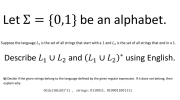 Can you please thoroughly explain part B?
Let Σ {0,1} be an alphabet. Suppose the language Ly is the set of all strings that start with a 1 and L2 is the set of all strings that end in a 1. Describe Lj U L2 and (L1 UL2)* using English. b) Decide if the given strings belong to the language defined by the given regular expression. If it does not belong, then explain why. 0(1|€)10(e|0)*11 , strings: 0110011, 0100011001111
Can you please thoroughly explain part B?
Let Σ {0,1} be an alphabet. Suppose the language Ly is the set of all strings that start with a 1 and L2 is the set of all strings that end in a 1. Describe Lj U L2 and (L1 UL2)* using English. b) Decide if the given strings belong to the language defined by the given regular expression. If it does not belong, then explain why. 0(1|€)10(e|0)*11 , strings: 0110011, 0100011001111
1. Use a Regular Expression to define the set of all bit strings of one or...
 1. Use a Regular Expression to define the set of all bit strings
of one or more 0's followed by only a 1.
2. Use a Regular Expression to define the set of all bit string
of two or more symbols followed by three or more 0's.
3. Are these two grammars the same?
a. S-> aSb|ab|λ
b. S-> aAb|ab A->aAb|λ
4. Use the process of elimination to find the language of the
following FA: (see picture for diagram)
5....
1. Use a Regular Expression to define the set of all bit strings
of one or more 0's followed by only a 1.
2. Use a Regular Expression to define the set of all bit string
of two or more symbols followed by three or more 0's.
3. Are these two grammars the same?
a. S-> aSb|ab|λ
b. S-> aAb|ab A->aAb|λ
4. Use the process of elimination to find the language of the
following FA: (see picture for diagram)
5....
 Can you please thoroughly explain part B?
Let Σ {0,1} be an alphabet. Suppose the language Ly is the set of all strings that start with a 1 and L2 is the set of all strings that end in a 1. Describe Lj U L2 and (L1 UL2)* using English. b) Decide if the given strings belong to the language defined by the given regular expression. If it does not belong, then explain why. 0(1|€)10(e|0)*11 , strings: 0110011, 0100011001111
Can you please thoroughly explain part B?
Let Σ {0,1} be an alphabet. Suppose the language Ly is the set of all strings that start with a 1 and L2 is the set of all strings that end in a 1. Describe Lj U L2 and (L1 UL2)* using English. b) Decide if the given strings belong to the language defined by the given regular expression. If it does not belong, then explain why. 0(1|€)10(e|0)*11 , strings: 0110011, 0100011001111
 1. Use a Regular Expression to define the set of all bit strings
of one or more 0's followed by only a 1.
2. Use a Regular Expression to define the set of all bit string
of two or more symbols followed by three or more 0's.
3. Are these two grammars the same?
a. S-> aSb|ab|λ
b. S-> aAb|ab A->aAb|λ
4. Use the process of elimination to find the language of the
following FA: (see picture for diagram)
5....
1. Use a Regular Expression to define the set of all bit strings
of one or more 0's followed by only a 1.
2. Use a Regular Expression to define the set of all bit string
of two or more symbols followed by three or more 0's.
3. Are these two grammars the same?
a. S-> aSb|ab|λ
b. S-> aAb|ab A->aAb|λ
4. Use the process of elimination to find the language of the
following FA: (see picture for diagram)
5....
Most questions answered within 3 hours.
-
Where is the error in this code sequence?
String s1 = "Hello";
String s2 = "ello";...
asked 10 months ago -
Financial data for Joel de Paris, Inc., for last year
follow:
Joel de Paris, Inc.
Balance...
asked 10 months ago -
Consider this reaction:
Al2(SO4)3 (aq)+ BaCl3
(aq) Al2Cl6 (aq)- +
3BaSO4(s) . What is the...
asked 10 months ago -
Suppose that Savneet is considering increasing her
recent random sample from 20 car rentals to 40...
asked 10 months ago -
Trucks arrive at an unloading terminal at an average rate of 120
per hour.
Trucks arrive...
asked 10 months ago -
Why are methanol and ethanol completely soluble in water while
octanol is not very little soluble....
asked 10 months ago -
A facilities manager at a university reads in a research report
that the mean amount of...
asked 10 months ago -
When the CuSO4 is rehydrated by adding water to the anhydrous
compound, is this an endothermic...
asked 10 months ago -
A ray of sunlight is passing from diamond into crown glass; the
angle of incidence is...
asked 10 months ago -
A block of mass 0.249 kg is placed on top of a light, vertical
spring of...
asked 10 months ago -
how do the kidneys compensate in the presences of acidosis
a) trigger hyperventilate
b) reserve acid...
asked 10 months ago -
Question 501 pts
The rental rate of capital to the firm increases. Which of the
following...
asked 10 months ago