State the two conditions where the assumptions for an ideal gas are no longer valid and...
Homework Answers
Request Answer!
We need at least 10 more requests to produce the answer.
0 / 10 have requested this problem solution
The more requests, the faster the answer.
Add Answer to:
State the two conditions where the assumptions for an ideal gas are
no longer valid and...
2. The ideal gas model is valid if which of the following conditions is true? The...
2. The ideal gas model is valid if which of the following conditions is true? The gas density is low. The gas density is high. The temperature is low. The temperature is high. The gas density and the temperature are low. The gas density and the temperature are high. The gas density is high and the temperature is low. The gas density is low and the temperature is high.
5. At extremely high pressures, the molar volume of a real gas deviates from that of...
 5. At extremely high pressures, the molar volume of a real gas deviates from that of an ideal gas. Please explain (hint: which of the three assum Theory are not true under conditions of high pressure)
1) According to kinetic-molecular theory, what makes a substance a gas? 2) What are the two...
 1) According to kinetic-molecular theory, what makes a substance a gas? 2) What are the two primary assumptions about the atoms or molecules of a gas made by the ideal gas law? Under what conditions are these assumptions most valid? 3) Describe why a gas exerts pressure on a molecular scale.
Pre-Laboratory Questions for Lab 10 1. The ideal gas law is an equation used for examining...
 Pre-Laboratory Questions for Lab 10 1. The ideal gas law is an equation used for examining ideal gases. The four tenets of kinetic molecular theory define what an ideal gas is. However, no ideal gases exist in nature, only real gases do. Van der Waals' equation attempts to make corrections to real gases that do not exhibit ideal behavior. Two gases are given below that do not exhibit ideal behavior. Explain for each one why it doesn't exhibit ideal behavior....
1. State whether the behavior of methylamine (CH,NH2) would be less ideal than that of argon. 2. Calculate the value of R in L-atm/mol-K by assuming that an ideal gas occupies 224 L/mol at STP Wh...
 1. State whether the behavior of methylamine (CH,NH2) would be less ideal than that of argon. 2. Calculate the value of R in L-atm/mol-K by assuming that an ideal gas occupies 224 L/mol at STP Why do you equalize the water levels in the bottle and the beaker? 3. Why does the vapor pressure of water contribute to the total pressure in the bottle? 4. What is the value of an error analysis? 5. 6. Suggest reasons why real gases...
Arrange the non-ideal equation of state, pVm = RT(1 + Bp), into two term that describe...
Arrange the non-ideal equation of state, pVm = RT(1 + Bp), into two term that describe ideal gas behavior and deviations from ideal gas behavior, then describe the type of inter-particle interactions that would lead to deviations from ideal gas behavior. Finally, using the derive an expression for the fugacity.
2. The gas laws are defined for ideal gases. Real gases do not always follow the...
 2. The gas laws are defined for ideal gases. Real gases do not always follow the gas laws exactly Under what conditions would you predict that real gases least approximate ideal gas behavior Explain why real gases behave least like ideal at the conditions you stated. 3. Define molar mass including the units in which it is expressed. on produced a 0.311 g sample of gas which occupied 225 ml at 55°C exerting a pressure of 886 mm Hg. What...
8. 10 Point Bonus! The Ideal Gas Equation of State is pV = nRT, where n=...
 8. 10 Point Bonus! The Ideal Gas Equation of State is pV = nRT, where n= number of moles of gas & R is the ideal the gas constant. The Van der Waals Equation of State is briefly discussed in Ch. 5 of the book by Reif. It is an empirical, crude attempt to improve on the Ideal Gas Model by allowing gas molecules to interact with each other. For one mole of non-ideal gas this equation of state is...
Question 1 (1 point) 1.50 Oxygen PV 1.ok Ideal gas 0.0 0 200 400 600 800...
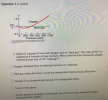 Question 1 (1 point) 1.50 Oxygen PV 1.ok Ideal gas 0.0 0 200 400 600 800 1000 Pressure (atm) 1. Above is a graph of one mole oxygen and an "ideal gas". The ratio of PV/T is plotted as a function of gas pressure. Why is the line that represents oxygen different from that of the "ideal gas"? Oxygen deviates from an ideal gas because it is diatomic Real gas molecules have a small but measurable intermolecular attraction Oxygen is...
The ideal gas law describes the relationship among the volume of an ideal gas (V), its...
The ideal gas law describes the relationship among the volume of an ideal gas (V), its pressure (P), its absolute temperature (T), and number of moles (n): PV=nRT Under standard conditions, the ideal gas law does a good job of approximating these properties for any gas. However, the ideal gas law does not account for all the properties of real gases such as intermolecular attraction and molecular volume, which become more pronounced at low temperatures and high pressures. The van...
 5. At extremely high pressures, the molar volume of a real gas deviates from that of an ideal gas. Please explain (hint: which of the three assum Theory are not true under conditions of high pressure)
 1) According to kinetic-molecular theory, what makes a substance a gas? 2) What are the two primary assumptions about the atoms or molecules of a gas made by the ideal gas law? Under what conditions are these assumptions most valid? 3) Describe why a gas exerts pressure on a molecular scale.
 Pre-Laboratory Questions for Lab 10 1. The ideal gas law is an equation used for examining ideal gases. The four tenets of kinetic molecular theory define what an ideal gas is. However, no ideal gases exist in nature, only real gases do. Van der Waals' equation attempts to make corrections to real gases that do not exhibit ideal behavior. Two gases are given below that do not exhibit ideal behavior. Explain for each one why it doesn't exhibit ideal behavior....
 1. State whether the behavior of methylamine (CH,NH2) would be less ideal than that of argon. 2. Calculate the value of R in L-atm/mol-K by assuming that an ideal gas occupies 224 L/mol at STP Why do you equalize the water levels in the bottle and the beaker? 3. Why does the vapor pressure of water contribute to the total pressure in the bottle? 4. What is the value of an error analysis? 5. 6. Suggest reasons why real gases...
 2. The gas laws are defined for ideal gases. Real gases do not always follow the gas laws exactly Under what conditions would you predict that real gases least approximate ideal gas behavior Explain why real gases behave least like ideal at the conditions you stated. 3. Define molar mass including the units in which it is expressed. on produced a 0.311 g sample of gas which occupied 225 ml at 55°C exerting a pressure of 886 mm Hg. What...
 8. 10 Point Bonus! The Ideal Gas Equation of State is pV = nRT, where n= number of moles of gas & R is the ideal the gas constant. The Van der Waals Equation of State is briefly discussed in Ch. 5 of the book by Reif. It is an empirical, crude attempt to improve on the Ideal Gas Model by allowing gas molecules to interact with each other. For one mole of non-ideal gas this equation of state is...
 Question 1 (1 point) 1.50 Oxygen PV 1.ok Ideal gas 0.0 0 200 400 600 800 1000 Pressure (atm) 1. Above is a graph of one mole oxygen and an "ideal gas". The ratio of PV/T is plotted as a function of gas pressure. Why is the line that represents oxygen different from that of the "ideal gas"? Oxygen deviates from an ideal gas because it is diatomic Real gas molecules have a small but measurable intermolecular attraction Oxygen is...
Most questions answered within 3 hours.
-
Where is the error in this code sequence?
String s1 = "Hello";
String s2 = "ello";...
asked 10 months ago -
Financial data for Joel de Paris, Inc., for last year
follow:
Joel de Paris, Inc.
Balance...
asked 10 months ago -
Consider this reaction:
Al2(SO4)3 (aq)+ BaCl3
(aq) Al2Cl6 (aq)- +
3BaSO4(s) . What is the...
asked 10 months ago -
Suppose that Savneet is considering increasing her
recent random sample from 20 car rentals to 40...
asked 10 months ago -
Trucks arrive at an unloading terminal at an average rate of 120
per hour.
Trucks arrive...
asked 10 months ago -
Why are methanol and ethanol completely soluble in water while
octanol is not very little soluble....
asked 10 months ago -
A facilities manager at a university reads in a research report
that the mean amount of...
asked 10 months ago -
When the CuSO4 is rehydrated by adding water to the anhydrous
compound, is this an endothermic...
asked 10 months ago -
A ray of sunlight is passing from diamond into crown glass; the
angle of incidence is...
asked 10 months ago -
A block of mass 0.249 kg is placed on top of a light, vertical
spring of...
asked 10 months ago -
how do the kidneys compensate in the presences of acidosis
a) trigger hyperventilate
b) reserve acid...
asked 10 months ago -
Question 501 pts
The rental rate of capital to the firm increases. Which of the
following...
asked 10 months ago