The engine of a locomotive exerts a constant force of magnitude 7.1 105 N to accelerate...
The engine of a locomotive exerts a constant force of magnitude 7.1 105 N to accelerate a train to 64 km/h. Determine the time taken for the train of mass 1.2 107 kg to reach this speed from rest.
Homework Answers
 This
may helps you.
This
may helps you.Add Answer to:
The engine of a locomotive exerts a constant force of magnitude
7.1 105 N to accelerate...
The engine of a locomotive exerts a constant force of 6.6 105 N to accelerate a...
The engine of a locomotive exerts a constant force of 6.6 105 N to accelerate a train to 72 km/h. Determine the time (in min) taken for the train of mass 1.7 107 kg to reach this speed from rest.
The engine of a locomotive exerts a constant force of 7.9x10^5 N to accelerate a train...
The engine of a locomotive exerts a constant force of 7.9x10^5 N to accelerate a train to 80 km/h. Determine the time (in min) taken for the train of mass 1.2x10^7 kg to reach this speed from rest. *I need the answer in minutes. I was calculating 5.06 minutes but it says that is incorrect.
1 53 WA e exerts a constant force of magnitude 7.9 x 10 N to accelerate...
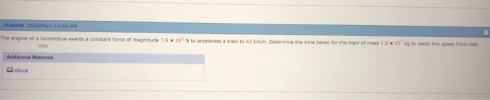 1 53 WA e exerts a constant force of magnitude 7.9 x 10 N to accelerate a train to 62 km/h. Determine the time taken for the train of mass 1.8 x 10 kg to reach this Additional Materials eBook
A train locomotive pulls a train with a mass of 1.30 ✕ 107 kg on level...
A train locomotive pulls a train with a mass of 1.30 ✕ 107 kg on level rails. The locomotive exerts a constant force of 7.40 ✕ 105 N on the train. How much time does it take to increase the speed of the train from rest to 64.0 km/h? (Ignore any resistance force from the rails on the wheels of the train. Enter your answer in minutes.) ______min
A freight train has a mass of 1.4 ✕ 107 kg. If the locomotive can exert...
A freight train has a mass of 1.4 ✕ 107 kg. If the locomotive can exert a constant pull of 7.1 ✕ 105 N, how long does it take to increase the speed of the train from rest to 88 km/h? (minutes)
A locomotive of mass m= 1.134 X 10⁵ kg uses 37.8 kW of power to accelerate...
A locomotive of mass m= 1.134 X 10⁵ kg uses 37.8 kW of power to accelerate at a constant rate for 15.0 s. a) The locomotive has an initial velocity of 0.500 m/s east. Calculate the locomotive’s speed after 15.0 s. After 15.0 s, the locomotive travels east at a constant speed and then collides and couples with a train of four cars. Each of the cars has half the mass of the locomotive. Before the collision, the train was...
Problem (4) A locomotive exerts a force on a train of three cars of masses 9,570...
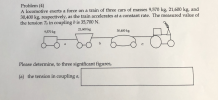 Problem (4) A locomotive exerts a force on a train of three cars of masses 9,570 kg, 21,600 kg, and 30,400 kg, respectively, as the train accelerates at a constant rate. The measured value of the tension Ty in coupling b is 35,700 N. 21,600 kg 9,570 kg 30,400 kg 5o. 5o. A Please determine, to three significant figures, (a) the tension in coupling a,
A jet aircraft with a mass of 4,475 kg has an engine that exerts a force...
A jet aircraft with a mass of 4,475 kg has an engine that exerts a force (thrust) equal to 60,200 N. (a) What is the jet's acceleration? (Give the magnitude.) (b)What is the jet's speed after it accelerates for 7 s? (Assume it starts from rest.) (c) How far does the jet travel during the 7 s?
A jet aircraft with a mass of 4,675 kg has an engine that exerts a force...
A jet aircraft with a mass of 4,675 kg has an engine that exerts a force (thrust) equal to 59,500 N. (a) What is the jet's acceleration when it takes off? (Give the magnitude.) m/s2 (b)What is the jet's speed after it accelerates for 9 s? (Assume it starts from rest.) m/s (c) How far does the jet travel during the 9 s? m
A train (engine and car fully loaded) has total mass of 10500 metric tons (1 metric...
A train (engine and car fully loaded) has total mass of 10500 metric tons (1 metric ton = 2000kg). if the train starts at rest and takes 10 minutes to reach speed of 22 m/s what traction force must the locomotive engine average over that time?
 1 53 WA e exerts a constant force of magnitude 7.9 x 10 N to accelerate a train to 62 km/h. Determine the time taken for the train of mass 1.8 x 10 kg to reach this Additional Materials eBook
 Problem (4) A locomotive exerts a force on a train of three cars of masses 9,570 kg, 21,600 kg, and 30,400 kg, respectively, as the train accelerates at a constant rate. The measured value of the tension Ty in coupling b is 35,700 N. 21,600 kg 9,570 kg 30,400 kg 5o. 5o. A Please determine, to three significant figures, (a) the tension in coupling a,
Most questions answered within 3 hours.
-
Where is the error in this code sequence?
String s1 = "Hello";
String s2 = "ello";...
asked 11 months ago -
Financial data for Joel de Paris, Inc., for last year
follow:
Joel de Paris, Inc.
Balance...
asked 11 months ago -
Consider this reaction:
Al2(SO4)3 (aq)+ BaCl3
(aq) Al2Cl6 (aq)- +
3BaSO4(s) . What is the...
asked 11 months ago -
Suppose that Savneet is considering increasing her
recent random sample from 20 car rentals to 40...
asked 11 months ago -
Trucks arrive at an unloading terminal at an average rate of 120
per hour.
Trucks arrive...
asked 11 months ago -
Why are methanol and ethanol completely soluble in water while
octanol is not very little soluble....
asked 11 months ago -
A facilities manager at a university reads in a research report
that the mean amount of...
asked 11 months ago -
When the CuSO4 is rehydrated by adding water to the anhydrous
compound, is this an endothermic...
asked 11 months ago -
A ray of sunlight is passing from diamond into crown glass; the
angle of incidence is...
asked 11 months ago -
A block of mass 0.249 kg is placed on top of a light, vertical
spring of...
asked 11 months ago -
how do the kidneys compensate in the presences of acidosis
a) trigger hyperventilate
b) reserve acid...
asked 11 months ago -
Question 501 pts
The rental rate of capital to the firm increases. Which of the
following...
asked 11 months ago