Write a User Defined Function in Matlab solve for the roots of a function using bisection...
Write a User Defined Function in Matlab solve for the roots of a function using bisection method. The user provides two variables for the function to test and bisect if needed.
Homework Answers
CODE
function root= bisection(fun, lb, ub,iter_max, Emax)
flb=fun(lb); % find the f(lb) value
fub=fun(ub); % find the f(ub) value
i=0; % the initial iteration
%Check if you have already found the solution
if flb==0
root=lb;
fprintf('The root is: %5.3f \n', root)
return
end
if fub==0
root=ub;
fprintf('The root is: %5.3f \n', root)
return
end
%now to test if there is a root within the uppper and lower
limits
if flb*fub>0
disp('termination type 1: there is no root within bracket')
root=NaN;
return
end
%solution guess
root= (lb+ub)/2;
for i=1:iter_max
rootPrevious=root;
fxr=fun(root);
if i >= iter_max
disp('termination type 0: algorithm terminated due to maximum
interations')
break
elseif fxr==0 % test if this is the case where root is directly the
root
disp('this is the root')
break
end
% if none of above is met, then process the commands below
if fxr*flb>0
lb=root;
else
ub=root;
end
root= (lb+ub)/2;
error=abs((root-rootPrevious)/root);
if error<Emax
break
end
end
fprintf('The iterations taken is: %d \n', i)
fprintf('The root is: %5.3f \n', root)
Add Answer to:
Write a User Defined Function in Matlab solve
for the roots of a function using bisection...
Using MATLAB and bisection Find the first 10 roots of the function y(x) = cos(5x). Note...
Using MATLAB and bisection Find the first 10 roots of the function y(x) = cos(5x). Note you will need to have a script file that steps along the x-axis and calls bisect when a root bracket is found.
3. Use the bisection MATLAB program to estimate the roots of the function k(x) = x2...
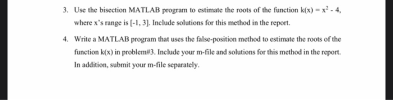 3. Use the bisection MATLAB program to estimate the roots of the function k(x) = x2 - 4, where x's range is [-1, 3). Include solutions for this method in the report. 4. Write a MATLAB program that uses the false-position method to estimate the roots of the function k(x) in problem#3. Include your m-file and solutions for this method in the report. In addition, submit your m-file separately.
#6 Write a Matlab program that finds numerically all the roots (or the zeros) of the...
#6 Write a Matlab program that finds numerically all the roots (or the zeros) of the algebraic equation below in the interval 1.0 <=x<=3.0: sqrt(log(x^2+1))=x^2*sin(e^x)+2 Part a) Prompt the user to enter a positive integer number n, defined the range 2<=n<=15, and then verify if the number entered lies within the specifications. Your program must allow the user to reenter the number without the need to rerun the program. Part b) Create a user-defined function for the bisection method(see details...
Solve in Matlab by using Script file: Problem 4: Write a user-defined MATLAB unction that calculates...
 Solve in Matlab by using Script file:
Problem 4: Write a user-defined MATLAB unction that calculates the determinant of a 3x3 matrix by using the formula: A22 A23 11 A32 A33 A23 A12 A31 A33 21 A For the function name and arguments use d3-det3by3 (A), where the input argument A is the matrix and the output argument d3 is the value of the determinant. Write the code of det3by3 such that it has a subfunction that calculates the 2x2...
Solve in Matlab by using Script file:
Problem 4: Write a user-defined MATLAB unction that calculates the determinant of a 3x3 matrix by using the formula: A22 A23 11 A32 A33 A23 A12 A31 A33 21 A For the function name and arguments use d3-det3by3 (A), where the input argument A is the matrix and the output argument d3 is the value of the determinant. Write the code of det3by3 such that it has a subfunction that calculates the 2x2...
Hi, I need help doing this. 3. Use the bisection MATLAB program to estimate the roots...
Hi, I need help doing this. 3. Use the bisection MATLAB program to estimate the roots of the function k(x) = x2 - 4, where x’s range is [-1, 3]. Include solutions for this method in the report. Write a MATLAB program that uses the false-position method to estimate the roots of the function k(x) in problem#3. Include your m-file and solutions for this method in the report. In addition, submit your m-file separately.
Consider the function xtan x -1 defined over all x. Sketch the function to get an idea of the roots 1 find the first couple of roots using bisection to a precision of machine epsilon 2 after straddli...
 Consider the function xtan x -1 defined over all x. Sketch the function to get an idea of the roots 1 find the first couple of roots using bisection to a precision of machine epsilon 2 after straddling a root, find its value using the Newton-Raphson method. 3 after straddling a root, find its value using the secant method 4 after straddling a root, find its value using the false position method. Determine the order of the methods and comment...
please solve in matlab 1[35p) Write a user-defined MATLAB function that determines the unit vector in...
 please solve in matlab
1[35p) Write a user-defined MATLAB function that determines the unit vector in the direction of the line that connects two points (A and B) in space. For the func- tion name and arguments, use n = unitvec (A,B). The input to the function are two vectors A and B, each with the Cartesian coordinates of the corre- sponding point. The output is a vector with the components of the unit vector Join the direction from A...
please solve in matlab
1[35p) Write a user-defined MATLAB function that determines the unit vector in the direction of the line that connects two points (A and B) in space. For the func- tion name and arguments, use n = unitvec (A,B). The input to the function are two vectors A and B, each with the Cartesian coordinates of the corre- sponding point. The output is a vector with the components of the unit vector Join the direction from A...
Question 1: Creating a user-defined function Write a user-defined MATLAB function named PBTask4pl_f.m for the following...
 Question 1: Creating a user-defined function Write a user-defined MATLAB function named PBTask4pl_f.m for the following math function with x the input argument and y the output y(x)=0.8x4-13x2-5x The function should work for x being a scalar or a vector. Write a script file named PBTask4pl.m to a) Use the function to calculate y(3) and y(5) and display the results in command window b) Use the function to make a plot of the function y(x) for -5:5: x 5:5. Label...
Write a MATLAB function that can be used by a user to perform polynomial interpolation using...
Write a MATLAB function that can be used by a user to perform polynomial interpolation using Lagrange Interpolation Method on a set of data.
Matlab Question. Please be detailed Write a user-defined function that performs LU decomposition (using Gauss Elimination...
Matlab Question. Please be detailed Write a user-defined function that performs LU decomposition (using Gauss Elimination without partial pivoting) of a square matrix. Do not use built-in MATLAB functions lu( ), inv(), \, linsolve(). Matrices (in [A]*{x}={B} form) A=[15 -3 -1; -3 15 -6; -4 -1 12] B=[3800; 1200; 2350] Given code lines: function[L,U]=myLUFact_username(A) [m,n]=size(A); %numbers of rows/comlumns of A assert(m==n, 'A should be a square matrix');
 3. Use the bisection MATLAB program to estimate the roots of the function k(x) = x2 - 4, where x's range is [-1, 3). Include solutions for this method in the report. 4. Write a MATLAB program that uses the false-position method to estimate the roots of the function k(x) in problem#3. Include your m-file and solutions for this method in the report. In addition, submit your m-file separately.
 Solve in Matlab by using Script file:
Problem 4: Write a user-defined MATLAB unction that calculates the determinant of a 3x3 matrix by using the formula: A22 A23 11 A32 A33 A23 A12 A31 A33 21 A For the function name and arguments use d3-det3by3 (A), where the input argument A is the matrix and the output argument d3 is the value of the determinant. Write the code of det3by3 such that it has a subfunction that calculates the 2x2...
Solve in Matlab by using Script file:
Problem 4: Write a user-defined MATLAB unction that calculates the determinant of a 3x3 matrix by using the formula: A22 A23 11 A32 A33 A23 A12 A31 A33 21 A For the function name and arguments use d3-det3by3 (A), where the input argument A is the matrix and the output argument d3 is the value of the determinant. Write the code of det3by3 such that it has a subfunction that calculates the 2x2...
 Consider the function xtan x -1 defined over all x. Sketch the function to get an idea of the roots 1 find the first couple of roots using bisection to a precision of machine epsilon 2 after straddling a root, find its value using the Newton-Raphson method. 3 after straddling a root, find its value using the secant method 4 after straddling a root, find its value using the false position method. Determine the order of the methods and comment...
 please solve in matlab
1[35p) Write a user-defined MATLAB function that determines the unit vector in the direction of the line that connects two points (A and B) in space. For the func- tion name and arguments, use n = unitvec (A,B). The input to the function are two vectors A and B, each with the Cartesian coordinates of the corre- sponding point. The output is a vector with the components of the unit vector Join the direction from A...
please solve in matlab
1[35p) Write a user-defined MATLAB function that determines the unit vector in the direction of the line that connects two points (A and B) in space. For the func- tion name and arguments, use n = unitvec (A,B). The input to the function are two vectors A and B, each with the Cartesian coordinates of the corre- sponding point. The output is a vector with the components of the unit vector Join the direction from A...
 Question 1: Creating a user-defined function Write a user-defined MATLAB function named PBTask4pl_f.m for the following math function with x the input argument and y the output y(x)=0.8x4-13x2-5x The function should work for x being a scalar or a vector. Write a script file named PBTask4pl.m to a) Use the function to calculate y(3) and y(5) and display the results in command window b) Use the function to make a plot of the function y(x) for -5:5: x 5:5. Label...
Most questions answered within 3 hours.
-
Where is the error in this code sequence?
String s1 = "Hello";
String s2 = "ello";...
asked 11 months ago -
Financial data for Joel de Paris, Inc., for last year
follow:
Joel de Paris, Inc.
Balance...
asked 11 months ago -
Consider this reaction:
Al2(SO4)3 (aq)+ BaCl3
(aq) Al2Cl6 (aq)- +
3BaSO4(s) . What is the...
asked 11 months ago -
Suppose that Savneet is considering increasing her
recent random sample from 20 car rentals to 40...
asked 11 months ago -
Trucks arrive at an unloading terminal at an average rate of 120
per hour.
Trucks arrive...
asked 11 months ago -
Why are methanol and ethanol completely soluble in water while
octanol is not very little soluble....
asked 11 months ago -
A facilities manager at a university reads in a research report
that the mean amount of...
asked 11 months ago -
When the CuSO4 is rehydrated by adding water to the anhydrous
compound, is this an endothermic...
asked 11 months ago -
A ray of sunlight is passing from diamond into crown glass; the
angle of incidence is...
asked 11 months ago -
A block of mass 0.249 kg is placed on top of a light, vertical
spring of...
asked 11 months ago -
how do the kidneys compensate in the presences of acidosis
a) trigger hyperventilate
b) reserve acid...
asked 11 months ago -
Question 501 pts
The rental rate of capital to the firm increases. Which of the
following...
asked 11 months ago