An ideal gas is enclosed in a cylinder with a movable piston on top of it....
An ideal gas is enclosed in a cylinder with a movable piston on top of it. The piston has a mass of 8,000 g and an area of 5.00 cm2 and is free to slide up and down, keeping the pressure of the gas constant.
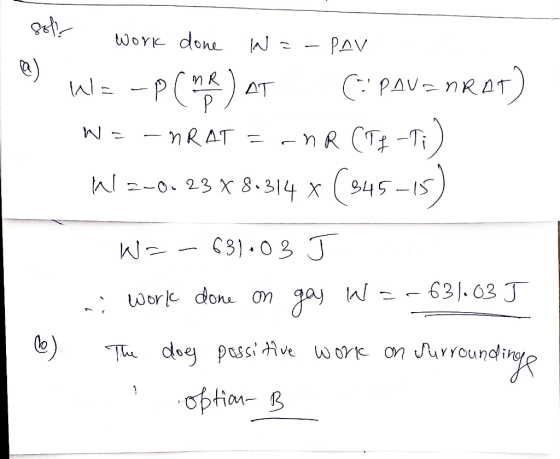
(a) How much work is done on the gas as the temperature of 0.230 mol of the gas is raised from 15.0°C to 345°C?
__________________J
(b) What does the sign of your answer to part (a) indicate?
A. There is no work done, by the gas or the surroundings.
B. The gas does positive work on its surroundings.
C. The surroundings do positive work on the gas.
Homework Answers
Request: Dear sir/madam, Please rate it. It will help to improve my CF score. Please thanks in advance.
Add Answer to:
An ideal gas is enclosed in a cylinder with a movable piston on
top of it....
An ideal gas is enclosed in a cylinder with a movable piston on top of it....
 An ideal gas is enclosed in a cylinder with a movable piston on top of it. The piston has a mass of 8,000 g and an area of 5.00 cm2 and is free to slide up and down, keeping the pressure of the gas constant. (a) How much work is done on the gas as the temperature of 0.280 mol of the gas is raised from 15.0°C to 270°c? (b) What does the sign of your answer to part (a)...
An ideal gas is enclosed in a cylinder with a movable piston on top of it....
An ideal gas is enclosed in a cylinder with a movable piston on top of it. The piston has a mass of 8,000 g and an area of 5.00 cm2 and is free to slide up and down, keeping the pressure of the gas constant. (a) How much work is done on the gas as the temperature of 0.180 mol of the gas is raised from 25.0°C to 310°C? J (b) What does the sign of your answer to part...
An ideal gas is enclosed in a cylinder with a movable piston on top of it....
 An ideal gas is enclosed in a cylinder with a movable piston on top of it. The piston has a mass of 8,000 g and an area of 5.00 cm2 and is free to slide up and down, keeping the pressure of the gas constant. (a) How much work is done on the gas as the temperature of 0.130 mol of the gas is raised from 15.0°C to 350°C? (b) What does the sign of your answer to part (a)...
An ideal gas is enclosed in a cylinder that has a movable piston on top. The...
An ideal gas is enclosed in a cylinder that has a movable piston on top. The piston has a mass 17g and an area 30 cm2 and is free to slide up and down, keeping the pressure of the gas constant. How much work is done on the gas as the temperature of 8.5 mol of the gas is raised from 32 °C to 64 °C? State your answer to nearest 1 J, R=8.31 JK-1mol-1and take the absolute zero to...
1) An ideal gas is enclosed in a cylinder with a movable piston on top of...
 1) An ideal gas is enclosed in a cylinder with a movable piston
on top of it. The piston has a mass of 8,000 g and an area of 5.00
cm2 and is free to slide up and down, keeping the pressure of the
gas constant. (a) How much work is done on the gas
as the temperature of 0.105 mol of the gas is raised from 10.0°C to
260°C? J b) What does the sign of your answer to...
1) An ideal gas is enclosed in a cylinder with a movable piston
on top of it. The piston has a mass of 8,000 g and an area of 5.00
cm2 and is free to slide up and down, keeping the pressure of the
gas constant. (a) How much work is done on the gas
as the temperature of 0.105 mol of the gas is raised from 10.0°C to
260°C? J b) What does the sign of your answer to...
A movable piston traps 0.205 moles of an ideal gas in a vertical cylinder. As the...
A movable piston traps 0.205 moles of an ideal gas in a vertical cylinder. As the temperature of the gas is decreased from 511 ◦C to 24.0◦C, the piston slides without friction, reducing the volume of the gas so that its pressure remains constant. Find the work (J) done on the gas in the piston. Hint: Use the ideal gas law to change W = −P∆V to an expression using n and T. Be sure to include the sign of...
A sample of gas is placed into an enclosed cylinder and fitted with a movable piston....
A sample of gas is placed into an enclosed cylinder and fitted with a movable piston. Calculate the work (in joules) done by the gas if it expands from 5.06 L to 17.68 L against a pressure of 2.077 atm. Answer in scientific notation using 3 significant figures.
A sample of gas is placed into an enclosed cylinder and fitted with a movable piston....
A sample of gas is placed into an enclosed cylinder and fitted with a movable piston. Calculate the work (in joules) done by the gas if it expands from 4.23 L to 14.58 L against a pressure of 5.429 atm. Answer in scientific notation using 3 significant figures.
D. An ideal gas is contained in a cylinder that is fixed in Ideal gas place....
 D. An ideal gas is contained in a cylinder that is fixed in Ideal gas place. The cylinder is closed by a piston, as shown in the diagram at right. There is no friction between the piston and the cylinder walls. 1. Describe the direction of the force that the piston exerts on the gas. Does your answer depend on whether the piston is moving? 2. How could the piston move so that the work it does on the gas...
24. Suppose that an ideal gas is inside a container with a movable piston. Which of...
 24. Suppose that an ideal gas is inside a container with a movable piston. Which of the following statements is true? 1) Increasing the temperature of the system while keeping the volume constant causes the gas to perform work. 2) When work is done by the system on the surroundings while temperature is kept constant, the pressure of the gas increases. 3) If temperature is kept constant, then decreasing the pressure of the gas causes a increase in volume 4)...
 An ideal gas is enclosed in a cylinder with a movable piston on top of it. The piston has a mass of 8,000 g and an area of 5.00 cm2 and is free to slide up and down, keeping the pressure of the gas constant. (a) How much work is done on the gas as the temperature of 0.280 mol of the gas is raised from 15.0°C to 270°c? (b) What does the sign of your answer to part (a)...
 An ideal gas is enclosed in a cylinder with a movable piston on top of it. The piston has a mass of 8,000 g and an area of 5.00 cm2 and is free to slide up and down, keeping the pressure of the gas constant. (a) How much work is done on the gas as the temperature of 0.130 mol of the gas is raised from 15.0°C to 350°C? (b) What does the sign of your answer to part (a)...
 1) An ideal gas is enclosed in a cylinder with a movable piston
on top of it. The piston has a mass of 8,000 g and an area of 5.00
cm2 and is free to slide up and down, keeping the pressure of the
gas constant. (a) How much work is done on the gas
as the temperature of 0.105 mol of the gas is raised from 10.0°C to
260°C? J b) What does the sign of your answer to...
1) An ideal gas is enclosed in a cylinder with a movable piston
on top of it. The piston has a mass of 8,000 g and an area of 5.00
cm2 and is free to slide up and down, keeping the pressure of the
gas constant. (a) How much work is done on the gas
as the temperature of 0.105 mol of the gas is raised from 10.0°C to
260°C? J b) What does the sign of your answer to...
 D. An ideal gas is contained in a cylinder that is fixed in Ideal gas place. The cylinder is closed by a piston, as shown in the diagram at right. There is no friction between the piston and the cylinder walls. 1. Describe the direction of the force that the piston exerts on the gas. Does your answer depend on whether the piston is moving? 2. How could the piston move so that the work it does on the gas...
 24. Suppose that an ideal gas is inside a container with a movable piston. Which of the following statements is true? 1) Increasing the temperature of the system while keeping the volume constant causes the gas to perform work. 2) When work is done by the system on the surroundings while temperature is kept constant, the pressure of the gas increases. 3) If temperature is kept constant, then decreasing the pressure of the gas causes a increase in volume 4)...
Most questions answered within 3 hours.
-
Where is the error in this code sequence?
String s1 = "Hello";
String s2 = "ello";...
asked 11 months ago -
Financial data for Joel de Paris, Inc., for last year
follow:
Joel de Paris, Inc.
Balance...
asked 11 months ago -
Consider this reaction:
Al2(SO4)3 (aq)+ BaCl3
(aq) Al2Cl6 (aq)- +
3BaSO4(s) . What is the...
asked 11 months ago -
Suppose that Savneet is considering increasing her
recent random sample from 20 car rentals to 40...
asked 11 months ago -
Trucks arrive at an unloading terminal at an average rate of 120
per hour.
Trucks arrive...
asked 11 months ago -
Why are methanol and ethanol completely soluble in water while
octanol is not very little soluble....
asked 11 months ago -
A facilities manager at a university reads in a research report
that the mean amount of...
asked 11 months ago -
When the CuSO4 is rehydrated by adding water to the anhydrous
compound, is this an endothermic...
asked 11 months ago -
A ray of sunlight is passing from diamond into crown glass; the
angle of incidence is...
asked 11 months ago -
A block of mass 0.249 kg is placed on top of a light, vertical
spring of...
asked 11 months ago -
how do the kidneys compensate in the presences of acidosis
a) trigger hyperventilate
b) reserve acid...
asked 11 months ago -
Question 501 pts
The rental rate of capital to the firm increases. Which of the
following...
asked 11 months ago