Most firms face external environments that are highly turbulent, complex and global. How do managers in...
Most firms face external environments that are highly turbulent, complex and global. How do managers in boundary–spanning positions obtain information to analyze global industry/ market changes and trends? Give example of any one industry/market i.e. global auto industry. ( Not less than 1000 words )
Guide Lines
- Porters’ diamond theory
- Competitiveness of nation diamond theory
- Competitiveness of industry 5 forces
- Give both diagrams and then explain
- Give examples based on hospitality industry, comparison will give you how competitive they are
Homework Answers
Analysis of environment is a strategic tool, we can easily identify all internal and external elements through this process. This analysis helps to assess the level of threat and opportunities. Here we are taking example of auto industry MARUTI SUZUKI.
We will explain this example with the help of Porter's 5 forces model for industry competitiveness.
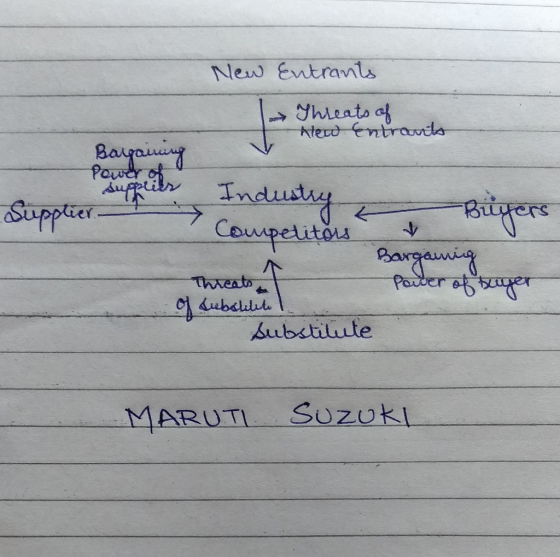
Maruti Suzuki is the one of the leading car manufacturing organisation which have many competitor. In 1982, Government of India enters into joint venture with Japan's company Suzuki motors corporation.
RIVALRY WITH THE INDUSTRY
1. New multinational competitors may be neters in the market
2. Increase in competition in selective market segment.
THREATS
1. Need more financial strenght and working capital as it needs enginea and high building capacity.
2. More players are enters in Market and more players are yet to come.
MARKET STRENGHTH OF SUPPLIER
1. Large number of components suppliers are available which gives strength to organisation
2. Improvement in models and variants of their cars.
MARKET STRENGTH OF CONSUMERS
1. Large numbee of consumen awareness
2. Prices of cars matters among the customers
THREATS FROM SUBSTITUTE
1. Preference from consumers are changing (mini cars are used instaed of mid size cars)
2. Launching of sports car in same prices increased competition
3. Lacking in competitive advantage.
Major Competitors
1. Honda
2. Hyundai
3.TATA
4. Ford
Add Answer to:
Most firms face external environments that are highly turbulent,
complex and global. How do managers in...
Risk management in Information Security today Everyday information security professionals are bombarded with marketing messages around...
Risk management in Information Security today Everyday information security professionals are bombarded with marketing messages around risk and threat management, fostering an environment in which objectives seem clear: manage risk, manage threat, stop attacks, identify attackers. These objectives aren't wrong, but they are fundamentally misleading.In this session we'll examine the state of the information security industry in order to understand how the current climate fails to address the true needs of the business. We'll use those lessons as a foundation...
Most questions answered within 3 hours.
-
Where is the error in this code sequence?
String s1 = "Hello";
String s2 = "ello";...
asked 10 months ago -
Financial data for Joel de Paris, Inc., for last year
follow:
Joel de Paris, Inc.
Balance...
asked 10 months ago -
Consider this reaction:
Al2(SO4)3 (aq)+ BaCl3
(aq) Al2Cl6 (aq)- +
3BaSO4(s) . What is the...
asked 10 months ago -
Suppose that Savneet is considering increasing her
recent random sample from 20 car rentals to 40...
asked 10 months ago -
Trucks arrive at an unloading terminal at an average rate of 120
per hour.
Trucks arrive...
asked 10 months ago -
Why are methanol and ethanol completely soluble in water while
octanol is not very little soluble....
asked 10 months ago -
A facilities manager at a university reads in a research report
that the mean amount of...
asked 10 months ago -
When the CuSO4 is rehydrated by adding water to the anhydrous
compound, is this an endothermic...
asked 10 months ago -
A ray of sunlight is passing from diamond into crown glass; the
angle of incidence is...
asked 10 months ago -
A block of mass 0.249 kg is placed on top of a light, vertical
spring of...
asked 10 months ago -
how do the kidneys compensate in the presences of acidosis
a) trigger hyperventilate
b) reserve acid...
asked 10 months ago -
Question 501 pts
The rental rate of capital to the firm increases. Which of the
following...
asked 10 months ago