How would longer stops affect his average velocity?
How would longer stops affect his average velocity?
Homework Answers
The average velocity=(u+v)/2 where u is the initial velocity and v is the final velocity, in this case zero.
Therefore average velocity=u/2.
Since average velocity depends only on the initial velocity longer or shorter stops do not affect it.
Bob drives his car 119 km [N], then he stops to get gas. Then he drives...
 Bob drives his car 119 km [N], then he stops to get gas. Then he drives his car 169 km [E], and stops to eat doughnuts. The he drives his car 279 km [S], and his journey ends. Bob's trip is completed in a time of 9.61 hours. The mass of his car is 1617 kg. What is the magnitude of Bob's average velocity in km/h and the direction?
A bear runs at John with a velocity of 12m/s. John stops the bear by pushing...
A bear runs at John with a velocity of 12m/s. John stops the bear by pushing on it for 2 seconds in a motion opposing the bear’s. If the bear weighs 200kg, what average force is needed to stop the bear? Answer: -1200N The answer is given, but I would like to know how to do this problem.
When FDR closed the banks during his declared "banking holiday" how would it affect the aggreagte...
When FDR closed the banks during his declared "banking holiday" how would it affect the aggreagte demand?
Page |2 3. A marathoner runs due east for 61.5% of the time, stops and rests...
 Page |2 3. A marathoner runs due east for 61.5% of the time, stops and rests for 6.5% of the time, and then runs due west for remainder of the time. The average eastward velocity has magnitude 12.5 miles/hour while the average westward velocity has a magnitude of 11.0 miles per hour. Find (a) the average speed, and (b) the average velocity for the entire race. (c) How far did he run for a total time 2 hours 20 min...
From his house, Jack bikes at a constant velocity of 8.5 m/s {east} for 40 seconds....
From his house, Jack bikes at a constant velocity of 8.5 m/s {east} for 40 seconds. He suddenly stops and takes a 10 second break. Then he heads south at a constant acceleration of 1.3 m/s/s {south} for 7.0 seconds. Determine his average velocity for the entire trip
v-O [al b) A driver engages in a collision with a wall, where his car stops...
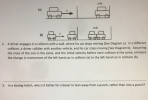 v-O [al b) A driver engages in a collision with a wall, where his car stops moving [See Diagram a]. In a different collision, a driver collides with another vehicle, and his car stops moving [See Diagram b]. Assuming the mass of the cars is the same, and the initial velocity before each collision is the same, compare the change in momentum of the left-hand car in collision (a) to the left-hand car in collision (b). 2. 3. In a...
How would a downward change in the money supply affect you personally? How would it affect...
How would a downward change in the money supply affect you personally? How would it affect your career? What impact would rational expectations have on your decisions in this situation?
A bus travels 280 km south along a straight path with an average velocity of 88 km/h to the south
A bus travels 280 km south along a straight path with an average velocity of 88 km/h to the south. The bus stops for 24 min, then it travels 210 km south with an average of 75 km/h to the south.a. How long does the total trip last?b. What is the average velocity for the total trip?
Bill laid on his back sunbathing. Describe how his body posture/position affect his respiration in terms...
Bill laid on his back sunbathing. Describe how his body posture/position affect his respiration in terms of (1) abdominal breathing (2) lung volume and (3) inspiration. What forces are involved in passive expiration?
When Matt turned 25 he invested $2,500 in his retirement account for 10 years and stops....
When Matt turned 25 he invested $2,500 in his retirement account for 10 years and stops. He earns an 8% return. Clay invests $2,500 from age 36-65 (30 years) and stops. He earns the same 8% return. How much money will each of then have at age 65? Who has more money and by how much?
 Bob drives his car 119 km [N], then he stops to get gas. Then he drives his car 169 km [E], and stops to eat doughnuts. The he drives his car 279 km [S], and his journey ends. Bob's trip is completed in a time of 9.61 hours. The mass of his car is 1617 kg. What is the magnitude of Bob's average velocity in km/h and the direction?
 Page |2 3. A marathoner runs due east for 61.5% of the time, stops and rests for 6.5% of the time, and then runs due west for remainder of the time. The average eastward velocity has magnitude 12.5 miles/hour while the average westward velocity has a magnitude of 11.0 miles per hour. Find (a) the average speed, and (b) the average velocity for the entire race. (c) How far did he run for a total time 2 hours 20 min...
 v-O [al b) A driver engages in a collision with a wall, where his car stops moving [See Diagram a]. In a different collision, a driver collides with another vehicle, and his car stops moving [See Diagram b]. Assuming the mass of the cars is the same, and the initial velocity before each collision is the same, compare the change in momentum of the left-hand car in collision (a) to the left-hand car in collision (b). 2. 3. In a...
Most questions answered within 3 hours.
-
Where is the error in this code sequence?
String s1 = "Hello";
String s2 = "ello";...
asked 10 months ago -
Financial data for Joel de Paris, Inc., for last year
follow:
Joel de Paris, Inc.
Balance...
asked 10 months ago -
Consider this reaction:
Al2(SO4)3 (aq)+ BaCl3
(aq) Al2Cl6 (aq)- +
3BaSO4(s) . What is the...
asked 10 months ago -
Suppose that Savneet is considering increasing her
recent random sample from 20 car rentals to 40...
asked 10 months ago -
Trucks arrive at an unloading terminal at an average rate of 120
per hour.
Trucks arrive...
asked 10 months ago -
Why are methanol and ethanol completely soluble in water while
octanol is not very little soluble....
asked 10 months ago -
A facilities manager at a university reads in a research report
that the mean amount of...
asked 10 months ago -
When the CuSO4 is rehydrated by adding water to the anhydrous
compound, is this an endothermic...
asked 10 months ago -
A ray of sunlight is passing from diamond into crown glass; the
angle of incidence is...
asked 10 months ago -
A block of mass 0.249 kg is placed on top of a light, vertical
spring of...
asked 10 months ago -
how do the kidneys compensate in the presences of acidosis
a) trigger hyperventilate
b) reserve acid...
asked 10 months ago -
Question 501 pts
The rental rate of capital to the firm increases. Which of the
following...
asked 10 months ago