Show explicitly, using FP transmission equation, that the finesse of FP is F = √R/(1-R)
Show explicitly, using FP transmission equation, that the finesse of FP is F = √R/(1-R)
Homework Answers

Add Answer to:
Show explicitly, using FP transmission equation, that the
finesse of FP is F = √R/(1-R)
1. Show how to explicitly solve the recurrence equation below (that is, do not simply quote the M...
 1. Show how to explicitly solve the recurrence equation below (that is, do not simply quote the Master theorem). T(n) T(n/2) +n2, T(1) 1
1. Show how to explicitly solve the recurrence equation below (that is, do not simply quote the Master theorem). T(n) T(n/2) +n2, T(1) 1
1. Show how to explicitly solve the recurrence equation below (that is, do not simply quote the Master theorem). T(n) T(n/2) +n2, T(1) 1
1. Using F(r) = -y/r2, show that the equation of motion in a central force, namely...
 1. Using F(r) = -y/r2, show that the equation of motion in a central force, namely a na = -u(0) - EF (), produces the solution u(b) = (-1(1 + e coso) What are the expressions for C and e in terms of the parameters of the problem? 2. Evaluate the entries for the following table for the given values of e (assume l,u,y are known) E (T + U) Pmax/rmin Shape of orbit 0 .5
[24] Suppose f: [a, b] -[0, 00) is Riemann integrable with respect to a. Show fp is also Riemann integrable with res...
 [24] Suppose f: [a, b] -[0, 00) is Riemann integrable with respect to a. Show fp is also Riemann integrable with respect to a over [a, b] for any p> 0.
[24] Suppose f: [a, b] -[0, 00) is Riemann integrable with respect to a. Show fp is also Riemann integrable with respect to a over [a, b] for any p> 0.
[24] Suppose f: [a, b] -[0, 00) is Riemann integrable with respect to a. Show fp is also Riemann integrable with respect to a over [a, b] for any p> 0.
Using Finite element method to show is Dar exist for f(x)-k! + 1. Support f: [-1, 1] →R
 D:derivative
w: weak
using Finite element method to show is Dar exist for f(x)-k! + 1. Support f: [-1, 1] →R
using Finite element method to show is Dar exist for f(x)-k! + 1. Support f: [-1, 1] →R
D:derivative
w: weak
using Finite element method to show is Dar exist for f(x)-k! + 1. Support f: [-1, 1] →R
using Finite element method to show is Dar exist for f(x)-k! + 1. Support f: [-1, 1] →R
Show how to find the absolute max and min using this equation. f(x) = 23 –...
 Show how to find the absolute
max and min using this equation.
f(x) = 23 – 2:02 + 15.r
Show how to find the absolute
max and min using this equation.
f(x) = 23 – 2:02 + 15.r
Q2. Introduction to numerical methods Write out +1 explicitly in terms of r and n using Euler's m...
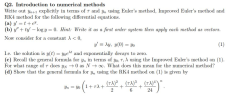 Q2. Introduction to numerical methods Write out +1 explicitly in terms of r and n using Euler's method, Improved Euler's method and RK4 method for the following differential equations (a) y, = t + ey (b) y" + ty'-logy = 0. Hint: Write it as a first order system then apply each method as vectors. Now consider for a constant λ < 0 L.e. the solution is y(t) and exponentially decays to zero. (c) Recall the general formula for yn...
Show that f(t – z/u) and f(t+z/u) are general solutions of the transmission line equations assuming...
Show that f(t – z/u) and f(t+z/u) are general solutions of the transmission line equations assuming that there are no losses ( R=0, G=0). Give the physical interpretation of these solutions. Please show clear work and steps.
Problem 7 (10 Pts) For the converging flow, write the continuity equation and show that V, = f(0)r. Then, write the...
 Problem 7 (10 Pts) For the converging flow, write the continuity equation and show that V, = f(0)r. Then, write the r and components of the Navier-Stokes equations, and put the Vr into the r and 0 components of the Navier- Stokes equations. Lastly, write the no-slip boundary conditions using f(e). You do not need to solve the equations
Problem 7 (10 Pts) For the converging flow, write the continuity equation and show that V, = f(0)r. Then, write the...
Problem 7 (10 Pts) For the converging flow, write the continuity equation and show that V, = f(0)r. Then, write the r and components of the Navier-Stokes equations, and put the Vr into the r and 0 components of the Navier- Stokes equations. Lastly, write the no-slip boundary conditions using f(e). You do not need to solve the equations
Problem 7 (10 Pts) For the converging flow, write the continuity equation and show that V, = f(0)r. Then, write the...
Problem 7 (10 Pts) For the converging flow, write the continuity equation and show that V, = f(e)/r. Then, write the...
 Problem 7 (10 Pts) For the converging flow, write the continuity equation and show that V, = f(e)/r. Then, write the r and e components of the Navier-Stokes equations, and put the Vr into the r and 0 components of the Navier- Stokes equations. Lastly, write the no-slip boundary conditions using f(0). You do not need to solve the equations.
Problem 7 (10 Pts) For the converging flow, write the continuity equation and show that V, = f(e)/r. Then, write...
Problem 7 (10 Pts) For the converging flow, write the continuity equation and show that V, = f(e)/r. Then, write the r and e components of the Navier-Stokes equations, and put the Vr into the r and 0 components of the Navier- Stokes equations. Lastly, write the no-slip boundary conditions using f(0). You do not need to solve the equations.
Problem 7 (10 Pts) For the converging flow, write the continuity equation and show that V, = f(e)/r. Then, write...
Explicitly show that the fourth-order polynomial Airy stress function QL will not satisfy the biharmonic equation...
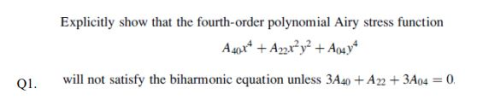 Explicitly show that the fourth-order polynomial Airy stress function QL will not satisfy the biharmonic equation unless 3A40 +A22 + 3A04-0
 1. Show how to explicitly solve the recurrence equation below (that is, do not simply quote the Master theorem). T(n) T(n/2) +n2, T(1) 1
1. Show how to explicitly solve the recurrence equation below (that is, do not simply quote the Master theorem). T(n) T(n/2) +n2, T(1) 1
1. Show how to explicitly solve the recurrence equation below (that is, do not simply quote the Master theorem). T(n) T(n/2) +n2, T(1) 1
 1. Using F(r) = -y/r2, show that the equation of motion in a central force, namely a na = -u(0) - EF (), produces the solution u(b) = (-1(1 + e coso) What are the expressions for C and e in terms of the parameters of the problem? 2. Evaluate the entries for the following table for the given values of e (assume l,u,y are known) E (T + U) Pmax/rmin Shape of orbit 0 .5
 [24] Suppose f: [a, b] -[0, 00) is Riemann integrable with respect to a. Show fp is also Riemann integrable with respect to a over [a, b] for any p> 0.
[24] Suppose f: [a, b] -[0, 00) is Riemann integrable with respect to a. Show fp is also Riemann integrable with respect to a over [a, b] for any p> 0.
[24] Suppose f: [a, b] -[0, 00) is Riemann integrable with respect to a. Show fp is also Riemann integrable with respect to a over [a, b] for any p> 0.
 D:derivative
w: weak
using Finite element method to show is Dar exist for f(x)-k! + 1. Support f: [-1, 1] →R
using Finite element method to show is Dar exist for f(x)-k! + 1. Support f: [-1, 1] →R
D:derivative
w: weak
using Finite element method to show is Dar exist for f(x)-k! + 1. Support f: [-1, 1] →R
using Finite element method to show is Dar exist for f(x)-k! + 1. Support f: [-1, 1] →R
 Show how to find the absolute
max and min using this equation.
f(x) = 23 – 2:02 + 15.r
Show how to find the absolute
max and min using this equation.
f(x) = 23 – 2:02 + 15.r
 Q2. Introduction to numerical methods Write out +1 explicitly in terms of r and n using Euler's method, Improved Euler's method and RK4 method for the following differential equations (a) y, = t + ey (b) y" + ty'-logy = 0. Hint: Write it as a first order system then apply each method as vectors. Now consider for a constant λ < 0 L.e. the solution is y(t) and exponentially decays to zero. (c) Recall the general formula for yn...
 Problem 7 (10 Pts) For the converging flow, write the continuity equation and show that V, = f(0)r. Then, write the r and components of the Navier-Stokes equations, and put the Vr into the r and 0 components of the Navier- Stokes equations. Lastly, write the no-slip boundary conditions using f(e). You do not need to solve the equations
Problem 7 (10 Pts) For the converging flow, write the continuity equation and show that V, = f(0)r. Then, write the...
Problem 7 (10 Pts) For the converging flow, write the continuity equation and show that V, = f(0)r. Then, write the r and components of the Navier-Stokes equations, and put the Vr into the r and 0 components of the Navier- Stokes equations. Lastly, write the no-slip boundary conditions using f(e). You do not need to solve the equations
Problem 7 (10 Pts) For the converging flow, write the continuity equation and show that V, = f(0)r. Then, write the...
 Problem 7 (10 Pts) For the converging flow, write the continuity equation and show that V, = f(e)/r. Then, write the r and e components of the Navier-Stokes equations, and put the Vr into the r and 0 components of the Navier- Stokes equations. Lastly, write the no-slip boundary conditions using f(0). You do not need to solve the equations.
Problem 7 (10 Pts) For the converging flow, write the continuity equation and show that V, = f(e)/r. Then, write...
Problem 7 (10 Pts) For the converging flow, write the continuity equation and show that V, = f(e)/r. Then, write the r and e components of the Navier-Stokes equations, and put the Vr into the r and 0 components of the Navier- Stokes equations. Lastly, write the no-slip boundary conditions using f(0). You do not need to solve the equations.
Problem 7 (10 Pts) For the converging flow, write the continuity equation and show that V, = f(e)/r. Then, write...
 Explicitly show that the fourth-order polynomial Airy stress function QL will not satisfy the biharmonic equation unless 3A40 +A22 + 3A04-0
Most questions answered within 3 hours.
-
Where is the error in this code sequence?
String s1 = "Hello";
String s2 = "ello";...
asked 10 months ago -
Financial data for Joel de Paris, Inc., for last year
follow:
Joel de Paris, Inc.
Balance...
asked 10 months ago -
Consider this reaction:
Al2(SO4)3 (aq)+ BaCl3
(aq) Al2Cl6 (aq)- +
3BaSO4(s) . What is the...
asked 10 months ago -
Suppose that Savneet is considering increasing her
recent random sample from 20 car rentals to 40...
asked 10 months ago -
Trucks arrive at an unloading terminal at an average rate of 120
per hour.
Trucks arrive...
asked 10 months ago -
Why are methanol and ethanol completely soluble in water while
octanol is not very little soluble....
asked 10 months ago -
A facilities manager at a university reads in a research report
that the mean amount of...
asked 10 months ago -
When the CuSO4 is rehydrated by adding water to the anhydrous
compound, is this an endothermic...
asked 10 months ago -
A ray of sunlight is passing from diamond into crown glass; the
angle of incidence is...
asked 10 months ago -
A block of mass 0.249 kg is placed on top of a light, vertical
spring of...
asked 10 months ago -
how do the kidneys compensate in the presences of acidosis
a) trigger hyperventilate
b) reserve acid...
asked 10 months ago -
Question 501 pts
The rental rate of capital to the firm increases. Which of the
following...
asked 10 months ago