A beam of 1 MeV neutrons of intensity 5 x10⁸ neutrons/cm2-sec strikes a thin ? target...
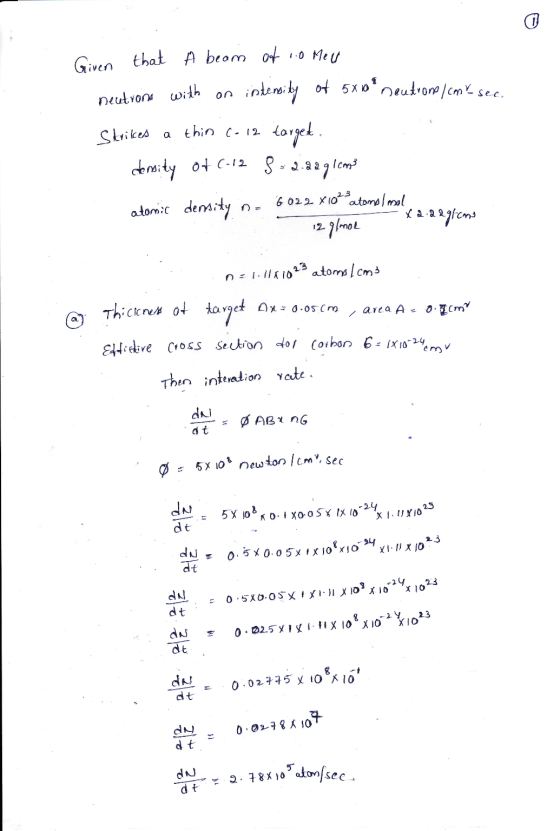
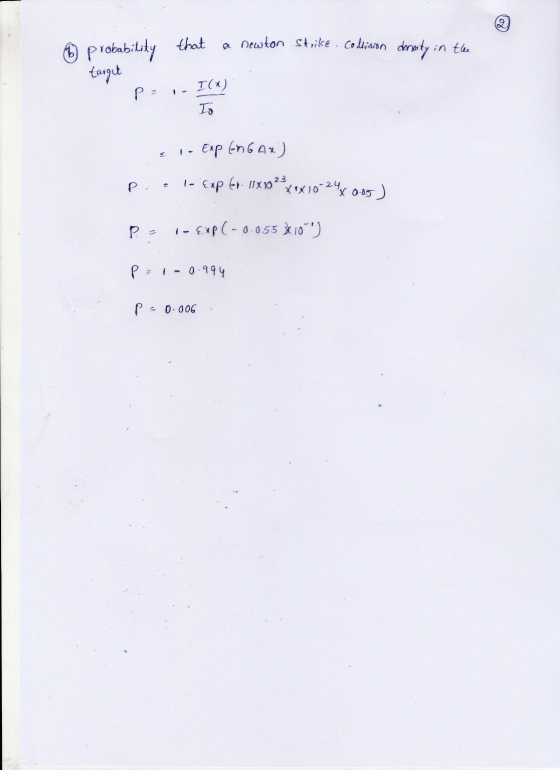
A beam of 1 MeV neutrons of intensity 5 x10⁸ neutrons/cm2-sec strikes a thin ? target of mass of 0.041grams . The area of the target is 0.5 cm2 and is 0.05 cm thick. The beam has a crosssectional area of 0.1 cm2. At 1 MeV, the total cross-section of ? is 2.6 b.
calculate the (a) macroscopic total cross-section of C-12 at 1MeV; (b) collision density in the target.
Homework Answers
Answer:
In contrast to the neutron flux, the neutron intensity is the number of neutrons crossing through some arbitrary cross-sectional unit area in a single direction per unit time (a surface is perpendicular to the direction of the beam). The neutron intensity is a vector quantity.
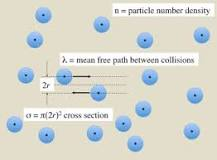
Collision among gas particles
n is the number density of the target particles (SI units: m−3). If the particles in the gas interact by a force with a larger range than their physical size, then the cross section is a larger effective area that may depend on a variety of variables such as the energy of the particles.
The influence of the target density on the charge-changing—ionization and electron capture—cross sections when fast ions penetrate through solid targets is considered. It is shown that, with the target density increasing, electron-capture cross sections decrease and ionization cross sections increase, resulting in a higher mean charge of exit ions after a solid target compared to a gas target
Add Answer to:
A beam of 1 MeV neutrons of intensity 5 x10⁸ neutrons/cm2-sec
strikes a thin ? target...
Suppose we consider a beam of neutrons incident upon a thin target with a flux of...
Suppose we consider a beam of neutrons incident upon a thin target with a flux of 1012 neutrons/cm2-sec. Suppose further that the total cross section for the nuclei in this target is 4 b. Using this information, determine how long one would have to wait, on the average, for a given nucleus in the target to suffer a neutron interaction. I know I am supposed to use the reaction rate of a thin target. just need to see some explain...
A radiation shield is used to attenuate a neutron beam of initial intensity L=1010 [neutrons /...
 A radiation shield is used to attenuate a neutron beam of initial intensity L=1010 [neutrons / (cm².sec)]. If the shield's macroscopic total cross section is , = 0.10 cm-1, what would be the thickness of the shield for attenuating the neutron beam’s intensity by a factor of 1 million (106) times, considering an exponential attenuation of the beam? Using the exponential attenuation law, calculate the e-folding distance (the thickness of a shield that would attenuate a beam of neutrons by...
A beam of 0.4 MeV y-rays with an intensity 108y-rays/cm-s is incident on thin foil of target material having thickness...
 A beam of 0.4 MeV y-rays with an intensity 108y-rays/cm-s is incident on thin foil of target material having thickness 0.2 cm. 95 % of photons pass through the foil without making any interactions. Total energy deposited in the foil is 1.5x10 MeV/cma-s. Determine attenuation and linear absorption coefficients of target material.
In order to determine the macroscopic and microscopic cross section for a certain you set up...
 In order to determine the macroscopic and microscopic cross section for a certain you set up a collimated neutron source on one side and a neutron detector fter single isotope material, on the other. The intensity of the neutron beam is initially 10% neutrons per cm2 per second. A passing through the 3 cm. thick sample, the bean se er of the material is 3.8 grams per cubic centimeter and the molar mass is 8 cond. If the density grams...
Researchers at IBM routinely use 2.50-MeV Het+ ions to analyze thin films using Rutherford backscattering. In...
 Researchers at IBM routinely use 2.50-MeV Het+ ions to analyze thin films using Rutherford backscattering. In a particular experiment, a 2.50-MeV *He ion beam is used to determine the thickness of a pure aluminum, 27AI, film. In this experiment, a surface barrier detector of area 10.0 cm² is placed 130 cm from the target at an angle of 170 degrees. A. Calculate the energy of the scattered 'Het+ ions that reach the detector. B. Calculate the solid angle of the...
2. Cirele the designator in front of the most correct answer from the list following each question or statement. (a) Classically, a particle of mass 1 u that has a kinetic energy of 0.5 MeV has what...
 2. Cirele the designator in front of the most correct answer from the list following each question or statement. (a) Classically, a particle of mass 1 u that has a kinetic energy of 0.5 MeV has what momen- tum? [10 points i. 1.631 x 10⁻²⁰ kg m-1 ii. 1.631 x10⁻¹⁰ kg m s-1 ii. 3.262 x 10⁻²⁰ kg m -1 iv. 3.262 × 10⁻¹⁰ kg m s-1 . 1.00 kg m s-1 (b) What is the mean free path length...
1) Consider an accelerator that collides beams of electrons and protons. The beams actually consist of...
 1) Consider an accelerator that collides beams of electrons and protons. The beams actually consist of bunches of particles, that are traveling essentially at the speed of light. For both the electron and proton beams, the bunche:s are 2 cm long (in the direction of motion) and they are circulating in rings of 300 m circumference. Each ring contains six bunches of protons (or electrons). Each bunch contains 1013 particles. Assume that the particles in the bunches are distributed uniformly...
 A radiation shield is used to attenuate a neutron beam of initial intensity L=1010 [neutrons / (cm².sec)]. If the shield's macroscopic total cross section is , = 0.10 cm-1, what would be the thickness of the shield for attenuating the neutron beam’s intensity by a factor of 1 million (106) times, considering an exponential attenuation of the beam? Using the exponential attenuation law, calculate the e-folding distance (the thickness of a shield that would attenuate a beam of neutrons by...
 A beam of 0.4 MeV y-rays with an intensity 108y-rays/cm-s is incident on thin foil of target material having thickness 0.2 cm. 95 % of photons pass through the foil without making any interactions. Total energy deposited in the foil is 1.5x10 MeV/cma-s. Determine attenuation and linear absorption coefficients of target material.
 In order to determine the macroscopic and microscopic cross section for a certain you set up a collimated neutron source on one side and a neutron detector fter single isotope material, on the other. The intensity of the neutron beam is initially 10% neutrons per cm2 per second. A passing through the 3 cm. thick sample, the bean se er of the material is 3.8 grams per cubic centimeter and the molar mass is 8 cond. If the density grams...
 Researchers at IBM routinely use 2.50-MeV Het+ ions to analyze thin films using Rutherford backscattering. In a particular experiment, a 2.50-MeV *He ion beam is used to determine the thickness of a pure aluminum, 27AI, film. In this experiment, a surface barrier detector of area 10.0 cm² is placed 130 cm from the target at an angle of 170 degrees. A. Calculate the energy of the scattered 'Het+ ions that reach the detector. B. Calculate the solid angle of the...
 2. Cirele the designator in front of the most correct answer from the list following each question or statement. (a) Classically, a particle of mass 1 u that has a kinetic energy of 0.5 MeV has what momen- tum? [10 points i. 1.631 x 10⁻²⁰ kg m-1 ii. 1.631 x10⁻¹⁰ kg m s-1 ii. 3.262 x 10⁻²⁰ kg m -1 iv. 3.262 × 10⁻¹⁰ kg m s-1 . 1.00 kg m s-1 (b) What is the mean free path length...
 1) Consider an accelerator that collides beams of electrons and protons. The beams actually consist of bunches of particles, that are traveling essentially at the speed of light. For both the electron and proton beams, the bunche:s are 2 cm long (in the direction of motion) and they are circulating in rings of 300 m circumference. Each ring contains six bunches of protons (or electrons). Each bunch contains 1013 particles. Assume that the particles in the bunches are distributed uniformly...
Most questions answered within 3 hours.
-
Where is the error in this code sequence?
String s1 = "Hello";
String s2 = "ello";...
asked 11 months ago -
Financial data for Joel de Paris, Inc., for last year
follow:
Joel de Paris, Inc.
Balance...
asked 11 months ago -
Consider this reaction:
Al2(SO4)3 (aq)+ BaCl3
(aq) Al2Cl6 (aq)- +
3BaSO4(s) . What is the...
asked 11 months ago -
Suppose that Savneet is considering increasing her
recent random sample from 20 car rentals to 40...
asked 11 months ago -
Trucks arrive at an unloading terminal at an average rate of 120
per hour.
Trucks arrive...
asked 11 months ago -
Why are methanol and ethanol completely soluble in water while
octanol is not very little soluble....
asked 11 months ago -
A facilities manager at a university reads in a research report
that the mean amount of...
asked 11 months ago -
When the CuSO4 is rehydrated by adding water to the anhydrous
compound, is this an endothermic...
asked 11 months ago -
A ray of sunlight is passing from diamond into crown glass; the
angle of incidence is...
asked 11 months ago -
A block of mass 0.249 kg is placed on top of a light, vertical
spring of...
asked 11 months ago -
how do the kidneys compensate in the presences of acidosis
a) trigger hyperventilate
b) reserve acid...
asked 11 months ago -
Question 501 pts
The rental rate of capital to the firm increases. Which of the
following...
asked 11 months ago