#1 Medical X-Rays are produced by accelerating electrons through a potential difference of 25000 V toward...
#1
Medical X-Rays are produced by accelerating electrons through a potential difference of 25000 V toward a metallic target. Calculate the relativistic velocity of such X-ray producing electrons.
Homework Answers
According to the special relativity,relativistic kinetic energy of an electron accelerated by V volts is given by
( - 1 )
mc2 = eV
- 1 )
mc2 = eV
where m - mass of the electron= 9.1 x 10⁻³¹kg
c - velocity of light = 3 x 10⁸m/s
e - charge of the electron = 1.6 x 10⁻¹⁹ C
V - potential difference = 25000 V
= (1-
v2/c2)-1/2; v - velocity of the
electron
substituting we get
( - 1) x9.1 x
10-31x( 3x10⁸)2 = 1.6 x
10-19 x25000
( - 1) x 8.19 x
10-14 = 4 x 10-15
( - 1) = 4 x
10-15 / 8.19 x 10-14 = 0.049
= 1 + 0.049 =
1.049
(1- v2/c2)-1/2 = 1.049
(1- v2/c2)-1= (1.049)2 = 1.1
(1- v2/c2) = 1/1.1 = 0.91
v2/c2 = 1 - 0.91 = 0.09
v2= c2 x 0.09
v = 0.3 c = 0.3 x 3 x 108 = 9 x 10⁷ m/s
Add Answer to:
#1
Medical X-Rays are produced by accelerating electrons through a
potential difference of 25000 V toward...
What is the minimum wavelength of x-rays produced by electrons accelerated through a potential difference of...
What is the minimum wavelength of x-rays produced by electrons accelerated through a potential difference of 20 000 V?
Problem 16. Find the maximum energy in eV of an x-ray photon produced by electrons accelerated...
 Problem 16. Find the maximum energy in eV of an x-ray photon produced by electrons accelerated through a potential difference of 50.0 kV in a CRT like the one show below. Metal target X rays High- voltage source Vacuum Electrons Heated filament Filament voltage X rays are produced when energetic electrons strike the copper anode of this cathode ray tube (CRT). Electrons (shown here as separate particles) interact individually with the material they strike, sometimes producing photons of EM radiation.
An electron is accelerated from rest through a difference of potential V. a) Show that the...
An electron is accelerated from rest through a difference of potential V. a) Show that the de Broglie wavelength, in unit of angstrom Å (10-10 m), for a non- relativistic electron accelerated through a small potential difference is: λ =12.27/(v)^1/2 b) Calculate λ if the electron is accelerated through 50 V. c) Find the de Broglie wavelength for a relativistic electron that is accelerated from rest through a large difference potential difference at a modern particle collider. d) Show that...
X-ray photons are produced by electrons accelerated through a potential difference of 63 kV. Determine the...
X-ray photons are produced by electrons accelerated through a potential difference of 63 kV. Determine the wavelength of such a photon in nm. Your answer should be a number with four decimal places, do not include unit. 1nm = 10-9 m
a) What is the minimum potential difference between the filament and the target of an X-ray...
a) What is the minimum potential difference between the filament and the target of an X-ray tube if the tube is to accelerate electrons to produce X-rays with a wavelength of 0.477 nm? b) What is the shortest wavelength produced in an X-ray tube operated at 28.0 kV?
10 pts Question 8 X-ray photons are produced by electrons accelerated through a potential difference of...
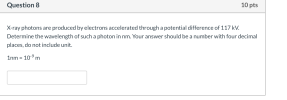 10 pts Question 8 X-ray photons are produced by electrons accelerated through a potential difference of 117 kV. Determine the wavelength of such a photon in nm. Your answer should be a number with four decimal places, do not include unit. 1nm 109 m
Question 8 10 pts X-ray photons are produced by electrons accelerated through a potential difference of...
 Question 8 10 pts X-ray photons are produced by electrons accelerated through a potential difference of 99 kv. Determine the wavelength of such a photon in nm. Your answer should be a number with four decimal places, do not include unit. 1nm = 10-9 m
x rays are produced when: a. electric current flows through the x ray tube filament b....
x rays are produced when: a. electric current flows through the x ray tube filament b. projectile electrons bounch off the cathode c. the outer shell electron binding energy d. the mass of filtration e the orientation of the target
Question 8 10 pts X-ray photons are produced by electrons accelerated through a potential difference of...
 Question 8 10 pts X-ray photons are produced by electrons accelerated through a potential difference of 87 kV. Determine the wavelength of such a photon in nm. Your answer should be a number with four decimal places, do not include unit 1nm = 10.9 m Question 9 10 pts An X-ray photon has a momentum of 4.5 x 10⁻²³ kg m/s. Determine its energy in keV. Your answer should be a number with one decimal place.
The tube in a medical research X-ray unit uses lead (Z=82) as it's target. 1) Use...
The tube in a medical research X-ray unit uses lead (Z=82) as it's target. 1) Use the Bohr model to estimate the minimum kinetic energy electrons must have to in order for Kα X-rays to just appear in the X-ray spectrum of the tube. Ee = 2) Assuming the electrons are accelerated from rest through a voltage, V, what is the minimum voltage necessary to produce the Kα X-rays?
 Problem 16. Find the maximum energy in eV of an x-ray photon produced by electrons accelerated through a potential difference of 50.0 kV in a CRT like the one show below. Metal target X rays High- voltage source Vacuum Electrons Heated filament Filament voltage X rays are produced when energetic electrons strike the copper anode of this cathode ray tube (CRT). Electrons (shown here as separate particles) interact individually with the material they strike, sometimes producing photons of EM radiation.
 10 pts Question 8 X-ray photons are produced by electrons accelerated through a potential difference of 117 kV. Determine the wavelength of such a photon in nm. Your answer should be a number with four decimal places, do not include unit. 1nm 109 m
 Question 8 10 pts X-ray photons are produced by electrons accelerated through a potential difference of 99 kv. Determine the wavelength of such a photon in nm. Your answer should be a number with four decimal places, do not include unit. 1nm = 10-9 m
 Question 8 10 pts X-ray photons are produced by electrons accelerated through a potential difference of 87 kV. Determine the wavelength of such a photon in nm. Your answer should be a number with four decimal places, do not include unit 1nm = 10.9 m Question 9 10 pts An X-ray photon has a momentum of 4.5 x 10⁻²³ kg m/s. Determine its energy in keV. Your answer should be a number with one decimal place.
Most questions answered within 3 hours.
-
Where is the error in this code sequence?
String s1 = "Hello";
String s2 = "ello";...
asked 10 months ago -
Financial data for Joel de Paris, Inc., for last year
follow:
Joel de Paris, Inc.
Balance...
asked 10 months ago -
Consider this reaction:
Al2(SO4)3 (aq)+ BaCl3
(aq) Al2Cl6 (aq)- +
3BaSO4(s) . What is the...
asked 10 months ago -
Suppose that Savneet is considering increasing her
recent random sample from 20 car rentals to 40...
asked 10 months ago -
Trucks arrive at an unloading terminal at an average rate of 120
per hour.
Trucks arrive...
asked 10 months ago -
Why are methanol and ethanol completely soluble in water while
octanol is not very little soluble....
asked 10 months ago -
A facilities manager at a university reads in a research report
that the mean amount of...
asked 10 months ago -
When the CuSO4 is rehydrated by adding water to the anhydrous
compound, is this an endothermic...
asked 10 months ago -
A ray of sunlight is passing from diamond into crown glass; the
angle of incidence is...
asked 10 months ago -
A block of mass 0.249 kg is placed on top of a light, vertical
spring of...
asked 10 months ago -
how do the kidneys compensate in the presences of acidosis
a) trigger hyperventilate
b) reserve acid...
asked 10 months ago -
Question 501 pts
The rental rate of capital to the firm increases. Which of the
following...
asked 10 months ago