LetY1, Y2, ..., Yn denote a random sample from a population having a Poisson distribution with...
LetY1, Y2, ..., Yn denote a random sample from a population having a Poisson distribution with mean λ.
a)Find the form of the rejection region for a most powerful test ofH0: λ= λ0 against HA: λ= λA, when λA<λ0. Show all work, including explaining how you know it is a most powerful test.
Homework Answers


Add Answer to:
LetY1, Y2, ..., Yn denote a random sample from a population
having a Poisson distribution with...
Let Y1, Y2, ..., Yn denote a random sample from an exponential distribution with mean θ
 Let Y1, Y2, ..., Yn denote a random sample from an exponential distribution with mean θ. Find the rejection region for the likelihood ratio test of H0 : θ = 2 versus Ha : θ ≠ 2 with α = 0.09 and n = 14. Rejection region =
Let X1, . . . , Xn be independent and identically distributed random variables with Xi...
Let X1, . . . , Xn be independent and identically distributed random variables with Xi ∼ Poisson(λ) for i = 1, . . . , n. It could be useful to recall that Σ Xi ∼ Poisson(nλ). Find the form the rejection region for a most powerful test of H0 : λ = λ0 vs HA : λ = λA For λA < λ0
Let X1, ..., Xn denote an independent random sample from a population with a Poisson distribution...
 Let X1, ..., Xn denote an independent random sample from a population with a Poisson distribution with mean . Derive the most powerful test for testing Ho : 1= 2 versus Ha: 1= 1/2.
Yi, Y2...., Yn is a random sample from the Uniform distribution ([a, b]). Let u to...
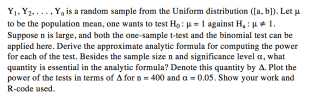 Yi, Y2...., Yn is a random sample from the Uniform distribution ([a, b]). Let u to be the population mean, one wants to test Ho : μ = 1 against Ha : μ 1. Suppose n is large, and both the one-sample t-test and the binomial test can be applied here. Derive the approximate analytic formula for computing the power for each of the test. Besides the sample size n and significance level α, what quantity is essential in the...
. Suppose the Y1, Y2, · · · , Yn denote a random sample from a...
 . Suppose the Y1, Y2, · · · , Yn denote a random sample from a
population with Rayleigh distribution (Weibull distribution with
parameters 2, θ) with density function f(y|θ) = 2y θ e −y 2/θ, θ
> 0, y > 0
Consider the estimators ˆθ1 = Y(1) = min{Y1, Y2, · · · , Yn},
and ˆθ2 = 1 n Xn i=1 Y 2 i .
ii) (10 points) Determine if ˆθ1 and ˆθ2 are unbiased
estimators, and in...
. Suppose the Y1, Y2, · · · , Yn denote a random sample from a
population with Rayleigh distribution (Weibull distribution with
parameters 2, θ) with density function f(y|θ) = 2y θ e −y 2/θ, θ
> 0, y > 0
Consider the estimators ˆθ1 = Y(1) = min{Y1, Y2, · · · , Yn},
and ˆθ2 = 1 n Xn i=1 Y 2 i .
ii) (10 points) Determine if ˆθ1 and ˆθ2 are unbiased
estimators, and in...
QUESTION 3 Let Y1, Y2, ..., Yn denote a random sample of size n from a...
 QUESTION 3 Let Y1, Y2, ..., Yn denote a random sample of size n from a population whose density is given by (Parcto distribution). Consider the estimator β-Yu)-min(n, Y, where β is unknown (a) Derive the bias of the estimator β. (b) Derive the mean square error of B. , Yn).
Suppose that Y1 , Y2 ,..., Yn denote a random sample of size n from a...
 Suppose
that Y1 , Y2 ,..., Yn denote a random sample of size n from a
normal population with mean μ and variance 2 .
Problem # 2: Suppose that Y , Y,,...,Y, denote a random sample of size n from a normal population with mean u and variance o . Then it can be shown that (n-1)S2 p_has a chi-square distribution with (n-1) degrees of freedom. o2 a. Show that S2 is an unbiased estimator of o. b....
Suppose
that Y1 , Y2 ,..., Yn denote a random sample of size n from a
normal population with mean μ and variance 2 .
Problem # 2: Suppose that Y , Y,,...,Y, denote a random sample of size n from a normal population with mean u and variance o . Then it can be shown that (n-1)S2 p_has a chi-square distribution with (n-1) degrees of freedom. o2 a. Show that S2 is an unbiased estimator of o. b....
Let Y,, Y2, .., Yn denote a random sample of size n from a population whose...
 Let Y,, Y2, .., Yn denote a random sample of size n from a population whose density is given by Find the method of moments estimator for α.
Let Y1 , Y2 , . . . , Yn denote a random sample from the...
 Let Y1 , Y2 , . . . , Yn denote a random sample from the uniform
distribution on the interval (θ, θ+1). Let
a. Show that both ? ̂1 and ? ̂2 are unbiased estimators of
θ.
Let Y1 , Y2 , . . . , Yn denote a random sample from the uniform
distribution on the interval (θ, θ+1). Let
a. Show that both ? ̂1 and ? ̂2 are unbiased estimators of
θ.
1. Let Yı,Y2,..., Yn denote a random sample from a population with mean E (-0,) and...
 1. Let Yı,Y2,..., Yn denote a random sample from a population with mean E (-0,) and variance o2 € (0,0). Let Yn = n- Y. Recall that, by the law of large numbers, Yn is a consistent estimator of . (a) (10 points) Prove that Un="in is a consistent estimator of . (b) (5 points) Prove that Vn = Yn-n is not a consistent estimator of (c) (5 points) Suppose that, for each i, P(Y, - of ? Prove what...
 Let X1, ..., Xn denote an independent random sample from a population with a Poisson distribution with mean . Derive the most powerful test for testing Ho : 1= 2 versus Ha: 1= 1/2.
 Yi, Y2...., Yn is a random sample from the Uniform distribution ([a, b]). Let u to be the population mean, one wants to test Ho : μ = 1 against Ha : μ 1. Suppose n is large, and both the one-sample t-test and the binomial test can be applied here. Derive the approximate analytic formula for computing the power for each of the test. Besides the sample size n and significance level α, what quantity is essential in the...
 . Suppose the Y1, Y2, · · · , Yn denote a random sample from a
population with Rayleigh distribution (Weibull distribution with
parameters 2, θ) with density function f(y|θ) = 2y θ e −y 2/θ, θ
> 0, y > 0
Consider the estimators ˆθ1 = Y(1) = min{Y1, Y2, · · · , Yn},
and ˆθ2 = 1 n Xn i=1 Y 2 i .
ii) (10 points) Determine if ˆθ1 and ˆθ2 are unbiased
estimators, and in...
. Suppose the Y1, Y2, · · · , Yn denote a random sample from a
population with Rayleigh distribution (Weibull distribution with
parameters 2, θ) with density function f(y|θ) = 2y θ e −y 2/θ, θ
> 0, y > 0
Consider the estimators ˆθ1 = Y(1) = min{Y1, Y2, · · · , Yn},
and ˆθ2 = 1 n Xn i=1 Y 2 i .
ii) (10 points) Determine if ˆθ1 and ˆθ2 are unbiased
estimators, and in...
 QUESTION 3 Let Y1, Y2, ..., Yn denote a random sample of size n from a population whose density is given by (Parcto distribution). Consider the estimator β-Yu)-min(n, Y, where β is unknown (a) Derive the bias of the estimator β. (b) Derive the mean square error of B. , Yn).
 Suppose
that Y1 , Y2 ,..., Yn denote a random sample of size n from a
normal population with mean μ and variance 2 .
Problem # 2: Suppose that Y , Y,,...,Y, denote a random sample of size n from a normal population with mean u and variance o . Then it can be shown that (n-1)S2 p_has a chi-square distribution with (n-1) degrees of freedom. o2 a. Show that S2 is an unbiased estimator of o. b....
Suppose
that Y1 , Y2 ,..., Yn denote a random sample of size n from a
normal population with mean μ and variance 2 .
Problem # 2: Suppose that Y , Y,,...,Y, denote a random sample of size n from a normal population with mean u and variance o . Then it can be shown that (n-1)S2 p_has a chi-square distribution with (n-1) degrees of freedom. o2 a. Show that S2 is an unbiased estimator of o. b....
 Let Y,, Y2, .., Yn denote a random sample of size n from a population whose density is given by Find the method of moments estimator for α.
 Let Y1 , Y2 , . . . , Yn denote a random sample from the uniform
distribution on the interval (θ, θ+1). Let
a. Show that both ? ̂1 and ? ̂2 are unbiased estimators of
θ.
Let Y1 , Y2 , . . . , Yn denote a random sample from the uniform
distribution on the interval (θ, θ+1). Let
a. Show that both ? ̂1 and ? ̂2 are unbiased estimators of
θ.
 1. Let Yı,Y2,..., Yn denote a random sample from a population with mean E (-0,) and variance o2 € (0,0). Let Yn = n- Y. Recall that, by the law of large numbers, Yn is a consistent estimator of . (a) (10 points) Prove that Un="in is a consistent estimator of . (b) (5 points) Prove that Vn = Yn-n is not a consistent estimator of (c) (5 points) Suppose that, for each i, P(Y, - of ? Prove what...
Most questions answered within 3 hours.
-
Where is the error in this code sequence?
String s1 = "Hello";
String s2 = "ello";...
asked 10 months ago -
Financial data for Joel de Paris, Inc., for last year
follow:
Joel de Paris, Inc.
Balance...
asked 10 months ago -
Consider this reaction:
Al2(SO4)3 (aq)+ BaCl3
(aq) Al2Cl6 (aq)- +
3BaSO4(s) . What is the...
asked 10 months ago -
Suppose that Savneet is considering increasing her
recent random sample from 20 car rentals to 40...
asked 10 months ago -
Trucks arrive at an unloading terminal at an average rate of 120
per hour.
Trucks arrive...
asked 10 months ago -
Why are methanol and ethanol completely soluble in water while
octanol is not very little soluble....
asked 10 months ago -
A facilities manager at a university reads in a research report
that the mean amount of...
asked 10 months ago -
When the CuSO4 is rehydrated by adding water to the anhydrous
compound, is this an endothermic...
asked 10 months ago -
A ray of sunlight is passing from diamond into crown glass; the
angle of incidence is...
asked 10 months ago -
A block of mass 0.249 kg is placed on top of a light, vertical
spring of...
asked 10 months ago -
how do the kidneys compensate in the presences of acidosis
a) trigger hyperventilate
b) reserve acid...
asked 10 months ago -
Question 501 pts
The rental rate of capital to the firm increases. Which of the
following...
asked 10 months ago