determine the net force necessary to give an object with 3.6 kg an acceleration of 6.0...
Homework Answers
m = mass of the object = 3.6 kg
a = acceleration of the object = 6 m/s2
Net force necessary is given as
F = ma
inserting the values
F = (3.6) (6)
F = 21.6 N
Add Answer to:
determine the net force necessary to give an object with 3.6 kg an
acceleration of 6.0...
1.)What force is necessary to give a 1900 kg car an acceleration of 2.5 m/s2? 2.)...
1.)What force is necessary to give a 1900 kg car an acceleration of 2.5 m/s2? 2.) Find the acceleration produced by a force of 78 N acting on a 6.5 kg object. 3.) What force must be applied to a 1100 kg tractor to give it an acceleration of 2.8 m/s2?
17. A net force of 24 N is acting on a 4.0-kg object. Find the acceleration...
 17. A net force of 24 N is acting on a 4.0-kg object. Find the acceleration in m/s2
An object experiences a net force of 20 N and has an acceleration of 4 m/s2....
An object experiences a net force of 20 N and has an acceleration of 4 m/s2. The object’s mass must be 20 kg 5 kg 80 kg 2 kg
A 7.1 kg object experiences an acceleration of 3.2 m/s2. (a) What is the magnitude of...
 A 7.1 kg object experiences an acceleration of 3.2 m/s2. (a) What is the magnitude of the resultant force acting on it (in N)? (b) If this same force is applied to a 4.3 kg object, what is the magnitude of the acceleration (In m/s2)? m/s2
An object, when pushed with a net force F, has an acceleration of 2 m/s2. Now...
An object, when pushed with a net force F, has an acceleration of 2 m/s2. Now three times the force is applied to an object that has four times the mass. Its acceleration will be.
m=7 kg Finding Net Force (20 pts) What is the acceleration for the object on an...
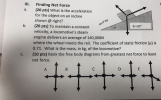 m=7 kg Finding Net Force (20 pts) What is the acceleration for the object on an incline shown @ right? (20 pts) To maintain a constant 0=35° velocity, a locomotive's steam engine delivers an average of 140,000N where the wheel meets the rail. The coefficient of static friction (u) is 0.71. What is the mass, in kg, of the locomotive? (10 pts) Rank the free body diagrams from greatest net force to least net force. TB I CID
Two forces act on a 3.20 kg object, the gravitational force and a second, constant force....
 Two forces act on a 3.20 kg object, the gravitational force and a second, constant force. The object starts from rest and in 1.20 s is displaced (4.251 - 3.301) m. Write the second force in unit vector notation. (Enter your answer in kg. m/s. Assume the gravitational force acts in the - direction.) = (18.888)i + (17.152); First, find the acceleration vector using kinematics, then substitute into Newton's second law to determine the unknown force vector. Recall that the...
Consider a constant total force of 1,216 N acting on an object. If the acceleration of...
Consider a constant total force of 1,216 N acting on an object. If the acceleration of the object is 9 m/s2, what is the mass in kg of this object if all other forces equal zero?
An upward force of 322 N is applied to a 15 kg object.
An upward force of 322 N is applied to a 15 kg object. If a downward drag force of 31 N acts on the object what is the acceleration of the object? g = 10 m/s2
a steady horizontal force lasting for 2.10 s gives a 1.25 kg object an acceleration of 3.20
a steady horizontal force lasting for 2.10 s gives a 1.25 kg object an acceleration of 3.20 m/s^2 on a frictionless table. what impulse does this force give to theobject?
 17. A net force of 24 N is acting on a 4.0-kg object. Find the acceleration in m/s2
 A 7.1 kg object experiences an acceleration of 3.2 m/s2. (a) What is the magnitude of the resultant force acting on it (in N)? (b) If this same force is applied to a 4.3 kg object, what is the magnitude of the acceleration (In m/s2)? m/s2
 m=7 kg Finding Net Force (20 pts) What is the acceleration for the object on an incline shown @ right? (20 pts) To maintain a constant 0=35° velocity, a locomotive's steam engine delivers an average of 140,000N where the wheel meets the rail. The coefficient of static friction (u) is 0.71. What is the mass, in kg, of the locomotive? (10 pts) Rank the free body diagrams from greatest net force to least net force. TB I CID
 Two forces act on a 3.20 kg object, the gravitational force and a second, constant force. The object starts from rest and in 1.20 s is displaced (4.251 - 3.301) m. Write the second force in unit vector notation. (Enter your answer in kg. m/s. Assume the gravitational force acts in the - direction.) = (18.888)i + (17.152); First, find the acceleration vector using kinematics, then substitute into Newton's second law to determine the unknown force vector. Recall that the...
Most questions answered within 3 hours.
-
Where is the error in this code sequence?
String s1 = "Hello";
String s2 = "ello";...
asked 10 months ago -
Financial data for Joel de Paris, Inc., for last year
follow:
Joel de Paris, Inc.
Balance...
asked 10 months ago -
Consider this reaction:
Al2(SO4)3 (aq)+ BaCl3
(aq) Al2Cl6 (aq)- +
3BaSO4(s) . What is the...
asked 10 months ago -
Suppose that Savneet is considering increasing her
recent random sample from 20 car rentals to 40...
asked 10 months ago -
Trucks arrive at an unloading terminal at an average rate of 120
per hour.
Trucks arrive...
asked 10 months ago -
Why are methanol and ethanol completely soluble in water while
octanol is not very little soluble....
asked 10 months ago -
A facilities manager at a university reads in a research report
that the mean amount of...
asked 10 months ago -
When the CuSO4 is rehydrated by adding water to the anhydrous
compound, is this an endothermic...
asked 10 months ago -
A ray of sunlight is passing from diamond into crown glass; the
angle of incidence is...
asked 10 months ago -
A block of mass 0.249 kg is placed on top of a light, vertical
spring of...
asked 10 months ago -
how do the kidneys compensate in the presences of acidosis
a) trigger hyperventilate
b) reserve acid...
asked 10 months ago -
Question 501 pts
The rental rate of capital to the firm increases. Which of the
following...
asked 10 months ago