Let us consider the builder pattern where Product has four possible parts Part1, Part2, Part3, and...
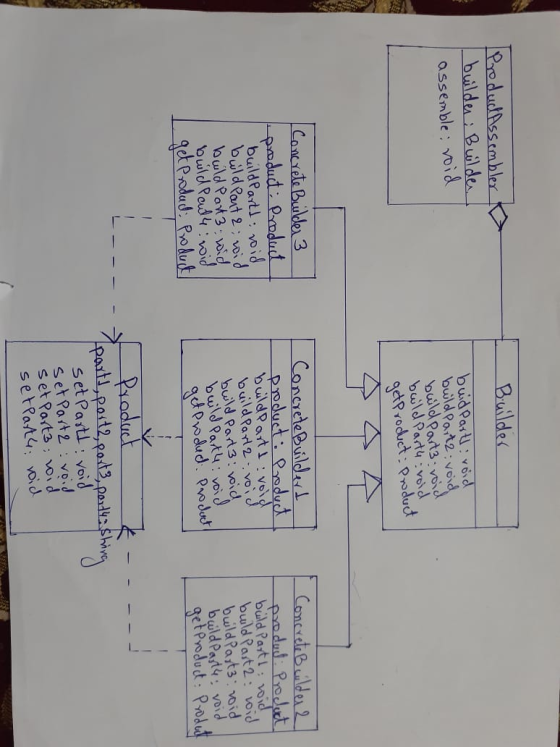
Let us consider the builder pattern where Product has four possible parts Part1, Part2, Part3, and Part4 (all integer).
Assume we have three concrete builders: ConcreteBuilder1, ConcreteBuilder2, and ConcreteBuilder3.
ConcreteBuilder1 assigns 11, 12, 13, and 14 to Part1, Part2, Part 3, and Part4 respectively.
ConcreteBuilder2 assigns 21, 22, 23, and 24 to Part1, Part2, Part 3, and Part4 respectively.
ConcreteBuilder3 assigns 31, 32, 33, and 34 to Part1, Part2, Part3, and Part4 respectively.
1) Give the UML diagram.
2) Implement the UML class diagram given in 1 in Java.
Homework Answers
1) UML diagram below
2) Java prpgram below
class Product
{
private String part1;
private String part2;
private String part3;
private String part4;
public void setPart1(String _part1)
{ this.part1 = _part1;
}
public void setPart2(String _part2)
{
this.part2 = _part2;
}
public void setPart3(String _part3)
{
this.part3 = _part3;
}
public void setPart4(String _part4)
{
this.part4 = _part4;
}
public String toString()
{
return " Part 1 : "+part1+
"\nPart 2 : "+part2+
"\nPart 3 : "+part3+
"\nPart 4 : "+part4;
}
}
interface Builder{
void buildPart1();
void buildPart2();
void buildPart3();
void buildPart4();
Product getProduct();
}
class ConcreteBuilder1 implements Builder{
Product product;
ConcreteBuilder1(){
this.product = new Product();
}
public void buildPart1(){
product.setPart1("11");
}
public void buildPart2(){
product.setPart2("12");
}
public void buildPart3(){
product.setPart3("13");
}
public void buildPart4(){
product.setPart4("14");
}
public Product getProduct(){
return product;
}
}
class ConcreteBuilder2 implements Builder{
Product product;
ConcreteBuilder2(){
this.product = new Product();
}
public void buildPart1(){
product.setPart1("21");
}
public void buildPart2(){
product.setPart2("22");
}
public void buildPart3(){
product.setPart3("23");
}
public void buildPart4(){
product.setPart4("24");
}
public Product getProduct(){
return product;
}
}
class ConcreteBuilder3 implements Builder{
Product product;
ConcreteBuilder3(){
this.product = new Product();
}
public void buildPart1(){
product.setPart1("31");
}
public void buildPart2(){
product.setPart2("32");
}
public void buildPart3(){
product.setPart3("33");
}
public void buildPart4(){
product.setPart4("34");
}
public Product getProduct(){
return product;
}
}
class ProductAssembler {
Builder builder ;
ProductAssembler (Builder builder){
this.builder = builder;
}
public void assemble(){
builder.buildPart1();
builder.buildPart2();
builder.buildPart3();
builder.buildPart4();
}
}
public class Main {
public static void main (String args[]){
Builder b1 = new ConcreteBuilder1();
ProductAssembler assembler = new ProductAssembler(b1);
assembler.assemble();
Product finalProduct = b1.getProduct();
System.out.println(" Final Product " + finalProduct);
}
}
Add Answer to:
Let us consider the builder pattern where Product has
four possible parts Part1, Part2, Part3, and...
In Parts This Skill Builder will require you to write several functions in which loops will...
 In Parts This Skill Builder will require you to write several functions in which loops will be the focus. In addition, some of these function will require you to design and implement finite state machines. So, let's get started! The template below has a class called SkillBuilder6 with a set of skeleton methods provided. The requirements for each method is provided below Left Triangle In the template below, SkillBuilder6 has a method with the following signature: public static String leftRightTriangle...
C++ Program 2 Consider a class Employee with data members: age (an integer), id (an integer)...
 C++
Program 2 Consider a class Employee with data members: age (an integer), id (an integer) and salary (a float), and their corresponding member functions as follows: class Employee { private: int age; int id; float salary: public: Employee; // default constructor: age=0, id=0, and salary=0 void setAge(int x); // let age = x void setId(int x); // let id = x void setSalary(float x); // salary = x int getAge(); // return age int getId; // return id float...
C++
Program 2 Consider a class Employee with data members: age (an integer), id (an integer) and salary (a float), and their corresponding member functions as follows: class Employee { private: int age; int id; float salary: public: Employee; // default constructor: age=0, id=0, and salary=0 void setAge(int x); // let age = x void setId(int x); // let id = x void setSalary(float x); // salary = x int getAge(); // return age int getId; // return id float...
In Problem Set 7 you designed and implemented a Message class. This time, let's design and...
 In Problem Set 7 you designed and implemented a Message class. This time, let's design and implement a Mailbox class in a file named Mailbox java. Do the following with this class • You may use the Message class from PS 7. You will have to add new features to the Message class from PS 7 as you work through this problem. You are welcome to start with my sample solution if you wish • Suppose there are multiple mail...
 In Parts This Skill Builder will require you to write several functions in which loops will be the focus. In addition, some of these function will require you to design and implement finite state machines. So, let's get started! The template below has a class called SkillBuilder6 with a set of skeleton methods provided. The requirements for each method is provided below Left Triangle In the template below, SkillBuilder6 has a method with the following signature: public static String leftRightTriangle...
 C++
Program 2 Consider a class Employee with data members: age (an integer), id (an integer) and salary (a float), and their corresponding member functions as follows: class Employee { private: int age; int id; float salary: public: Employee; // default constructor: age=0, id=0, and salary=0 void setAge(int x); // let age = x void setId(int x); // let id = x void setSalary(float x); // salary = x int getAge(); // return age int getId; // return id float...
C++
Program 2 Consider a class Employee with data members: age (an integer), id (an integer) and salary (a float), and their corresponding member functions as follows: class Employee { private: int age; int id; float salary: public: Employee; // default constructor: age=0, id=0, and salary=0 void setAge(int x); // let age = x void setId(int x); // let id = x void setSalary(float x); // salary = x int getAge(); // return age int getId; // return id float...
 In Problem Set 7 you designed and implemented a Message class. This time, let's design and implement a Mailbox class in a file named Mailbox java. Do the following with this class • You may use the Message class from PS 7. You will have to add new features to the Message class from PS 7 as you work through this problem. You are welcome to start with my sample solution if you wish • Suppose there are multiple mail...
Most questions answered within 3 hours.
-
Where is the error in this code sequence?
String s1 = "Hello";
String s2 = "ello";...
asked 10 months ago -
Financial data for Joel de Paris, Inc., for last year
follow:
Joel de Paris, Inc.
Balance...
asked 10 months ago -
Consider this reaction:
Al2(SO4)3 (aq)+ BaCl3
(aq) Al2Cl6 (aq)- +
3BaSO4(s) . What is the...
asked 10 months ago -
Suppose that Savneet is considering increasing her
recent random sample from 20 car rentals to 40...
asked 10 months ago -
Trucks arrive at an unloading terminal at an average rate of 120
per hour.
Trucks arrive...
asked 10 months ago -
Why are methanol and ethanol completely soluble in water while
octanol is not very little soluble....
asked 10 months ago -
A facilities manager at a university reads in a research report
that the mean amount of...
asked 10 months ago -
When the CuSO4 is rehydrated by adding water to the anhydrous
compound, is this an endothermic...
asked 10 months ago -
A ray of sunlight is passing from diamond into crown glass; the
angle of incidence is...
asked 10 months ago -
A block of mass 0.249 kg is placed on top of a light, vertical
spring of...
asked 10 months ago -
how do the kidneys compensate in the presences of acidosis
a) trigger hyperventilate
b) reserve acid...
asked 10 months ago -
Question 501 pts
The rental rate of capital to the firm increases. Which of the
following...
asked 10 months ago