write a c++ program that computes the L^2 - Norm (Euclidean norm) of a given vector...
write a c++ program that computes the L^2 - Norm (Euclidean norm) of a given vector (L^2 norm of a vector is the square root of the sum of the squares of all the components of the vector)
Homework Answers
#include <bits/stdc++.h>
using namespace std;
int v[1000000];
int main()
{
int n;//Enter the no of dimensions of the vector
cin>>n;
int i;
int sum=0;
for(i=0;i<n;i++)
{
cin>>v[i];//Enter the coefficient of the vector
sum=sum+abs(v[i]);//Calculating Sum of Vector
}
cout<<" L^1 - Norm of a given vector "<<sum<<"
";
return 0;
}
Input-->
4
-1 -1 2 3
Output-->
L^1 - Norm of a given vector 7
 Any
doubt ask in comments section.Please Upvote.Thanks and Regards
Any
doubt ask in comments section.Please Upvote.Thanks and Regards
Add Answer to:
write a c++ program that computes the L^2 - Norm (Euclidean
norm) of a given vector...
write a c++ program that computes the L^1 - Norm of a given vector (L^1 norm...
write a c++ program that computes the L^1 - Norm of a given vector (L^1 norm of a vector is the sum of the absolute values of all the components of the vector)
(25 pts) The Euclidean norm of a d dimensional vector x, is defined as lxla -...
 (25 pts) The Euclidean norm of a d dimensional vector x, is defined as lxla - Vii xllP. Given a d x d square matrix M, we are interested in the following optimization problem: Maximize aT Ma subject to llx2 1 (Hint: this question will use a bit of linear algebra) 1. What is the maxima for the above optimization problem (in terms of matrix M), show your steps. 2. What is the maximum value of the above optimization problem
Given two vectors of length n that are represented with one-dimensional arrays, write a code fragment...
Given two vectors of length n that are represented with one-dimensional arrays, write a code fragment that computes the Euclidean distance between them (the square root of the sums of the squares of the differences between corresponding elements).. Implement using while loops
The Euclidean norm of an n-dimensional vector is defined by Implement a robust routine for computing...
 The Euclidean norm of an n-dimensional vector is defined by Implement a robust routine for computing this quantity for any given input vector I. Your routine should avoid overflow and harmful underflow. Compare both the accuracy and performance of your robust routine with a more straightforward naive implementation. Can you devise a vector that produces significantly different results from the two routines? How much performance does the robust routine sacrifice?
this program is in C. Write a program that computes the number of elements in an...
 this program is in C.
Write a program that computes the number of elements in an array divisible by a user specified number. Declare an integer array of size 7 and read the array elements from the user. Then, read a number k from the user and compute the number of elements in the array divisible by k. Consider the following example. 3 elements in this array are divisible by 2 ({2,2,4}). Sample execution of the program for this array...
this program is in C.
Write a program that computes the number of elements in an array divisible by a user specified number. Declare an integer array of size 7 and read the array elements from the user. Then, read a number k from the user and compute the number of elements in the array divisible by k. Consider the following example. 3 elements in this array are divisible by 2 ({2,2,4}). Sample execution of the program for this array...
(b) Write a Ruby function sigma that uses your function mean and computes the standard deviation of an arbitrary number of arguments. Function calls sigma (1,2,1,2) , sigma (1) and sigma should r...
 (b) Write a Ruby function sigma that uses your function mean and computes the standard deviation of an arbitrary number of arguments. Function calls sigma (1,2,1,2) , sigma (1) and sigma should respectively return 1 ,0,and "No arguments". (Hint: the standard deviation is the square root o variance, and variance is the mean value of squares minus the square of the mean value) (c) Write a Ruby function stat that computes and returns the mean value, standard deviation, and the...
It's given the following metric space [ir?,d) with the euclidean norm and the set M= {Ixoy)ER?:...
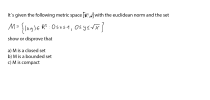 It's given the following metric space [ir?,d) with the euclidean norm and the set M= {Ixoy)ER?: Osxs1, Osyste} show or disprove that a) M is a closed set b) M is a bounded set c) M is compact
Simulation: Write a MIPS program which computes the vector dot product. Vector dot product involv...
 Simulation: Write a MIPS program which computes the vector dot product. Vector dot product involves calculations of two vectors. Let A and B be two vectors of length n. Their dot product is defined as: Dot Product-2.0 A(i): B(i) Where the result is stored in memory location DOTPROD. The first elements of each vector, A(0) and B(0), are stored at memory locations A_vec and B_vec, with the remaining elements in the following word locations Results: Put your MIPS code here...
in c++ Program 1 Write a program that sorts a vector of names alphabetically using the...
 in c++
Program 1 Write a program that sorts a vector of names alphabetically using the selection sort and then searches the vector for a specific name using binary search. To do that, you need to write three functions I. void selSort (vector string &v: sorts the vector using selection sort 2. void display (const vector <string & v): displays the vector contents . int binSearch (const vector <ing& v, string key): searches the vector for a key returns the...
in c++
Program 1 Write a program that sorts a vector of names alphabetically using the selection sort and then searches the vector for a specific name using binary search. To do that, you need to write three functions I. void selSort (vector string &v: sorts the vector using selection sort 2. void display (const vector <string & v): displays the vector contents . int binSearch (const vector <ing& v, string key): searches the vector for a key returns the...
(a) Write a Ruby function mean that computes the mean value of an arbitrary number of arguments. Function calls mean (1,2,3,4,5) mean 3 ,1 ,and "No arguments". (1) and mean should respect...
 (a) Write a Ruby function mean that computes the mean value of an arbitrary number of arguments. Function calls mean (1,2,3,4,5) mean 3 ,1 ,and "No arguments". (1) and mean should respectively return tion sigma that uses your function mean and computes the standard deviation of an arbitrary of arguments. Function calls sigma (1,2,1,2)sigma (1) and sigma should respectively return1, o, and "No arguments" (Hint: the standard deviation is the square root of (b) Write a Ruby func variance, and...
 (25 pts) The Euclidean norm of a d dimensional vector x, is defined as lxla - Vii xllP. Given a d x d square matrix M, we are interested in the following optimization problem: Maximize aT Ma subject to llx2 1 (Hint: this question will use a bit of linear algebra) 1. What is the maxima for the above optimization problem (in terms of matrix M), show your steps. 2. What is the maximum value of the above optimization problem
 The Euclidean norm of an n-dimensional vector is defined by Implement a robust routine for computing this quantity for any given input vector I. Your routine should avoid overflow and harmful underflow. Compare both the accuracy and performance of your robust routine with a more straightforward naive implementation. Can you devise a vector that produces significantly different results from the two routines? How much performance does the robust routine sacrifice?
 this program is in C.
Write a program that computes the number of elements in an array divisible by a user specified number. Declare an integer array of size 7 and read the array elements from the user. Then, read a number k from the user and compute the number of elements in the array divisible by k. Consider the following example. 3 elements in this array are divisible by 2 ({2,2,4}). Sample execution of the program for this array...
this program is in C.
Write a program that computes the number of elements in an array divisible by a user specified number. Declare an integer array of size 7 and read the array elements from the user. Then, read a number k from the user and compute the number of elements in the array divisible by k. Consider the following example. 3 elements in this array are divisible by 2 ({2,2,4}). Sample execution of the program for this array...
 (b) Write a Ruby function sigma that uses your function mean and computes the standard deviation of an arbitrary number of arguments. Function calls sigma (1,2,1,2) , sigma (1) and sigma should respectively return 1 ,0,and "No arguments". (Hint: the standard deviation is the square root o variance, and variance is the mean value of squares minus the square of the mean value) (c) Write a Ruby function stat that computes and returns the mean value, standard deviation, and the...
 It's given the following metric space [ir?,d) with the euclidean norm and the set M= {Ixoy)ER?: Osxs1, Osyste} show or disprove that a) M is a closed set b) M is a bounded set c) M is compact
 Simulation: Write a MIPS program which computes the vector dot product. Vector dot product involves calculations of two vectors. Let A and B be two vectors of length n. Their dot product is defined as: Dot Product-2.0 A(i): B(i) Where the result is stored in memory location DOTPROD. The first elements of each vector, A(0) and B(0), are stored at memory locations A_vec and B_vec, with the remaining elements in the following word locations Results: Put your MIPS code here...
 in c++
Program 1 Write a program that sorts a vector of names alphabetically using the selection sort and then searches the vector for a specific name using binary search. To do that, you need to write three functions I. void selSort (vector string &v: sorts the vector using selection sort 2. void display (const vector <string & v): displays the vector contents . int binSearch (const vector <ing& v, string key): searches the vector for a key returns the...
in c++
Program 1 Write a program that sorts a vector of names alphabetically using the selection sort and then searches the vector for a specific name using binary search. To do that, you need to write three functions I. void selSort (vector string &v: sorts the vector using selection sort 2. void display (const vector <string & v): displays the vector contents . int binSearch (const vector <ing& v, string key): searches the vector for a key returns the...
 (a) Write a Ruby function mean that computes the mean value of an arbitrary number of arguments. Function calls mean (1,2,3,4,5) mean 3 ,1 ,and "No arguments". (1) and mean should respectively return tion sigma that uses your function mean and computes the standard deviation of an arbitrary of arguments. Function calls sigma (1,2,1,2)sigma (1) and sigma should respectively return1, o, and "No arguments" (Hint: the standard deviation is the square root of (b) Write a Ruby func variance, and...
Most questions answered within 3 hours.
-
Where is the error in this code sequence?
String s1 = "Hello";
String s2 = "ello";...
asked 11 months ago -
Financial data for Joel de Paris, Inc., for last year
follow:
Joel de Paris, Inc.
Balance...
asked 11 months ago -
Consider this reaction:
Al2(SO4)3 (aq)+ BaCl3
(aq) Al2Cl6 (aq)- +
3BaSO4(s) . What is the...
asked 11 months ago -
Suppose that Savneet is considering increasing her
recent random sample from 20 car rentals to 40...
asked 11 months ago -
Trucks arrive at an unloading terminal at an average rate of 120
per hour.
Trucks arrive...
asked 11 months ago -
Why are methanol and ethanol completely soluble in water while
octanol is not very little soluble....
asked 11 months ago -
A facilities manager at a university reads in a research report
that the mean amount of...
asked 11 months ago -
When the CuSO4 is rehydrated by adding water to the anhydrous
compound, is this an endothermic...
asked 11 months ago -
A ray of sunlight is passing from diamond into crown glass; the
angle of incidence is...
asked 11 months ago -
A block of mass 0.249 kg is placed on top of a light, vertical
spring of...
asked 11 months ago -
how do the kidneys compensate in the presences of acidosis
a) trigger hyperventilate
b) reserve acid...
asked 11 months ago -
Question 501 pts
The rental rate of capital to the firm increases. Which of the
following...
asked 11 months ago