The electric potential at a point in space near a 7.5 mC charge is 7,081 V....
The electric potential at a point in space near a 7.5 mC charge is 7,081 V. How far away from the charge is the point? Give your answer in meters.
Homework Answers
Use equation for electric potential due to a charge to find the
required distance of the charge from the given point as shown
below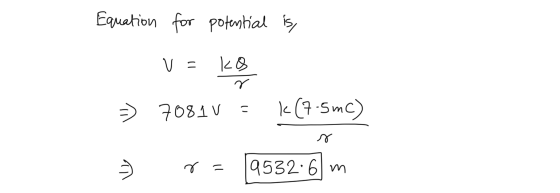
***********************************************************************************************
This concludes the answers. If there is any mistake or
omission, let me know in the comments immediately and I will fix
it....
Add Answer to:
The electric potential at a point in space near a 7.5 mC charge
is 7,081 V....
The electric potential at some point in space due to a point charge is 83 volts....
The electric potential at some point in space due to a point charge is 83 volts. If the charge is kept in the same place, what is the electric potential at a point which is 6 times further away compared to the first point? Answer in volts.
The electric potential at point A is + 940 V and the electric potential at point...
 The electric potential at point A is + 940 V and the electric potential at point B is + 490 V . A positive point charge q = 7.75 mC (millicoulombs) moves from point A to point B. The only force on the charge is the electric force. Part A - If the kinetic energy of q is 7.50 J when it is at point A, what is its kinetic energy when it is at point B? 3.49 J 4.01...
Charge q1 = 7.5 nC is located at the coordinate system origin, while charge q2 = -3.33 mC is located at (a, 0), where a = 1.1 m.
 Charge q1 = 7.5 nC is located at the coordinate system origin, while charge q2 = -3.33 mC is located at (a, 0), where a = 1.1 m. The point P has coordinates (a, b), where b = 0.25 m. A third charge q3 = 9.5 nC will be placed later. Part (a) Find the electric potential Vp at point P, in volts. Assume the potential is zero at infinity. Part (b) How much work II', in joules, would you have to...
1. At one point in space, the electric potential energy of a 15 nC charge is...
1. At one point in space, the electric potential energy of a 15 nC charge is 30 μJ . What is the electric potential at this point? 2. Moving a charge from point A, where the potential is 300 V , to point B, where the potential is 180 V , takes 4.0×10⁻⁴ J of work. What is the value of the charge? 3. What is the voltage of a battery that will charge a 4.0 μF capacitor to ±...
The Equation: is often used to calculate the electric potential from a point charge at an...
 The Equation: is often used to calculate the electric potential from a point charge at an observation location. If we were to write this as a potential difference, we might write it as the potential difference from the observation to a point infinitely far away: The difference, Δν· is the quantity we can actually measure in the real world this is done by calibrating a voltage-measuring device to a location, and then moving elsewhere and reading off the difference in...
A 5.00-mC point charge is at the origin, and a point charge q_2 = -22.00 mC...
 A 5.00-mC point charge is at the origin, and a point charge q_2 = -22.00 mC is on the x-axis at (3.00, 0) m. If the electric potential is taken to be zero at infinity, find the electric potential due to these charges at point P with coordinates (0, 4.00) How much work is required to bring a third point charge of 4.00 mC from infinity to P?
The electric potential a distance r from a point charge q is 2.90×10⁴ V . One...
The electric potential a distance r from a point charge q is 2.90×10⁴ V . One meter farther away from the charge the potential is 6300 V . Part A Find the initial distance r. r r = m Part B Find the charge q. q q = μC
The electric potential in a region of space is V= (350Vm) / ( sqrt(x^2 + y^2...
The electric potential in a region of space is V= (350Vm) / ( sqrt(x^2 + y^2 ), where x and y are in meters. A: What is the strength of the electric field at (x,y)=(2.6m,2.4m)? E= ? V/m B: What is the direction of the electric field at (x,y)=(2.6m,2.4m)? Give the direction as an angle ccw from the positive x-axis. Express your answer using two significant figures.
The electric potential in a region of space is V = (250 V middot m)/squareroot x^2...
 The electric potential in a region of space is V = (250 V middot m)/squareroot x^2 + y^2, where x and y are in meters. Part A What is the strength of the electric field at (x, y) = (2.3 m, 1.8 m)? Express your answer using two significant figures. E = ______________ Part B What is the direction of the electric field at (x, y) = (2.3 m, 1.8 m)? Give the direction as an angle ccw from the...
The electric potential V in the space between two flat parallel plates 1 and 2 is...
The electric potential V in the space between two flat parallel plates 1 and 2 is given (in volts) by V = 2200x2, where x (in meters) is the perpendicular distance from plate 1. At x = 1.7 cm, (a) what is the magnitude of the electric field and (b) is the field directed toward or away from plate 1?
 The electric potential at point A is + 940 V and the electric potential at point B is + 490 V . A positive point charge q = 7.75 mC (millicoulombs) moves from point A to point B. The only force on the charge is the electric force. Part A - If the kinetic energy of q is 7.50 J when it is at point A, what is its kinetic energy when it is at point B? 3.49 J 4.01...
 The Equation: is often used to calculate the electric potential from a point charge at an observation location. If we were to write this as a potential difference, we might write it as the potential difference from the observation to a point infinitely far away: The difference, Δν· is the quantity we can actually measure in the real world this is done by calibrating a voltage-measuring device to a location, and then moving elsewhere and reading off the difference in...
 A 5.00-mC point charge is at the origin, and a point charge q_2 = -22.00 mC is on the x-axis at (3.00, 0) m. If the electric potential is taken to be zero at infinity, find the electric potential due to these charges at point P with coordinates (0, 4.00) How much work is required to bring a third point charge of 4.00 mC from infinity to P?
 The electric potential in a region of space is V = (250 V middot m)/squareroot x^2 + y^2, where x and y are in meters. Part A What is the strength of the electric field at (x, y) = (2.3 m, 1.8 m)? Express your answer using two significant figures. E = ______________ Part B What is the direction of the electric field at (x, y) = (2.3 m, 1.8 m)? Give the direction as an angle ccw from the...
Most questions answered within 3 hours.
-
Where is the error in this code sequence?
String s1 = "Hello";
String s2 = "ello";...
asked 10 months ago -
Financial data for Joel de Paris, Inc., for last year
follow:
Joel de Paris, Inc.
Balance...
asked 10 months ago -
Consider this reaction:
Al2(SO4)3 (aq)+ BaCl3
(aq) Al2Cl6 (aq)- +
3BaSO4(s) . What is the...
asked 10 months ago -
Suppose that Savneet is considering increasing her
recent random sample from 20 car rentals to 40...
asked 10 months ago -
Trucks arrive at an unloading terminal at an average rate of 120
per hour.
Trucks arrive...
asked 10 months ago -
Why are methanol and ethanol completely soluble in water while
octanol is not very little soluble....
asked 10 months ago -
A facilities manager at a university reads in a research report
that the mean amount of...
asked 10 months ago -
When the CuSO4 is rehydrated by adding water to the anhydrous
compound, is this an endothermic...
asked 10 months ago -
A ray of sunlight is passing from diamond into crown glass; the
angle of incidence is...
asked 10 months ago -
A block of mass 0.249 kg is placed on top of a light, vertical
spring of...
asked 10 months ago -
how do the kidneys compensate in the presences of acidosis
a) trigger hyperventilate
b) reserve acid...
asked 10 months ago -
Question 501 pts
The rental rate of capital to the firm increases. Which of the
following...
asked 10 months ago