Speculate on appearance of the C13 NMR spectrum of each of the possible dialkylated products of...
Speculate on appearance of the C13 NMR spectrum of each of the possible dialkylated products of the alkylation of dimethoxybenzene with t-butanol. Draw out each experiment. Can C13 NMR spectroscopy be used to differenciate them? Explain
Homework Answers

Add Answer to:
Speculate on appearance of the C13 NMR spectrum of each of the
possible dialkylated products of...
Explain the appearance of the 1H-NMR spectrum of 1,1,3,3-tetrachloropropane. How many signals would you expect, and...
Explain the appearance of the 1H-NMR spectrum of 1,1,3,3-tetrachloropropane. How many signals would you expect, and into how many peaks will each of the signals be split.
ng Pattern 3. Explain how 'H-NMR spectroscopy could be used to distinguish between the two compounds...
 ng Pattern 3. Explain how 'H-NMR spectroscopy could be used to distinguish between the two compounds shown below. Be as specific as possible. [10 Points] CH2COCH3 CH2CH3 4. Predict the approximate chemical shift position for each of the different hydrogens in the 'H-NMR spectrum of this compound. [10 Points] Cl CH2CH2-COCH2CH3 . Predict the multiplicity of each of the signals in the H-NMR spectrum of the
Interpret the 13C NMR of aspirin. Assign as many signals as possible on the spectrum to...
Interpret the 13C NMR of aspirin. Assign as many signals as possible on the spectrum to the structure (you’re not expected to definitively assign each carbon, but you can get close!). Report the appropriate expected chemical shift range of each carbon using the NMR table of values.
starting material is propanic acide and isoyml acid. end product is isoyml acetate starting material- isoamyl...
 starting material is propanic acide and isoyml acid. end
product is isoyml acetate
starting material- isoamyl alchol and propanic acid.
2. (3 Points) NMR spectroscopy could have been used to characterize the products in this experiment (we didn't use it because many of the products give spectra with overlapping peaks). NMR could have been advantageous, as the IR spectrum can give a false negative on the product if water or remaining carboxylic acid are in the product (presence of an...
starting material is propanic acide and isoyml acid. end
product is isoyml acetate
starting material- isoamyl alchol and propanic acid.
2. (3 Points) NMR spectroscopy could have been used to characterize the products in this experiment (we didn't use it because many of the products give spectra with overlapping peaks). NMR could have been advantageous, as the IR spectrum can give a false negative on the product if water or remaining carboxylic acid are in the product (presence of an...
5. Consider the Grignard reactions shown here. Describe how you would use NMR to distinguish the...
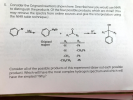 5. Consider the Grignard reactions shown here. Describe how you would use NMR to distinguish the products. Of the four possible products, which are chiral? (You may retrieve the spectra from online sources and give the interpretation using the NMR table technique.) ОН .Br MgBr Mg Н+ R, R2 R1 R2 R2 Grignard reagent -H -Ph -CH2Ph -Н -Ph -CH3 -Ph -CH2CH3 Consider all of the possible products of this experiment (draw out each possible product). Which will have the...
Q1 The proton NMR spectrum shown in this problem is for Expansions are shown for each...
 Q1 The proton NMR spectrum shown in this problem is for Expansions are shown for each of the five unique types of protons in this compound. Determine the coupling constants. Draw tree diagrams for each of the protons shown in the expansions and label them with the appreciate. MUMU MMMWWW (ppm) (udd) www
2. Is it possible to distinguish the molecules given below from each other by using 'H...
 2. Is it possible to distinguish the molecules given below from each other by using 'H NMR spectroscopy? Explain your answer in detail. H3C CH3 and H3c1 CH2CH3 3. How many peaks will the following compounds have in its 'H NMR spectrum? Show each Hatom. a HC H b) 4. What is the multiplicity (splitting) expected in the 'H NMR spectrum for all the hydrogen atoms in the following 3 compounds? Hz OH CHCH H 11 CH3-C-CH2-CH3 here are so...
The 13C NMR spectra A and B for two molecules, each with a formula C5H8, are...
 The 13C NMR spectra A and B for two molecules, each with a
formula C5H8, are shown below. One of them is for a molecule with
conjugated double bonds, the other is for a structure that is not
conjugated.
CHM 26200 Problem Set 2 Spring 2020 Due Feb 19 1) (30 points) The 13C NMR spectra A and B for two molecules, each with a formula CsHx, are shown below. One of them is for a molecule with conjugated double...
The 13C NMR spectra A and B for two molecules, each with a
formula C5H8, are shown below. One of them is for a molecule with
conjugated double bonds, the other is for a structure that is not
conjugated.
CHM 26200 Problem Set 2 Spring 2020 Due Feb 19 1) (30 points) The 13C NMR spectra A and B for two molecules, each with a formula CsHx, are shown below. One of them is for a molecule with conjugated double...
Label each proton with the predicted splitting pattern it would exhibit in a 1H NMR spectrum....
 Label each proton with the predicted splitting pattern it would
exhibit in a 1H NMR spectrum. Either a Singlet, Doublet, Triplet,
Quartet, or Multiplet. They can be used once, more than once, or
none.
Label each proton with the predicted splitting pattern it would exhibit in a 1H NMR spectrum. Either a Singlet, Doublet, Triplet, Quartet, or Multiplet. They can be used once, more than once, or none.
Label each proton with the predicted splitting pattern it would
exhibit in a 1H NMR spectrum. Either a Singlet, Doublet, Triplet,
Quartet, or Multiplet. They can be used once, more than once, or
none.
Label each proton with the predicted splitting pattern it would exhibit in a 1H NMR spectrum. Either a Singlet, Doublet, Triplet, Quartet, or Multiplet. They can be used once, more than once, or none.
PART 2 Draw the most accurate 'H-NMR spectrum you can for the following molecules. Show all...
 PART 2 Draw the most accurate 'H-NMR spectrum you can for the following molecules. Show all signals including an accurate representation of splitting, intensity and position. Assume no signal overlap (i.e. if you expect signals have similar chemical shifts, just place them next to each other). Clearly label the integration value for each signal. Indicate the correlation between each proton (HA, HB, etc) and each signal (label signals A, B, etc.) ppm 12.5 10 11 O ppm 12.5 10 ii...
 ng Pattern 3. Explain how 'H-NMR spectroscopy could be used to distinguish between the two compounds shown below. Be as specific as possible. [10 Points] CH2COCH3 CH2CH3 4. Predict the approximate chemical shift position for each of the different hydrogens in the 'H-NMR spectrum of this compound. [10 Points] Cl CH2CH2-COCH2CH3 . Predict the multiplicity of each of the signals in the H-NMR spectrum of the
 starting material is propanic acide and isoyml acid. end
product is isoyml acetate
starting material- isoamyl alchol and propanic acid.
2. (3 Points) NMR spectroscopy could have been used to characterize the products in this experiment (we didn't use it because many of the products give spectra with overlapping peaks). NMR could have been advantageous, as the IR spectrum can give a false negative on the product if water or remaining carboxylic acid are in the product (presence of an...
starting material is propanic acide and isoyml acid. end
product is isoyml acetate
starting material- isoamyl alchol and propanic acid.
2. (3 Points) NMR spectroscopy could have been used to characterize the products in this experiment (we didn't use it because many of the products give spectra with overlapping peaks). NMR could have been advantageous, as the IR spectrum can give a false negative on the product if water or remaining carboxylic acid are in the product (presence of an...
 5. Consider the Grignard reactions shown here. Describe how you would use NMR to distinguish the products. Of the four possible products, which are chiral? (You may retrieve the spectra from online sources and give the interpretation using the NMR table technique.) ОН .Br MgBr Mg Н+ R, R2 R1 R2 R2 Grignard reagent -H -Ph -CH2Ph -Н -Ph -CH3 -Ph -CH2CH3 Consider all of the possible products of this experiment (draw out each possible product). Which will have the...
 Q1 The proton NMR spectrum shown in this problem is for Expansions are shown for each of the five unique types of protons in this compound. Determine the coupling constants. Draw tree diagrams for each of the protons shown in the expansions and label them with the appreciate. MUMU MMMWWW (ppm) (udd) www
 2. Is it possible to distinguish the molecules given below from each other by using 'H NMR spectroscopy? Explain your answer in detail. H3C CH3 and H3c1 CH2CH3 3. How many peaks will the following compounds have in its 'H NMR spectrum? Show each Hatom. a HC H b) 4. What is the multiplicity (splitting) expected in the 'H NMR spectrum for all the hydrogen atoms in the following 3 compounds? Hz OH CHCH H 11 CH3-C-CH2-CH3 here are so...
 The 13C NMR spectra A and B for two molecules, each with a
formula C5H8, are shown below. One of them is for a molecule with
conjugated double bonds, the other is for a structure that is not
conjugated.
CHM 26200 Problem Set 2 Spring 2020 Due Feb 19 1) (30 points) The 13C NMR spectra A and B for two molecules, each with a formula CsHx, are shown below. One of them is for a molecule with conjugated double...
The 13C NMR spectra A and B for two molecules, each with a
formula C5H8, are shown below. One of them is for a molecule with
conjugated double bonds, the other is for a structure that is not
conjugated.
CHM 26200 Problem Set 2 Spring 2020 Due Feb 19 1) (30 points) The 13C NMR spectra A and B for two molecules, each with a formula CsHx, are shown below. One of them is for a molecule with conjugated double...
 Label each proton with the predicted splitting pattern it would
exhibit in a 1H NMR spectrum. Either a Singlet, Doublet, Triplet,
Quartet, or Multiplet. They can be used once, more than once, or
none.
Label each proton with the predicted splitting pattern it would exhibit in a 1H NMR spectrum. Either a Singlet, Doublet, Triplet, Quartet, or Multiplet. They can be used once, more than once, or none.
Label each proton with the predicted splitting pattern it would
exhibit in a 1H NMR spectrum. Either a Singlet, Doublet, Triplet,
Quartet, or Multiplet. They can be used once, more than once, or
none.
Label each proton with the predicted splitting pattern it would exhibit in a 1H NMR spectrum. Either a Singlet, Doublet, Triplet, Quartet, or Multiplet. They can be used once, more than once, or none.
 PART 2 Draw the most accurate 'H-NMR spectrum you can for the following molecules. Show all signals including an accurate representation of splitting, intensity and position. Assume no signal overlap (i.e. if you expect signals have similar chemical shifts, just place them next to each other). Clearly label the integration value for each signal. Indicate the correlation between each proton (HA, HB, etc) and each signal (label signals A, B, etc.) ppm 12.5 10 11 O ppm 12.5 10 ii...
Most questions answered within 3 hours.
-
Where is the error in this code sequence?
String s1 = "Hello";
String s2 = "ello";...
asked 10 months ago -
Financial data for Joel de Paris, Inc., for last year
follow:
Joel de Paris, Inc.
Balance...
asked 10 months ago -
Consider this reaction:
Al2(SO4)3 (aq)+ BaCl3
(aq) Al2Cl6 (aq)- +
3BaSO4(s) . What is the...
asked 10 months ago -
Suppose that Savneet is considering increasing her
recent random sample from 20 car rentals to 40...
asked 10 months ago -
Trucks arrive at an unloading terminal at an average rate of 120
per hour.
Trucks arrive...
asked 10 months ago -
Why are methanol and ethanol completely soluble in water while
octanol is not very little soluble....
asked 10 months ago -
A facilities manager at a university reads in a research report
that the mean amount of...
asked 10 months ago -
When the CuSO4 is rehydrated by adding water to the anhydrous
compound, is this an endothermic...
asked 10 months ago -
A ray of sunlight is passing from diamond into crown glass; the
angle of incidence is...
asked 10 months ago -
A block of mass 0.249 kg is placed on top of a light, vertical
spring of...
asked 10 months ago -
how do the kidneys compensate in the presences of acidosis
a) trigger hyperventilate
b) reserve acid...
asked 10 months ago -
Question 501 pts
The rental rate of capital to the firm increases. Which of the
following...
asked 10 months ago