1. Air standard dual cycle. Compression starts with in-cylinder conditions of T = 20°C and P...
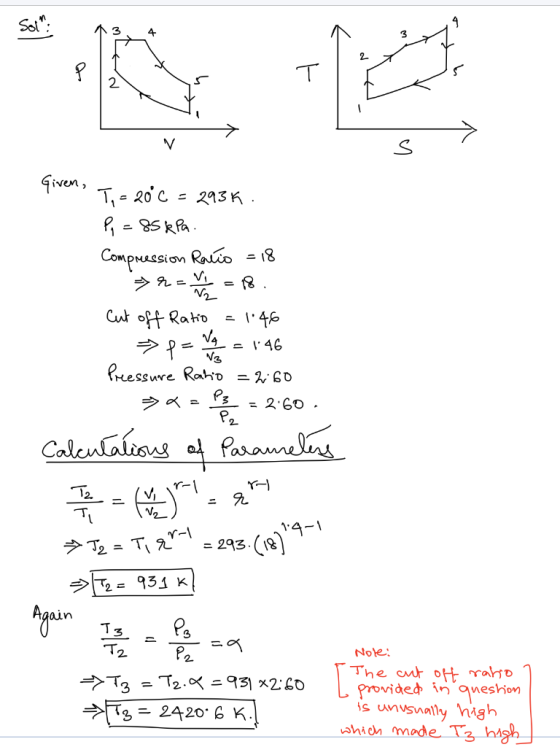
1. Air standard dual cycle. Compression starts with in-cylinder conditions of T = 20°C and P = 85 kPa. The compression ratio is 18. The cut-off ratio is 1.46. The pressure ratio is 2.60.
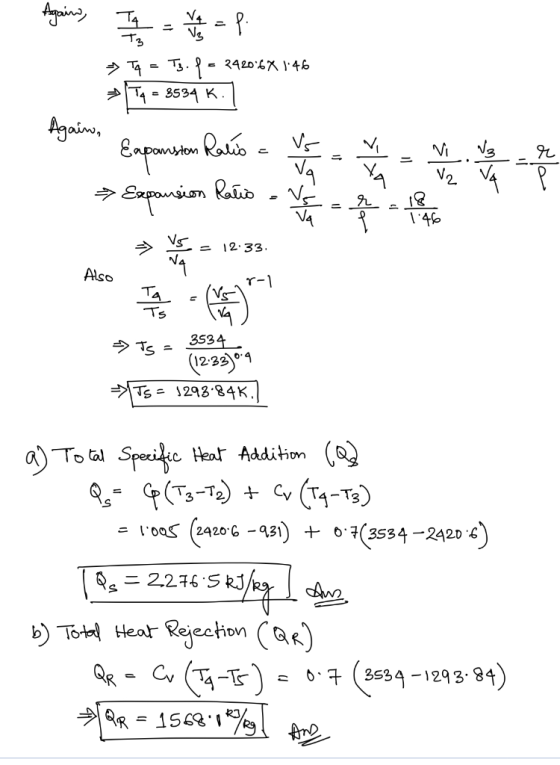
a) Determine the total specific heat addition [kJ/kg, 3].
b) Determine the total heat rejection [kJ/kg. 3].
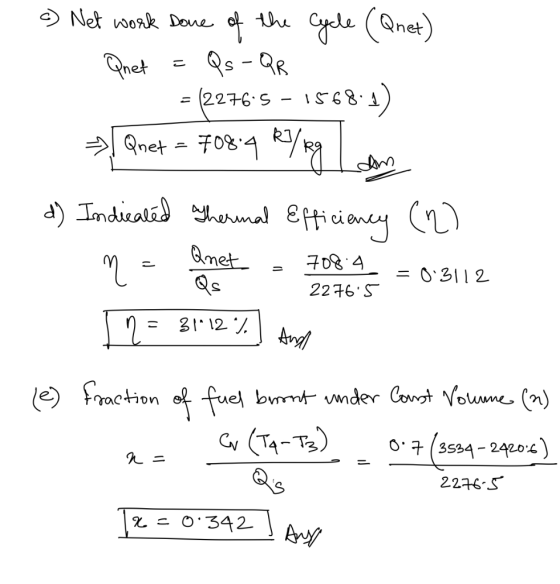
c) Determine the net work of the cycle [kJ/kg, 3].
d) Determine the indicated thermal efficiency [unitless, 3].
e) What fraction of the fuel burned under constant volume conditions? Assume that all of the fuel is present at the start of combustion (that is, neglect the fact that the mass is constantly changing due to fuel injection). Also, assume that the combustion efficiency is the same during constant-volume and constant-pressure combustion.
Homework Answers
In this question we will first draw the PV Diagram and T S Diagram and take its help and help of thermodynamic equations to find out parameters at different points. This will help us at arriving at the answer.
We have found out the Value of efficiency as approximately 31 %
which is accurate. However it is smaller than expected as pressure
ratio (2.6) is very high.
Note : I have solved it using Cv =0.7 KJ/KgK. You can use Cv=0.718
Kg/KgK if you want.
Hope you like my solution and give me a ??. Happy Chegging.
Add Answer to:
1. Air standard dual cycle. Compression starts with in-cylinder
conditions of T = 20°C and P...
An ideal dual combustion cycle operates on 454 kg. of air. At the beginning of compression,...
 An ideal dual combustion cycle operates on 454 kg. of air. At the beginning of compression, the air is at 96.53 kPa, 43.3-degree Celsius. Pressure ratio is equal to 1.5, cut-off ratio is 1.6, and compression ratio is 11. Using the air properties, determine (a) the percentage clearance (b) the pressure, the volume, and the temperature at each corner of the cycle, (c) Heat added, Heat rejected, and work net, (d) the thermal efficiency (e) the MEP in kPa.
Problem 9.025 SI An air-standard dual cycle has a compression ratio of 8.6 and displacement of...
 Problem 9.025 SI An air-standard dual cycle has a compression ratio of 8.6 and displacement of Vo = 2.2 L. At the beginning of compression, P1 = 95 kPa, and T1 = 290 K. The heat addition is 4.25 kJ, with one quarter added at constant volume and the rest added at constant pressure. Determine: c) each of the unknown temperatures at the various states, in K. the net work of the cycle, in kJ. the power developed at 3000...
An air-standard dual cycle has a compression ratio of 9.1 and displacement of Vd= 2.2 L....
An air-standard dual cycle has a compression ratio of 9.1 and displacement of Vd= 2.2 L. At the beginning of compression, p1 = 95 kPa, and T1 = 290 K. The heat addition is 4.75 kJ, with one quarter added at constant volume and the rest added at constant pressure. Determine: a) each of the unknown temperatures at the various states, in K. b) the net work of the cycle, in kJ. c) the power developed at 3000 cycles per...
A Diesel engine is approximated by a pressure limited (dual) cycle. The data is as follows:...
 A Diesel engine is approximated by a pressure limited (dual)
cycle. The data is as follows:
A Diesel engine is approximated by a pressure limited (dual) cycle. The data is as follows: Inlet temperature and pressure: P1 = 100 kPa, T1 = 298 K Compression ratio = 16:1 Heat added during combustion = 44000 kJ/kgfuel (please note that this value is per kg fuel) A/F = 23 kg/kgf 40% of the heat is added in the constant volume combustion part....
A Diesel engine is approximated by a pressure limited (dual)
cycle. The data is as follows:
A Diesel engine is approximated by a pressure limited (dual) cycle. The data is as follows: Inlet temperature and pressure: P1 = 100 kPa, T1 = 298 K Compression ratio = 16:1 Heat added during combustion = 44000 kJ/kgfuel (please note that this value is per kg fuel) A/F = 23 kg/kgf 40% of the heat is added in the constant volume combustion part....
Calculate without constant specific heat (Cp). An air-standard dual cycle has a compression ratio of 14...
Calculate without constant specific heat (Cp). An air-standard dual cycle has a compression ratio of 14 and cut-off ratio of 1.2. The pressure ratio during constant volume heat addition is 1.5. Determine the: (A) Thermal efficiency (B) Amount of heat added (C) Maximum gas pressure and temperature when the cycle is operated at 80kPA and 20°C at the beginning of the compression.
A Diesel engine is approximated by a pressure limited (dual) cycle. The data is as follows:...
 A Diesel engine is approximated by a pressure limited (dual) cycle. The data is as follows: Inlet temperature and pressure: P1 = 100 kPa, T = 298 K Compression ratio = 16:1 Heat added during combustion = 44000 kJ/kgfuel (please note that this value is per kg fuel) A/F = 23 kg/kgf 40% of the heat is added in the constant volume combustion part. k=1.3, CH = 0.81 kJ/kg.K, isentropic expansion and compression Find the values of pressure rise parameter...
A Diesel engine is approximated by a pressure limited (dual) cycle. The data is as follows:...
 A Diesel engine is approximated by a pressure limited (dual) cycle. The data is as follows: Inlet temperature and pressure: P, = 100 kPa, T = 298 K Compression ratio = 16:1 Heat added during combustion = 44000 kJ/kgfuel (please note that this value is per kg fuel) A/F = 23 kg./kgf 40% of the heat is added in the constant volume combustion part. k=1.3, Cv = 0.81 kJ/kg.K, isentropic expansion and compression Find the values of pressure rise parameter...
Use variable specific heats. An air-standard dual cycle has a compression ratio of 14 and cut-off...
Use variable specific heats. An air-standard dual cycle has a compression ratio of 14 and cut-off ratio of 1.2. The pressure ratio during constant volume heat addition (process 2-X) is 1.5. Determine the: (A) Thermal efficiency (B) Amount of heat added (C) Maximum gas pressure and temperature when the cycle is operated at 80kPA and 20°C at the beginning of the compression. Use variable specific heats.
QUESTION 2(25%) A Diesel engine is approximated by a pressure limited (dual) cycle. The data is...
 QUESTION 2(25%) A Diesel engine is approximated by a pressure limited (dual) cycle. The data is as follows: Inlet temperature and pressure: P. = 100 kPa, T, = 298 K Compression ratio=16:1 Heat added during combustion = 44000 kJ/kgfuel (please note that this value is per kg fuel) A/F = 23 kg/kg 40% of the heat is added in the constant volume combustion part. k = 1.3, C, = 0.81 kJ/kg.K, isentropic expansion and compression Find the values of pressure...
QUESTION 2(25%) A Diesel engine is approximated by a pressure limited (dual) cycle. The data is...
 QUESTION 2(25%) A Diesel engine is approximated by a pressure limited (dual) cycle. The data is as follows: Inlet temperature and pressure: P. = 100 kPa, T, = 298 K Compression ratio=16:1 Heat added during combustion = 44000 kJ/kgfuel (please note that this value is per kg fuel) A/F = 23 kg/kg 40% of the heat is added in the constant volume combustion part. k = 1.3, C, = 0.81 kJ/kg.K, isentropic expansion and compression Find the values of pressure...
 An ideal dual combustion cycle operates on 454 kg. of air. At the beginning of compression, the air is at 96.53 kPa, 43.3-degree Celsius. Pressure ratio is equal to 1.5, cut-off ratio is 1.6, and compression ratio is 11. Using the air properties, determine (a) the percentage clearance (b) the pressure, the volume, and the temperature at each corner of the cycle, (c) Heat added, Heat rejected, and work net, (d) the thermal efficiency (e) the MEP in kPa.
 Problem 9.025 SI An air-standard dual cycle has a compression ratio of 8.6 and displacement of Vo = 2.2 L. At the beginning of compression, P1 = 95 kPa, and T1 = 290 K. The heat addition is 4.25 kJ, with one quarter added at constant volume and the rest added at constant pressure. Determine: c) each of the unknown temperatures at the various states, in K. the net work of the cycle, in kJ. the power developed at 3000...
 A Diesel engine is approximated by a pressure limited (dual)
cycle. The data is as follows:
A Diesel engine is approximated by a pressure limited (dual) cycle. The data is as follows: Inlet temperature and pressure: P1 = 100 kPa, T1 = 298 K Compression ratio = 16:1 Heat added during combustion = 44000 kJ/kgfuel (please note that this value is per kg fuel) A/F = 23 kg/kgf 40% of the heat is added in the constant volume combustion part....
A Diesel engine is approximated by a pressure limited (dual)
cycle. The data is as follows:
A Diesel engine is approximated by a pressure limited (dual) cycle. The data is as follows: Inlet temperature and pressure: P1 = 100 kPa, T1 = 298 K Compression ratio = 16:1 Heat added during combustion = 44000 kJ/kgfuel (please note that this value is per kg fuel) A/F = 23 kg/kgf 40% of the heat is added in the constant volume combustion part....
 A Diesel engine is approximated by a pressure limited (dual) cycle. The data is as follows: Inlet temperature and pressure: P1 = 100 kPa, T = 298 K Compression ratio = 16:1 Heat added during combustion = 44000 kJ/kgfuel (please note that this value is per kg fuel) A/F = 23 kg/kgf 40% of the heat is added in the constant volume combustion part. k=1.3, CH = 0.81 kJ/kg.K, isentropic expansion and compression Find the values of pressure rise parameter...
 A Diesel engine is approximated by a pressure limited (dual) cycle. The data is as follows: Inlet temperature and pressure: P, = 100 kPa, T = 298 K Compression ratio = 16:1 Heat added during combustion = 44000 kJ/kgfuel (please note that this value is per kg fuel) A/F = 23 kg./kgf 40% of the heat is added in the constant volume combustion part. k=1.3, Cv = 0.81 kJ/kg.K, isentropic expansion and compression Find the values of pressure rise parameter...
 QUESTION 2(25%) A Diesel engine is approximated by a pressure limited (dual) cycle. The data is as follows: Inlet temperature and pressure: P. = 100 kPa, T, = 298 K Compression ratio=16:1 Heat added during combustion = 44000 kJ/kgfuel (please note that this value is per kg fuel) A/F = 23 kg/kg 40% of the heat is added in the constant volume combustion part. k = 1.3, C, = 0.81 kJ/kg.K, isentropic expansion and compression Find the values of pressure...
 QUESTION 2(25%) A Diesel engine is approximated by a pressure limited (dual) cycle. The data is as follows: Inlet temperature and pressure: P. = 100 kPa, T, = 298 K Compression ratio=16:1 Heat added during combustion = 44000 kJ/kgfuel (please note that this value is per kg fuel) A/F = 23 kg/kg 40% of the heat is added in the constant volume combustion part. k = 1.3, C, = 0.81 kJ/kg.K, isentropic expansion and compression Find the values of pressure...
Most questions answered within 3 hours.
-
Where is the error in this code sequence?
String s1 = "Hello";
String s2 = "ello";...
asked 11 months ago -
Financial data for Joel de Paris, Inc., for last year
follow:
Joel de Paris, Inc.
Balance...
asked 11 months ago -
Consider this reaction:
Al2(SO4)3 (aq)+ BaCl3
(aq) Al2Cl6 (aq)- +
3BaSO4(s) . What is the...
asked 11 months ago -
Suppose that Savneet is considering increasing her
recent random sample from 20 car rentals to 40...
asked 11 months ago -
Trucks arrive at an unloading terminal at an average rate of 120
per hour.
Trucks arrive...
asked 11 months ago -
Why are methanol and ethanol completely soluble in water while
octanol is not very little soluble....
asked 11 months ago -
A facilities manager at a university reads in a research report
that the mean amount of...
asked 11 months ago -
When the CuSO4 is rehydrated by adding water to the anhydrous
compound, is this an endothermic...
asked 11 months ago -
A ray of sunlight is passing from diamond into crown glass; the
angle of incidence is...
asked 11 months ago -
A block of mass 0.249 kg is placed on top of a light, vertical
spring of...
asked 11 months ago -
how do the kidneys compensate in the presences of acidosis
a) trigger hyperventilate
b) reserve acid...
asked 11 months ago -
Question 501 pts
The rental rate of capital to the firm increases. Which of the
following...
asked 11 months ago