A freight firm holds a monopoly over rail freight transport in Australia. The freight firm has...
A freight firm holds a monopoly over rail freight transport in Australia. The freight firm has two types of customers:
• Coal mining companies’ demand for freight services is
Qc = 38 − Pc .
• Grain farmers’ demand for freight services is Qg = 56
− 4Pg .
All quantities are measured in tonnes. The firm faces a constant marginal cost of $10 per tonne, regardless of which commodity is being transported. The firm has no fixed costs.
a) Express the demand for each group of customers as an inverse demand function. Sketch the inverse demand functions of the two groups in a single diagram (with P on the vertical axis and Q on the horizontal axis). Which is the larger market segment? What is the “choke price”, i.e. the price above which there is no demand, for each group of customers?
b) Write a total cost function for the firm as a function of quantity of goods transported.
c) If the firm can discriminate between coal miners and grain farmers, what price will it charge to each group of customers?
d) What is the firm’s profit under price discrimination?
e) Now suppose that the government regulates, requiring the monopoly to charge a uniform price. Find the optimal uniform price and the corresponding firm profit. [Hints: First derive the combined demand of the two market segments, and then express it as an inverse demand function. Note that this combined inverse demand function is NOT a continuous straight line. It may be instructive to graph the combined inverse demand function before deriving the freight firm’s optimal uniform price.]
f) Which, if any, group of customers benefits from price discrimination in this instance? What does it tell you about price discrimination in general?
Homework Answers
Demand functions as given-
Coal Miners: Qc = 38 − Pc ...... (i)
Grain farmers: Qg = 56 − 4Pg ..... (ii)
a. Inverse demand functions are-
Coal Miners: Pc = 38 - Qc ..... (iii)
Grain farmers: Pg= (56 − Qg ) / 4 ..... (iv)
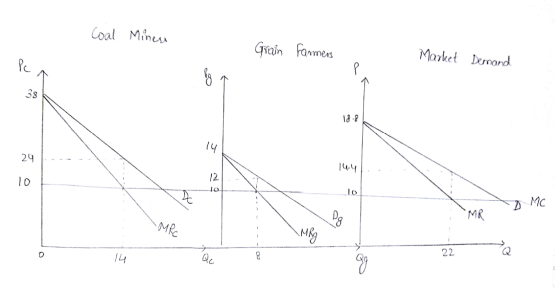
Larger market segment is that for the coal miners of demand equal to 14 tonnes.
Choke Price, the price above which the demand is zero-
Pg = 14
Pc = 38
lower the choke price, more elastic the demand curve. Hence the demand curve of Grain farmers is more elastic as compared to coal miners.
Total demand (horizontal summing of demand by coal miners and grain farmers) = 94 - 5P
P = 18.8 when Q = 0
********
b. Total Cost function-
TC = 10 (Qc + Qg)
*****
c. Coal Miners
TRc = (38 - Qc) * Qc
TRc = 38 Qc - Qc2
therefore, MRc = 38 - 2Qc .... (v)
MC = MRc
10 = 38 - 2Qc
Qc = 14
Pc = 38 - 14 = 24
Grain Framers
TRg = (14 - 1/4*Qg) * Qg
TRg = 14 Qg - 1/4*Qg 2
therefore, MRg = 14 - 1/2*Qg .... (vi)
MC = MRg
10 = 14 - 1/2*Qg
Qg = 8
Pg = (56 − Qg ) / 4
Pg = 12
*********
d. Profit
Profit = TRc + TRg - TC
Profit = 38 Qc - Qc2 + 14 Qg - 1/4*Qg 2 - (10 (Qc + Qg))
substituting values
Profit = 38 * 14 - 196 + 14(8) - 16 - 220
= 532-196 + 112 -16 -220
= 644 - 432
Profit = 212
*******
Add Answer to:
A freight firm holds a monopoly over rail freight transport in
Australia. The freight firm has...
1. Suppose there are two potential customers in the market. One has demand function D1(p)=10-p ....
1. Suppose there are two potential customers in the market. One has demand function D1(p)=10-p . The other has demand function D2(p)=20-2p. The only firm in this market has constant marginal cost of 2. (1) Draw the two demand curves in a graph, with price on the vertical axis and demand on the horizontal axis. (2) (3rd-degree price discrimination) If the monopoly can identify the two consumers and charge different prices to them, what is the optimal price charged to...
1. Suppose there are two potential customers in the market. One has demand function D1(p)=10-p ....
1. Suppose there are two potential customers in the market. One has demand function D1(p)=10-p . The other has demand function D2(p)=20-2p. The only firm in this market has constant marginal cost of 2. (1) Draw the two demand curves in a graph, with price on the vertical axis and demand on the horizontal axis. (2) (3rd-degree price discrimination) If the monopoly can identify the two consumers and charge different prices to them, what is the optimal price charged to...
1) The "Profit-Max/Loss-Min/Shutdown Rule" applies to: Group of answer choices Pure Monopoly only Perfect Competition only...
1) The "Profit-Max/Loss-Min/Shutdown Rule" applies to: Group of answer choices Pure Monopoly only Perfect Competition only Most market structures All market structures 3) A firm in a monopoly market structure always operates at an economic profit. Group of answer choices True False 4) Comparing monopoly and competitive market structures, "Deadweight Loss" refers to: Group of answer choices Underground markets developing to supply the monopoly good. Shortages caused by high monopoly pricing. The production gap resulting from under-allocation of resources. Surpluses...
Stewie is the only supplier of Cold Hwhip in Quahog, giving him a monopoly. His only customer, Meg, has inverse demand g...
Stewie is the only supplier of Cold Hwhip in Quahog, giving him a monopoly. His only customer, Meg, has inverse demand given by p = 8 − q and Stewie as a marginal cost of 4 for each tub of Cold Hwhip. (a) Find the profit-maximizing uniform price and quantity, as well as Stewie’s profits (b) Now suppose Brian gets wind of Stewie’s Cold Hwhip and wants to buy some as well. Brian’s inverse demand is p = 20 −...
7) A for-profit firm is bidding on a contract that would make it the sole provider...
 7) A for-profit firm is bidding on a contract that would make it the sole provider of trash and recycling pick-up services in a city. The city-wide demand for trash and recycling pick-up is given by Qp = 50,000 - 200P where is measured in tons of material picked up and P is the price per ton. That demand curve implies that the inverse demand (i.e., rewriting the demand equation with as a function of P) for trash and recycling...
Consider a monopoly (firm A) which produces and sells gadgets. The firm has been around for...
Consider a monopoly (firm A) which produces and sells gadgets. The firm has been around for along time, implying it has no fixed cost for the production. The inverse market demand function is: P= 14−Q, wherePis the price of gadgets, Q is total supply. Firm A’s marginal (and average-)cost for producing gadgets is 2. 1. Suppose now that a firm B considers entering the market. If it enters, the two firms decideabout production volumes simultaneously. Firm B has the same...
1) Decreasing returns to scale may occur as increasing the amount of inputs used A) increases...
 1) Decreasing returns to scale may occur as increasing the amount of inputs used A) increases specialization B) may cause coordination difficulties. C) always increases the amount of output produced D) increases efficiency. 2) Which of the following statements is NOT true? A) AFC = AC - AVC C) AVC = wage/MPL B) AC = AFC + AVC D) C=F-VC 3) The more elastic the demand curve, a monopoly A) will have a larger Lemer Index. will face a lower...
OPS Practice quiz 2. The benefits of risk pooling depend on the behavior of demand from...
OPS Practice quiz 2. The benefits of risk pooling depend on the behavior of demand from one market relative to demand from another. True False 3. What is Supply Chain Management? A set of approaches utilized to efficiently integrate suppliers, manufacturers, warehouses and stores so that merchandize is produced, distributed at the right quantities, to the right locations and at the right time in order to minimize system wide costs while satisfying service level requirements. The management of the flow...
 7) A for-profit firm is bidding on a contract that would make it the sole provider of trash and recycling pick-up services in a city. The city-wide demand for trash and recycling pick-up is given by Qp = 50,000 - 200P where is measured in tons of material picked up and P is the price per ton. That demand curve implies that the inverse demand (i.e., rewriting the demand equation with as a function of P) for trash and recycling...
 1) Decreasing returns to scale may occur as increasing the amount of inputs used A) increases specialization B) may cause coordination difficulties. C) always increases the amount of output produced D) increases efficiency. 2) Which of the following statements is NOT true? A) AFC = AC - AVC C) AVC = wage/MPL B) AC = AFC + AVC D) C=F-VC 3) The more elastic the demand curve, a monopoly A) will have a larger Lemer Index. will face a lower...
Most questions answered within 3 hours.
-
Where is the error in this code sequence?
String s1 = "Hello";
String s2 = "ello";...
asked 10 months ago -
Financial data for Joel de Paris, Inc., for last year
follow:
Joel de Paris, Inc.
Balance...
asked 10 months ago -
Consider this reaction:
Al2(SO4)3 (aq)+ BaCl3
(aq) Al2Cl6 (aq)- +
3BaSO4(s) . What is the...
asked 10 months ago -
Suppose that Savneet is considering increasing her
recent random sample from 20 car rentals to 40...
asked 10 months ago -
Trucks arrive at an unloading terminal at an average rate of 120
per hour.
Trucks arrive...
asked 10 months ago -
Why are methanol and ethanol completely soluble in water while
octanol is not very little soluble....
asked 10 months ago -
A facilities manager at a university reads in a research report
that the mean amount of...
asked 10 months ago -
When the CuSO4 is rehydrated by adding water to the anhydrous
compound, is this an endothermic...
asked 10 months ago -
A ray of sunlight is passing from diamond into crown glass; the
angle of incidence is...
asked 10 months ago -
A block of mass 0.249 kg is placed on top of a light, vertical
spring of...
asked 10 months ago -
how do the kidneys compensate in the presences of acidosis
a) trigger hyperventilate
b) reserve acid...
asked 10 months ago -
Question 501 pts
The rental rate of capital to the firm increases. Which of the
following...
asked 10 months ago