What happens to pKa if some mass of the acid was lost while transfer before begging...
What happens to pKa if some mass of the acid was lost while transfer before begging a titration
Homework Answers

Add Answer to:
What happens to pKa if some mass of the acid was lost while
transfer before begging...
Part A: Numerical Practice A student chemist was investigating the molar mass and pKa of an...
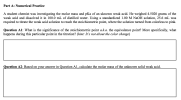 Part A: Numerical Practice A student chemist was investigating the molar mass and pKa of an uknown weak acid. He weighed 4.5020 grams of the weak acid and dissolved it in 100.0 mL of distilled water. Using a standardized 1.00 M NaOH solution, 25.6 mL was required to titrate the weak acid solution to reach the stoichiometric point, where the solution turned from colorless to pink. Question A1: What is the significance of the stoichiometric point a.k.a. the equivalence point?...
For the titration of a weak acid with a strong base what is the pKa of...
For the titration of a weak acid with a strong base what is the pKa of the weak acid if the pH is 6.72 at the equilvalence point (100% T), 9.12 at the end point, and 3.3 at 50% T? Please answer with one sig fig.
1) Titration curve of aspartate/ aspartic acid? 2) What happens when aspartic acid reacting with excess...
1) Titration curve of aspartate/ aspartic acid? 2) What happens when aspartic acid reacting with excess hydrochloric acid? explain what happens to structure of amino acid 3) What happens when aspartic acid reacts with excess sodium hydroxide? explain what happens to structure of amino acid
What is the pH of 1.0 mol of acetic acid (pKa = 4.76) in the presence...
What is the pH of 1.0 mol of acetic acid (pKa = 4.76) in the presence of 0.3 mol of NaOH? Is this in the buffering region based on the titration curve?
Below is shown an acid-base (proton transfer) reaction. Using the pka information presented in lecture, calculate...
 Below is shown an acid-base (proton transfer) reaction. Using the pka information presented in lecture, calculate the pKa value for the species in the box. Keq = 10-9.1 + CH3OH + CH30 Z -I
3) A weak monoprotic acid has a pKa 6.15. 50.00 mL of an 0.1250M aqueous solution...
 3) A weak monoprotic acid has a pKa 6.15. 50.00 mL of an 0.1250M aqueous solution of this weak acid is titrated with 0.1000M NaOH. a) What is the equivalence point volume and 2 equivalence point volume for this titration? Find the pH b) before the titration begins; c) after 20.00 mL of the NAOH has been added, d) after 62.50 mL of the NaOH has been added; and e) after 85.00 mL of the NAOH has been added. 4)...
what happens to organic compounds upon exposure to NaOH or HCl. how we use pka data...
what happens to organic compounds upon exposure to NaOH or HCl. how we use pka data to predict reactivity and choose a correct reagent. how is it applied to acid-base extraction?
Question 8 For the polyprotic acid histidine (HisH3), the hydrogens in bold can be lost. When...
 Question 8 For the polyprotic acid histidine (HisH3), the hydrogens in bold can be lost. When HisH3t is titrated w to reach the second pka? Another way of asking this is when presented with a titration curve of Hisha A. 45 ml B. 37.5 mL C. 30 mL OD. 15 mL E. 22.5 mL Question 8 121 O points Save Answer with NaOH and it takes 45.0 mL to remove all protons possible. In the titration curve, how many mL...
What is the predominant form of pyruvic acid (pKa =2.50) and lactic acid (pKa = 3.86)...
What is the predominant form of pyruvic acid (pKa =2.50) and lactic acid (pKa = 3.86) at physiological pH (7.4)? Draw the predominant structure of each. In which amino acid does the R group bond to the amino group?
20) the pH at the half titrated point of a weak acid strong base titration curve is 4.15, what is the pka and the f...
 20) the pH at the half titrated point of a weak acid strong base titration curve is 4.15, what is the pka and the for the weak acid being titrated 9 7.08X10⁻⁹ Opha 4.15
 Part A: Numerical Practice A student chemist was investigating the molar mass and pKa of an uknown weak acid. He weighed 4.5020 grams of the weak acid and dissolved it in 100.0 mL of distilled water. Using a standardized 1.00 M NaOH solution, 25.6 mL was required to titrate the weak acid solution to reach the stoichiometric point, where the solution turned from colorless to pink. Question A1: What is the significance of the stoichiometric point a.k.a. the equivalence point?...
 Below is shown an acid-base (proton transfer) reaction. Using the pka information presented in lecture, calculate the pKa value for the species in the box. Keq = 10-9.1 + CH3OH + CH30 Z -I
 3) A weak monoprotic acid has a pKa 6.15. 50.00 mL of an 0.1250M aqueous solution of this weak acid is titrated with 0.1000M NaOH. a) What is the equivalence point volume and 2 equivalence point volume for this titration? Find the pH b) before the titration begins; c) after 20.00 mL of the NAOH has been added, d) after 62.50 mL of the NaOH has been added; and e) after 85.00 mL of the NAOH has been added. 4)...
 Question 8 For the polyprotic acid histidine (HisH3), the hydrogens in bold can be lost. When HisH3t is titrated w to reach the second pka? Another way of asking this is when presented with a titration curve of Hisha A. 45 ml B. 37.5 mL C. 30 mL OD. 15 mL E. 22.5 mL Question 8 121 O points Save Answer with NaOH and it takes 45.0 mL to remove all protons possible. In the titration curve, how many mL...
 20) the pH at the half titrated point of a weak acid strong base titration curve is 4.15, what is the pka and the for the weak acid being titrated 9 7.08X10⁻⁹ Opha 4.15
Most questions answered within 3 hours.
-
Where is the error in this code sequence?
String s1 = "Hello";
String s2 = "ello";...
asked 11 months ago -
Financial data for Joel de Paris, Inc., for last year
follow:
Joel de Paris, Inc.
Balance...
asked 11 months ago -
Consider this reaction:
Al2(SO4)3 (aq)+ BaCl3
(aq) Al2Cl6 (aq)- +
3BaSO4(s) . What is the...
asked 11 months ago -
Suppose that Savneet is considering increasing her
recent random sample from 20 car rentals to 40...
asked 11 months ago -
Trucks arrive at an unloading terminal at an average rate of 120
per hour.
Trucks arrive...
asked 11 months ago -
Why are methanol and ethanol completely soluble in water while
octanol is not very little soluble....
asked 11 months ago -
A facilities manager at a university reads in a research report
that the mean amount of...
asked 11 months ago -
When the CuSO4 is rehydrated by adding water to the anhydrous
compound, is this an endothermic...
asked 11 months ago -
A ray of sunlight is passing from diamond into crown glass; the
angle of incidence is...
asked 11 months ago -
A block of mass 0.249 kg is placed on top of a light, vertical
spring of...
asked 11 months ago -
how do the kidneys compensate in the presences of acidosis
a) trigger hyperventilate
b) reserve acid...
asked 11 months ago -
Question 501 pts
The rental rate of capital to the firm increases. Which of the
following...
asked 11 months ago