The pH pH scale for acidity is defined by pH = − log 10 [ H...
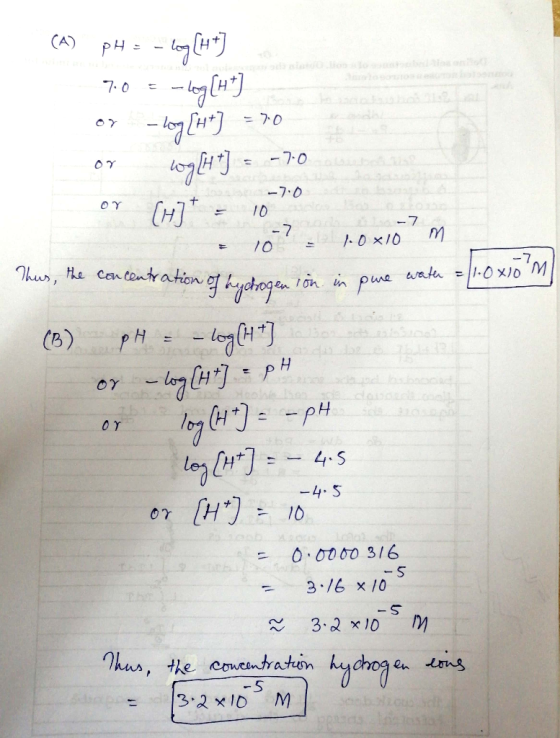
The pH pH scale for acidity is defined by pH = − log 10 [ H + ] pH=-log10[H+] where [ H + ] [H+] is the concentration of hydrogen ions measured in moles per liter (M). (A) The pH pH of pure water is 7.0. Calculate the concentration of hydrogen ions in moles per liter (M). [ H + ] = [H+]= M (B) The pH pH of tomatoes is 4.5. Calculate the concentration of hydrogen ions in moles per liter (M). [ H + ] =
Homework Answers
Answer:
(A). Concentration of hydrogen ion, [H+] = 1.0x10⁻⁷ M
(B). Concentration of hydrogen ion, [H+] = 3.2x10⁻⁵ M
The pH scale measures the acidity of a solution and is represented by the equation pH...
 The pH scale measures the acidity of a solution and is represented by the equation pH = -log(+1) where [H+] is the concentration of hydrogen ions in solution in moles per litre. An acid solution has [H*]=5.3 x 10⁻⁶. Find the pH. A. 5.25 B. 6.23 C.5.28 OD. 5.25
The acidity of a solution can be measured by pH=-log([H+] =-log([H3O+]. What is the pH of...
The acidity of a solution can be measured by pH=-log([H+] =-log([H3O+]. What is the pH of a solution if the concentration of H3O+ ions is 1.0X10^-5 M
18. Acidity of a solution is determined by the concentration Hof hydrogen ions in the solution (measured in moles p...
 18. Acidity of a solution is determined by the concentration Hof hydrogen ions in the solution (measured in moles per liter of solution). Chemists use the negative of the logarithm of the concentration of hydrogen ions to define the pH scale. pH = -log H Solution A has a pH value of 5.6 and solution B has a pH value of 2.7. Compare the acidity of the two solutions. a) Solution A is more acidic by a factor of 2.07...
The stomach of a healthy person has pH=2. pH= -1 log [H+] where the concentration of...
The stomach of a healthy person has pH=2. pH= -1 log [H+] where the concentration of hydrogen ions is given in moles per liter. What is the concentration of hydrogen ions in a healthy person's stomach? Show your work.
Compute [H+] for a solution for which pH = 4.3. (Round your answer eight decimal places.)
Use the acidity model pH = -log[H+] where acidity (pH) is a measure of the hydrogen ion concentration [H+] (in moles of hydrogen per liter) of a solution. Compute [H+] for a solution for which pH = 4.3. (Round your answer eight decimal places.) _______ moles per liter
2 points 11 My Notes Acidity of solution is determined by the concentration C of hydrogen ions in the solution (measure...
 2 points 11 My Notes Acidity of solution is determined by the concentration C of hydrogen ions in the solution (measured in moles per liter of solution). Chemists use the negative of the logarithm the following formula. of the concentration of hydrogen ions to define the pH scale, as shown pH log (C) Lower pH values indicate a more acidic solution. (a) Normal rain has a pH value of 5.6. Rain in the eastern United States often has a pH...
E. 59) The pH of a solution ranges from 0 to 14. An acid has a pH less than 7. Pure water is neut...
 e. 59) The pH of a solution ranges from 0 to 14. An acid has a pH less than 7. Pure water is neutral and has a pH of 7. The pH of a solution is given by pH--log (x)where x represents the concentration of the hydrogen ions in the solution in moles per liter. Find the pH if the hydrogen ion concentration is 3 x 10⁻³, A) 3.52 B) 2.48 C) 2.52 D) 3.48
e. 59) The pH of...
e. 59) The pH of a solution ranges from 0 to 14. An acid has a pH less than 7. Pure water is neutral and has a pH of 7. The pH of a solution is given by pH--log (x)where x represents the concentration of the hydrogen ions in the solution in moles per liter. Find the pH if the hydrogen ion concentration is 3 x 10⁻³, A) 3.52 B) 2.48 C) 2.52 D) 3.48
e. 59) The pH of...
What is acidity and what are the compounds controlling it? Acidity is a measure of the...
 What is
acidity and what are the compounds controlling it?
Acidity is a measure of
the concentration of hydrogen ions (H+ or protons) in a solution. We
use pH (potential of H+) as a scale of acidity and this can be
calculated as below:
pH =
-log10[H+] =
log10
(1/[H+])
Q1. Figure 10.3 shows you a range
of pH in some common liquids. Pick 2 liquids (one each from acidic
and basic solutions) and compare the molarity of
[H+] in...
What is
acidity and what are the compounds controlling it?
Acidity is a measure of
the concentration of hydrogen ions (H+ or protons) in a solution. We
use pH (potential of H+) as a scale of acidity and this can be
calculated as below:
pH =
-log10[H+] =
log10
(1/[H+])
Q1. Figure 10.3 shows you a range
of pH in some common liquids. Pick 2 liquids (one each from acidic
and basic solutions) and compare the molarity of
[H+] in...
) The acidity or alkalinity of a solution is described using the pH scale. Basically, pH...
 ) The acidity or alkalinity of a solution is described using the pH scale. Basically, pH (which stands for "potential of hydrogen") is a measure of how many H+ ions there are in a solution. As we saw in the previous question, the more H*s there are in a solution, the more acidic it is. The formula for calculating pH is given below: In words, pH equals the negative log base ten of the hydrogen ion concentration. Solution X has...
pH is a logarithmic scale used to indicate the hydrogen ion concentration, [H+], of a solution:...
pH is a logarithmic scale used to indicate the hydrogen ion concentration, [H+], of a solution: pH=−log[H+] Due to the autoionization of water, in any aqueous solution, the hydrogen ion concentration and the hydroxide ion concentration, [OH−], are related to each other by the Kw of water: Kw=[H+][OH−]=1.00×10⁻¹⁴ where 1.00×10⁻¹⁴ is the value at approximately 297 K. Based on this relation, the pH and pOH are also related to each other as 14.00=pH+pOH Part B Part complete 0.25 g of...
 The pH scale measures the acidity of a solution and is represented by the equation pH = -log(+1) where [H+] is the concentration of hydrogen ions in solution in moles per litre. An acid solution has [H*]=5.3 x 10⁻⁶. Find the pH. A. 5.25 B. 6.23 C.5.28 OD. 5.25
 18. Acidity of a solution is determined by the concentration Hof hydrogen ions in the solution (measured in moles per liter of solution). Chemists use the negative of the logarithm of the concentration of hydrogen ions to define the pH scale. pH = -log H Solution A has a pH value of 5.6 and solution B has a pH value of 2.7. Compare the acidity of the two solutions. a) Solution A is more acidic by a factor of 2.07...
 2 points 11 My Notes Acidity of solution is determined by the concentration C of hydrogen ions in the solution (measured in moles per liter of solution). Chemists use the negative of the logarithm the following formula. of the concentration of hydrogen ions to define the pH scale, as shown pH log (C) Lower pH values indicate a more acidic solution. (a) Normal rain has a pH value of 5.6. Rain in the eastern United States often has a pH...
 e. 59) The pH of a solution ranges from 0 to 14. An acid has a pH less than 7. Pure water is neutral and has a pH of 7. The pH of a solution is given by pH--log (x)where x represents the concentration of the hydrogen ions in the solution in moles per liter. Find the pH if the hydrogen ion concentration is 3 x 10⁻³, A) 3.52 B) 2.48 C) 2.52 D) 3.48
e. 59) The pH of...
e. 59) The pH of a solution ranges from 0 to 14. An acid has a pH less than 7. Pure water is neutral and has a pH of 7. The pH of a solution is given by pH--log (x)where x represents the concentration of the hydrogen ions in the solution in moles per liter. Find the pH if the hydrogen ion concentration is 3 x 10⁻³, A) 3.52 B) 2.48 C) 2.52 D) 3.48
e. 59) The pH of...
 What is
acidity and what are the compounds controlling it?
Acidity is a measure of
the concentration of hydrogen ions (H+ or protons) in a solution. We
use pH (potential of H+) as a scale of acidity and this can be
calculated as below:
pH =
-log10[H+] =
log10
(1/[H+])
Q1. Figure 10.3 shows you a range
of pH in some common liquids. Pick 2 liquids (one each from acidic
and basic solutions) and compare the molarity of
[H+] in...
What is
acidity and what are the compounds controlling it?
Acidity is a measure of
the concentration of hydrogen ions (H+ or protons) in a solution. We
use pH (potential of H+) as a scale of acidity and this can be
calculated as below:
pH =
-log10[H+] =
log10
(1/[H+])
Q1. Figure 10.3 shows you a range
of pH in some common liquids. Pick 2 liquids (one each from acidic
and basic solutions) and compare the molarity of
[H+] in...
 ) The acidity or alkalinity of a solution is described using the pH scale. Basically, pH (which stands for "potential of hydrogen") is a measure of how many H+ ions there are in a solution. As we saw in the previous question, the more H*s there are in a solution, the more acidic it is. The formula for calculating pH is given below: In words, pH equals the negative log base ten of the hydrogen ion concentration. Solution X has...
Most questions answered within 3 hours.
-
Where is the error in this code sequence?
String s1 = "Hello";
String s2 = "ello";...
asked 10 months ago -
Financial data for Joel de Paris, Inc., for last year
follow:
Joel de Paris, Inc.
Balance...
asked 10 months ago -
Consider this reaction:
Al2(SO4)3 (aq)+ BaCl3
(aq) Al2Cl6 (aq)- +
3BaSO4(s) . What is the...
asked 10 months ago -
Suppose that Savneet is considering increasing her
recent random sample from 20 car rentals to 40...
asked 10 months ago -
Trucks arrive at an unloading terminal at an average rate of 120
per hour.
Trucks arrive...
asked 10 months ago -
Why are methanol and ethanol completely soluble in water while
octanol is not very little soluble....
asked 10 months ago -
A facilities manager at a university reads in a research report
that the mean amount of...
asked 10 months ago -
When the CuSO4 is rehydrated by adding water to the anhydrous
compound, is this an endothermic...
asked 10 months ago -
A ray of sunlight is passing from diamond into crown glass; the
angle of incidence is...
asked 10 months ago -
A block of mass 0.249 kg is placed on top of a light, vertical
spring of...
asked 10 months ago -
how do the kidneys compensate in the presences of acidosis
a) trigger hyperventilate
b) reserve acid...
asked 10 months ago -
Question 501 pts
The rental rate of capital to the firm increases. Which of the
following...
asked 10 months ago