The estimated demand for a good is Q=25-5p+0.32m+12pr where Q is the quantity demanded of the...
- The estimated demand for a good is Q=25-5p+0.32m+12pr
where Q is the quantity demanded of the good, P is the price of the good, M is income, and PR is the price of related good R. If the price of the good falls by $4, the quantity demanded will ________ by ________ units.- increase 5 units
- increase 20 units.
- increase 50 units
- increase 48 units
- decrease 12 units
- A theoretical restriction on the short-run cubic cost
equation, TVC = aQ + bQ + cQ2, is
- a > 0, b > 0, c > 0
- a > 0, b < 0, c > 0
- a > 0, b > 0, c < 0
- a > 0, b < 0, c < 0
Homework Answers
1. b. increase 20 units.
(We can see that as p changes by 1 unit so Q changes by -5 units.
So, if p decreases by 4 units then Q changes by (-5)*(-4) = 20
units.)
2. b. a > 0, b < 0, c >
0
(Constants a and c are positive while b is negative.)
Add Answer to:
The estimated demand for a good is Q=25-5p+0.32m+12pr
where Q is the quantity demanded of the...
The estimated demand for a good Is Q 3,600- 12P+ 0.6M- 2.5PR where Q Is the quantity demanded of the good, Pis the pric...
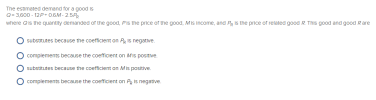 The estimated demand for a good Is Q 3,600- 12P+ 0.6M- 2.5PR where Q Is the quantity demanded of the good, Pis the price of the good, Mis Income, and P Is the price of related good R. This good and good Rare O substitutes because the coefficlent on P Is negative. O complements because the coefficlent on MIs positive. O substitutes because the coefficlent on M Is positive. O complements because the coefficlent on PR Is negative.
Suppose that the quantity of a good demanded rises from 90 units to 110 units when...
Suppose that the quantity of a good demanded rises from 90 units to 110 units when the price falls from $1.20 to 80 cents per unit. The own price elasticity of demand for this product is A)- 0.5. B) 1.0. C) 1.5. D) 0.5 E) 4.0. If the price elasticity of demand for some good is 2.7, a 2 percent increase in the price results in A) a 27% decrease in the quantity demanded. B) a 5.4% increase in the...
Let demand for good X be given by the functionld=100-5P and supply be given by Q;=5P-40....
 Let demand for good X be given by the functionld=100-5P and supply be given by Q;=5P-40. 4. What are the equilibrium price and quantity in this market? (3 points) a. b. Suppose the demand function shifts, doubling quantity demanded for every possible price. What is the new demand function? What are the new equilibrium price and quantity? (4 points)
QUESTION 1 To say that the quantity demanded of a good is negatively related to the...
 QUESTION 1 To say that the quantity demanded of a good is negatively related to the price of the good is to say that o a there is a weak relationship between the quantity demanded of a good and the price of the good o b. an increase in the quantity demanded of the good leads to a decrease in the price of the good O c, there is no relationship between the quantity demanded of a good and the...
The general linear demand for good X is estimated to be Q=250000-500P-1.5M-240PR Where P is the...
The general linear demand for good X is estimated to be Q=250000-500P-1.5M-240PR Where P is the price of good Q, M is average income of consumers who buy good Q, and PR is the price of related good R. The values of P, M, and PR are expected to be $200, $60,000, and $100, respectively. Use these values at this point on demand to make the following computations. A. Compute the quantity of good Q demanded for the given values...
Question 11 0.16 pts If the price and quantity for an inferior good, Good X, is...
 Question 11 0.16 pts If the price and quantity for an inferior good, Good X, is $8 and 6 units at the original equilibrium, what is one possibility for the new equilibrium of Good X if we see income increase and all other factors stay constant? O $6 and 8 units O $10 and 8 units $6 and 4 units O $10 and 2 units O $10 and 4 units Question 12 0.16 pts According to the law of demand,...
Assume a demand equation for good'x: where pown price of the good Q-quantity demanded Py price...
 Assume a demand equation for good'x: where pown price of the good Q-quantity demanded Py price of a related good $3 Pz price of a different related good $200 Y = consumer income = $4,000/mo The quantity demanded as a function of the price can be written:
19. An increase in the quantity demanded of a good is most often due to: a....
 19. An increase in the quantity demanded of a good is most often due to: a. a decrease in the price of a substitute good. b. higher prices. c. an increase in wages paid to workers. d. lower prices. 20.- An increase in the supply of the product implies: a. producers will now charge a lower price for a given quantity of output. b. the price of this product has increased. c. the supply curve will shift to the left....
4) Given the following demand function: Q = 50P-1.310.9 40.2 Where: Q: monthly quantity demanded A:...
 4) Given the following demand function: Q = 50P-1.310.9 40.2 Where: Q: monthly quantity demanded A: Advertising exp. (S000 US) : price in I: Disposable income (SUS) a) What is the price elasticity of demand (use calculus)? b) Will an increase in price increase or decrease the amount spent on this product? c) What is the income elasticity of demand?
Q3. The general linear demand for good X is estimated to be Q = 25,000 -...
 Q3. The general linear demand for good X is estimated to be Q = 25,000 - 80P-0.25M + 72P (6 Pts) where P is the price of good X, M is average income of consumers who buy good X, and P, is the price of related good R. The values of P, M, and P, are expected to be $100, $35,000, and $60, respectively. Use these values at this point on demand to make the following computations. a. Compute the...
 The estimated demand for a good Is Q 3,600- 12P+ 0.6M- 2.5PR where Q Is the quantity demanded of the good, Pis the price of the good, Mis Income, and P Is the price of related good R. This good and good Rare O substitutes because the coefficlent on P Is negative. O complements because the coefficlent on MIs positive. O substitutes because the coefficlent on M Is positive. O complements because the coefficlent on PR Is negative.
 Let demand for good X be given by the functionld=100-5P and supply be given by Q;=5P-40. 4. What are the equilibrium price and quantity in this market? (3 points) a. b. Suppose the demand function shifts, doubling quantity demanded for every possible price. What is the new demand function? What are the new equilibrium price and quantity? (4 points)
 QUESTION 1 To say that the quantity demanded of a good is negatively related to the price of the good is to say that o a there is a weak relationship between the quantity demanded of a good and the price of the good o b. an increase in the quantity demanded of the good leads to a decrease in the price of the good O c, there is no relationship between the quantity demanded of a good and the...
 Question 11 0.16 pts If the price and quantity for an inferior good, Good X, is $8 and 6 units at the original equilibrium, what is one possibility for the new equilibrium of Good X if we see income increase and all other factors stay constant? O $6 and 8 units O $10 and 8 units $6 and 4 units O $10 and 2 units O $10 and 4 units Question 12 0.16 pts According to the law of demand,...
 Assume a demand equation for good'x: where pown price of the good Q-quantity demanded Py price of a related good $3 Pz price of a different related good $200 Y = consumer income = $4,000/mo The quantity demanded as a function of the price can be written:
 19. An increase in the quantity demanded of a good is most often due to: a. a decrease in the price of a substitute good. b. higher prices. c. an increase in wages paid to workers. d. lower prices. 20.- An increase in the supply of the product implies: a. producers will now charge a lower price for a given quantity of output. b. the price of this product has increased. c. the supply curve will shift to the left....
 4) Given the following demand function: Q = 50P-1.310.9 40.2 Where: Q: monthly quantity demanded A: Advertising exp. (S000 US) : price in I: Disposable income (SUS) a) What is the price elasticity of demand (use calculus)? b) Will an increase in price increase or decrease the amount spent on this product? c) What is the income elasticity of demand?
 Q3. The general linear demand for good X is estimated to be Q = 25,000 - 80P-0.25M + 72P (6 Pts) where P is the price of good X, M is average income of consumers who buy good X, and P, is the price of related good R. The values of P, M, and P, are expected to be $100, $35,000, and $60, respectively. Use these values at this point on demand to make the following computations. a. Compute the...
Most questions answered within 3 hours.
-
Where is the error in this code sequence?
String s1 = "Hello";
String s2 = "ello";...
asked 10 months ago -
Financial data for Joel de Paris, Inc., for last year
follow:
Joel de Paris, Inc.
Balance...
asked 10 months ago -
Consider this reaction:
Al2(SO4)3 (aq)+ BaCl3
(aq) Al2Cl6 (aq)- +
3BaSO4(s) . What is the...
asked 10 months ago -
Suppose that Savneet is considering increasing her
recent random sample from 20 car rentals to 40...
asked 10 months ago -
Trucks arrive at an unloading terminal at an average rate of 120
per hour.
Trucks arrive...
asked 10 months ago -
Why are methanol and ethanol completely soluble in water while
octanol is not very little soluble....
asked 10 months ago -
A facilities manager at a university reads in a research report
that the mean amount of...
asked 10 months ago -
When the CuSO4 is rehydrated by adding water to the anhydrous
compound, is this an endothermic...
asked 10 months ago -
A ray of sunlight is passing from diamond into crown glass; the
angle of incidence is...
asked 10 months ago -
A block of mass 0.249 kg is placed on top of a light, vertical
spring of...
asked 10 months ago -
how do the kidneys compensate in the presences of acidosis
a) trigger hyperventilate
b) reserve acid...
asked 10 months ago -
Question 501 pts
The rental rate of capital to the firm increases. Which of the
following...
asked 10 months ago