Consider a double slit experiment with electrons as you studied in the class. Does light behave...
Consider a double slit experiment with electrons as
you studied in the class. Does light behave as a particle, or a
wave, or both? Briefly explain why? (10 marks)
(Take into account all possible cases.)
Homework Answers


Add Answer to:
Consider a double slit experiment with electrons as
you studied in the class. Does light behave...
Diffraction of light experiment using single slit and double slit interference experiment: Does the slit separation...
Diffraction of light experiment using single slit and double slit interference experiment: Does the slit separation affect the width of the peaks in the intensity curve or the envelope curve? What about the slit width? Explain briefly.
In the double-slit experiment, light particle is also called photon. Does the photons go through the...
In the double-slit experiment, light particle is also called photon. Does the photons go through the slits in the double-slit experiment? What happens if you reduce the light to one photon and direct it at the duble-slit ? How are double-slits related to holograms?
Consider the experiment in the figure _a double double- slit experiment. A particle may take four paths from the source...
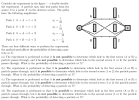 Consider the experiment in the figure _a double double- slit experiment. A particle may take four paths from the source S to a point X on the detector scrcen. The paths have the following amplitudes Path 1: S→A→1→X pi 10 Path 2: S→B→1→X 10 Path 3: S→A→2→X Path 4: S→B→2→X 2 There are four different ways to perform the experiment the method used affects the probability of detccting a par- ticle at x. (a) The experiment is performed so that...
4) (a) In a double-slit experiment with distance 0.0235 mm between the slits and using light...
 4) (a) In a double-slit experiment with distance 0.0235 mm between the slits and using light with wavelength 485 nm, what is the distance from the second-order bright fringe to the fifth-order bright fringe if the screen is situated 1.80 m away from the slits? 2/L sin(8mz/L) for 0 < x < L with L a constant, and it is 0 everywhere else. Find the probability of finding the particle in the region (b) The wave function of a particle...
To understand the cause of constructive and destructive interference for the double-slit experiment, and to explain...
To understand the cause of constructive and destructive interference for the double-slit experiment, and to explain how the interference pattern depends on the parameters of the emitted waves. For this tutorial, use the PhET simulation Wave Interference. This simulation allows you to send waves through a variety of barriers and look at the resulting interference patterns. Start the simulation. You will see three possible selections: Waves, Interference, and Slits. To change between simulations at any point, select the desired simulation...
Question 4 1 pts Which experiment best demonstrates the particle nature of light? Young's Double-Slit Experiment...
 Question 4 1 pts Which experiment best demonstrates the particle nature of light? Young's Double-Slit Experiment Photelectric Effect Heisenberg Trials Milikan's Oil-Drop Experiment Stern-Gerlach Experiment Question 5 1 pts An electron and a proton are traveling at the same speed in the same direction. Which has the longer wavelength? Electron Proton Both have the same wavelength.
Matter Waves - Double Slit Interference Previously we learned the wave behaviors of light - the...
 Matter Waves - Double Slit Interference Previously we learned the wave behaviors of light - the single-slit diffraction, and the double-slit interference. In this problem, you will explore the wave behaviors of matter (particles). Double Slit Screen Interference y=Ltane 0 L bright fringes: sine Dark fringes above central sin 8 = (m m-0, 11, 12(constructive) (destructive). Matter Waves - Double Slit electrons Max Men Max photons Electrons pass through a double slit separated by d = 0.0100 um, 1um =...
1) In a double slit experiment, what happens to the fringe pattern when the slit separation...
1) In a double slit experiment, what happens to the fringe pattern when the slit separation (d) is decreased and the screen is moved away from the slit ( L is increased)? a) fringes get further apart b) fringes get closer together c) cannot be determined without knowing the values of d and L 2) White light is being analyzed by a diffraction grating (100 lines/mm). In the interference pattern, the third order blue (wavelength=400 nm) appears 10 cm from...
Consider a Young’s double-slit experiment. The slits are separated by 1.2 mm, and the monochromatic light...
Consider a Young’s double-slit experiment. The slits are separated by 1.2 mm, and the monochromatic light has a wavelength of 600 nm. The angular position of the first-order bright (maxima) fringe is 0.054 degrees 0.018 degrees 0.029 degrees 0.035 degrees
Suppose that the angle of incidence of plane waves on a double slit with 0.010 mm...
Suppose that the angle of incidence of plane waves on a double slit with 0.010 mm is β = 20° (instead of the 0° angle we considered in class). If λ = 532 nm, then what angle θ1 does the m = 1 far-field interference fringe make? Hint: You must take into account the path difference for the light rays incident on the slits. [ans. 23.3°] 1) wave pulse
 Consider the experiment in the figure _a double double- slit experiment. A particle may take four paths from the source S to a point X on the detector scrcen. The paths have the following amplitudes Path 1: S→A→1→X pi 10 Path 2: S→B→1→X 10 Path 3: S→A→2→X Path 4: S→B→2→X 2 There are four different ways to perform the experiment the method used affects the probability of detccting a par- ticle at x. (a) The experiment is performed so that...
 4) (a) In a double-slit experiment with distance 0.0235 mm between the slits and using light with wavelength 485 nm, what is the distance from the second-order bright fringe to the fifth-order bright fringe if the screen is situated 1.80 m away from the slits? 2/L sin(8mz/L) for 0 < x < L with L a constant, and it is 0 everywhere else. Find the probability of finding the particle in the region (b) The wave function of a particle...
 Question 4 1 pts Which experiment best demonstrates the particle nature of light? Young's Double-Slit Experiment Photelectric Effect Heisenberg Trials Milikan's Oil-Drop Experiment Stern-Gerlach Experiment Question 5 1 pts An electron and a proton are traveling at the same speed in the same direction. Which has the longer wavelength? Electron Proton Both have the same wavelength.
 Matter Waves - Double Slit Interference Previously we learned the wave behaviors of light - the single-slit diffraction, and the double-slit interference. In this problem, you will explore the wave behaviors of matter (particles). Double Slit Screen Interference y=Ltane 0 L bright fringes: sine Dark fringes above central sin 8 = (m m-0, 11, 12(constructive) (destructive). Matter Waves - Double Slit electrons Max Men Max photons Electrons pass through a double slit separated by d = 0.0100 um, 1um =...
Most questions answered within 3 hours.
-
Where is the error in this code sequence?
String s1 = "Hello";
String s2 = "ello";...
asked 10 months ago -
Financial data for Joel de Paris, Inc., for last year
follow:
Joel de Paris, Inc.
Balance...
asked 10 months ago -
Consider this reaction:
Al2(SO4)3 (aq)+ BaCl3
(aq) Al2Cl6 (aq)- +
3BaSO4(s) . What is the...
asked 10 months ago -
Suppose that Savneet is considering increasing her
recent random sample from 20 car rentals to 40...
asked 10 months ago -
Trucks arrive at an unloading terminal at an average rate of 120
per hour.
Trucks arrive...
asked 10 months ago -
Why are methanol and ethanol completely soluble in water while
octanol is not very little soluble....
asked 10 months ago -
A facilities manager at a university reads in a research report
that the mean amount of...
asked 10 months ago -
When the CuSO4 is rehydrated by adding water to the anhydrous
compound, is this an endothermic...
asked 10 months ago -
A ray of sunlight is passing from diamond into crown glass; the
angle of incidence is...
asked 10 months ago -
A block of mass 0.249 kg is placed on top of a light, vertical
spring of...
asked 10 months ago -
how do the kidneys compensate in the presences of acidosis
a) trigger hyperventilate
b) reserve acid...
asked 10 months ago -
Question 501 pts
The rental rate of capital to the firm increases. Which of the
following...
asked 10 months ago