Compute the speed and associated wavelength of a 1 MeV electron (that is an electron with...
Compute the speed and associated wavelength of a 1 MeV electron (that is an electron with 1 MeV of kinetic energy). Ask yourself if you will need to consider relativistic effects for this particle and if it makes sense to address an electron as a wave.
Homework Answers

Add Answer to:
Compute the speed and associated wavelength of a 1 MeV electron
(that is an electron with...
Show that if an electron is accelerated through V volts then the deBroglie wave- length in angstr...
 solve last one .include all the steps
Show that if an electron is accelerated through V volts then the deBroglie wave- length in angstroms is given by λ-(1 ) 12 A thermal neutron has a speed v at temperature T 300 K and kinetic energy L. Calculate its deBroglie wavelength. State whether a beam of these neutrons could be diffracted by a crystal, and why? (b) Use Heisenberg's Uncertainty principle to estimate the kinetic energy (in MeV) of a nucleon...
solve last one .include all the steps
Show that if an electron is accelerated through V volts then the deBroglie wave- length in angstroms is given by λ-(1 ) 12 A thermal neutron has a speed v at temperature T 300 K and kinetic energy L. Calculate its deBroglie wavelength. State whether a beam of these neutrons could be diffracted by a crystal, and why? (b) Use Heisenberg's Uncertainty principle to estimate the kinetic energy (in MeV) of a nucleon...
A) If the De Broglie wavelength of an electron is equal to 350 nm calculate the...
A) If the De Broglie wavelength of an electron is equal to 350 nm calculate the velocity of the electron. Assume that the electron's speed is non-relativistic. B) If the kinetic energy of an electron is 440 eV, calculate its De Broglie wavelength. For this non-relativistic electron you must first calculate its velocity from the general kinetic energy equation. Then you can find the De Broglie wavelength of the electron.
2. The relativistic momentum of an electron is 4.5990 MeV/c. Determine, (a) the time dilation factor,...
 2. The relativistic momentum of an electron is 4.5990 MeV/c. Determine, (a) the time dilation factor, y and (b) the speed of the electron, v both to five significant figures. Determine also, in MeV, (c) the kinetic energy, and (d) the total energy of the electron.
If the De Broglie wavelength of an electron is equal to 400 nm calculate the velocity...
If the De Broglie wavelength of an electron is equal to 400 nm calculate the velocity of the electron. Assume that the electron's speed is non-relativistic. Answer: 1832.42 m/s If the kinetic energy of an electron is 400 eV, calculate its De Broglie wavelength. For this non-relativistic electron you must first calculate its velocity from the general kinetic energy equation. Then you can find the De Broglie wavelength of the electron. I cannot figure out the second part, please explain!
Determine the wavelength of an electron that has been accelerated through a potential difference of 100V...
Determine the wavelength of an electron that has been accelerated through a potential difference of 100V (Hints:) 1. Kinetic energy T=.5 mv2 2. For an electron .511 MeV=mc2=E 3. Energy is conserved 4.The de Broglie idea of wave-particle duality states h/p where p is momentum and h is Planck's constant
An electron and an alpha particle (a helium-4 nucleus) each have the same non-relativistic speed. Which...
An electron and an alpha particle (a helium-4 nucleus) each have the same non-relativistic speed. Which has the greatest kinetic energy, and which has the shortest de Broglie wavelength? Group of answer choices the electron, the electron the alpha particle, the electron the electron, the alpha particle the alpha particle, the alpha particle
Determine the following (in MeV) for an alpha particle travelling with a speed of 0.926c. (The...
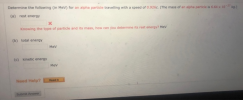 Determine the following (in MeV) for an alpha particle travelling with a speed of 0.926c. (The mass of an alpha particle is 6.64 x 10⁻²⁷ kg.) (a) rest energy Knowing the type of particle and its mass, how can you determine its rest energy? MeV (b) total energy Mev (c) kinetic energy Mev Need Help? Submit Answer
1) Consider light in the near-infrared regime with a wavelength = 1000 nm. (a) What is...
 1) Consider light in the near-infrared regime with a wavelength
= 1000 nm.
(a) What is the energy of a photon at this wavelength?
(b) Consider an electron that has a kinetic energy that equals the
photon energy in part (a). Calculate the electron momentum and
compare it to the momentum of the photon from part (a). Is the
momentum of the electron larger or smaller than the momentum of the
photon?
Hint: You can use non-relativistic equations for the...
1) Consider light in the near-infrared regime with a wavelength
= 1000 nm.
(a) What is the energy of a photon at this wavelength?
(b) Consider an electron that has a kinetic energy that equals the
photon energy in part (a). Calculate the electron momentum and
compare it to the momentum of the photon from part (a). Is the
momentum of the electron larger or smaller than the momentum of the
photon?
Hint: You can use non-relativistic equations for the...
An electron is moving with a kinetic energy of 0.923 MeV. What is its speed?
An electron is moving with a kinetic energy of 0.923 MeV. What is its speed?
Find the de Broglie wavelength of an electron with a speed of 0.76c. Take relativistic effects...
Find the de Broglie wavelength of an electron with a speed of 0.76c. Take relativistic effects into account.
 solve last one .include all the steps
Show that if an electron is accelerated through V volts then the deBroglie wave- length in angstroms is given by λ-(1 ) 12 A thermal neutron has a speed v at temperature T 300 K and kinetic energy L. Calculate its deBroglie wavelength. State whether a beam of these neutrons could be diffracted by a crystal, and why? (b) Use Heisenberg's Uncertainty principle to estimate the kinetic energy (in MeV) of a nucleon...
solve last one .include all the steps
Show that if an electron is accelerated through V volts then the deBroglie wave- length in angstroms is given by λ-(1 ) 12 A thermal neutron has a speed v at temperature T 300 K and kinetic energy L. Calculate its deBroglie wavelength. State whether a beam of these neutrons could be diffracted by a crystal, and why? (b) Use Heisenberg's Uncertainty principle to estimate the kinetic energy (in MeV) of a nucleon...
 2. The relativistic momentum of an electron is 4.5990 MeV/c. Determine, (a) the time dilation factor, y and (b) the speed of the electron, v both to five significant figures. Determine also, in MeV, (c) the kinetic energy, and (d) the total energy of the electron.
 Determine the following (in MeV) for an alpha particle travelling with a speed of 0.926c. (The mass of an alpha particle is 6.64 x 10⁻²⁷ kg.) (a) rest energy Knowing the type of particle and its mass, how can you determine its rest energy? MeV (b) total energy Mev (c) kinetic energy Mev Need Help? Submit Answer
 1) Consider light in the near-infrared regime with a wavelength
= 1000 nm.
(a) What is the energy of a photon at this wavelength?
(b) Consider an electron that has a kinetic energy that equals the
photon energy in part (a). Calculate the electron momentum and
compare it to the momentum of the photon from part (a). Is the
momentum of the electron larger or smaller than the momentum of the
photon?
Hint: You can use non-relativistic equations for the...
1) Consider light in the near-infrared regime with a wavelength
= 1000 nm.
(a) What is the energy of a photon at this wavelength?
(b) Consider an electron that has a kinetic energy that equals the
photon energy in part (a). Calculate the electron momentum and
compare it to the momentum of the photon from part (a). Is the
momentum of the electron larger or smaller than the momentum of the
photon?
Hint: You can use non-relativistic equations for the...
Most questions answered within 3 hours.
-
Where is the error in this code sequence?
String s1 = "Hello";
String s2 = "ello";...
asked 11 months ago -
Financial data for Joel de Paris, Inc., for last year
follow:
Joel de Paris, Inc.
Balance...
asked 11 months ago -
Consider this reaction:
Al2(SO4)3 (aq)+ BaCl3
(aq) Al2Cl6 (aq)- +
3BaSO4(s) . What is the...
asked 11 months ago -
Suppose that Savneet is considering increasing her
recent random sample from 20 car rentals to 40...
asked 11 months ago -
Trucks arrive at an unloading terminal at an average rate of 120
per hour.
Trucks arrive...
asked 11 months ago -
Why are methanol and ethanol completely soluble in water while
octanol is not very little soluble....
asked 11 months ago -
A facilities manager at a university reads in a research report
that the mean amount of...
asked 11 months ago -
When the CuSO4 is rehydrated by adding water to the anhydrous
compound, is this an endothermic...
asked 11 months ago -
A ray of sunlight is passing from diamond into crown glass; the
angle of incidence is...
asked 11 months ago -
A block of mass 0.249 kg is placed on top of a light, vertical
spring of...
asked 11 months ago -
how do the kidneys compensate in the presences of acidosis
a) trigger hyperventilate
b) reserve acid...
asked 11 months ago -
Question 501 pts
The rental rate of capital to the firm increases. Which of the
following...
asked 11 months ago