QUESTION 10 Two people on ice skates stand face to face and then push each other...
QUESTION 10
Two people on ice skates stand face to face and then push each other away. If their masses are 45 and 75 kg, what is the ratio of their speeds immediately afterward?
|
Speed of the 45 kg skater is 1.7 times the speed of the 75 kg skater |
||
|
Speed of the 45 kg skater is 1.2 times the speed of the 75 kg skater |
||
|
Speed of the 45 kg skater is 0.6 times the speed of the 75 kg skater |
||
|
Speed of the 45 kg skater is 2.0 times the speed of the 75 kg skater |
Homework Answers
By the law of conservation of momentum
m1v1 = m2v2
Here m1 = 45 kg and m2 = 75 kg
45 v1 = 75 v2
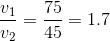

So Speed of the 45 kg skater is 1.7 times the speed of the 75 kg skater
Add Answer to:
QUESTION 10
Two people on ice skates stand face to face and then push each
other...
Two ice skaters stand facing each other at rest on a frozen pond. They push off...
Two ice skaters stand facing each other at rest on a frozen pond. They push off against one another and the 48-kg skater acquires a speed of 0.69 m/s. If the other skater acquires a speed of 0.87 m/s, what is her mass? ____kg
Two ice skaters have masses m1 and m2 and are initially stationary. Their skates are identical....
Two ice skaters have masses m1 and m2 and are initially stationary. Their skates are identical. They push against one another, as in Figure 7.10, and move in opposite directions with different speeds. While they are pushing against each other, any kinetic frictional forces acting on their skates can be ignored. However, once the skaters separate, kinetic frictional forces eventually bring them to a halt. As they glide to a halt, the magnitudes of their accelerations are equal, and skater...
Two ice skaters stand at rest in the center of an ice rink. When they push...
 Two ice skaters stand at rest in the center of an ice rink. When they push off against one another the 70-kg skater acquires a speed of 0.69 m/s If the speed of the other skater is 0.88 m/s. What is the skater's mass? Express your answer using two significant figures. m_2 =
Two ice skaters, with masses of 73kg and 55kg , stand facing each other on a 18-m-wide frozen river. The skaters push o...
Two ice skaters, with masses of 73kg and 55kg , stand facing each other on a 18-m-wide frozen river. The skaters push off against each other, glide backward straight toward the river's edges, and reach the edges at exactly the same time. how far did the 73kg skater glide?
Three ice skaters meet at the center of a rink and each stand at rest facing...
Three ice skaters meet at the center of a rink and each stand at rest facing the center, within arm’s reach of the other two. On a signal, each skater pushes himself away from the other two across the frictionless ice. After the push, skater A with mass mA = 80.0 kg moves in the negative y-direction at 3.50 m/s and skater B with mass mB = 75.0 kg moves in the negative x-direction at 4.00 m/s. Find the x-...
Chapter 07, Problem 63 Two ice skaters have masses m, and m2 and are initially stationary....
 Chapter 07, Problem 63 Two ice skaters have masses m, and m2 and are initially stationary. Their skates are identical. They push against one another, as in Figure 7.10, and move in opposite directions with different speeds. While they are pushing against each other, any kinetic frictional forces acting on their skates can be ignored. However, once the skaters separate, kinetic frictional forces eventually bring them to a halt. As they glide to a halt, the magnitudes of their accelerations...
#4-7 Two ice skaters stand facing each other at rest on a frozen pond. They push...
 #4-7
Two ice skaters stand facing each other at rest on a frozen pond. They push off against one another and the 48 kg skater acquires a speed of 0.69 m/s If the other skater acquires a speed of 0.81 m/s, what is her mass in kilograms? kg My Notes Ask Your Teacher -/2 points HAFColPhys1 8.2WA019. O5 Submissiens Used A man holding a rock sits on a sled that is sliding across a frozen lake (negligible friction) with a...
#4-7
Two ice skaters stand facing each other at rest on a frozen pond. They push off against one another and the 48 kg skater acquires a speed of 0.69 m/s If the other skater acquires a speed of 0.81 m/s, what is her mass in kilograms? kg My Notes Ask Your Teacher -/2 points HAFColPhys1 8.2WA019. O5 Submissiens Used A man holding a rock sits on a sled that is sliding across a frozen lake (negligible friction) with a...
Two ice skaters stand together as illustrated in Figure (a) below. They "push off" and travel...
Two ice skaters stand together as illustrated in Figure (a) below. They "push off" and travel directly away from each other, the boy with a velocity of v = 0.74 m/s to the left. If the boy weighs 711 N and the girl weighs 473 N, what is the girl's velocity after they push off? (Consider the ice to be frictionless. Enter the magnitude only.)Two ice skaters stand together as illustrated in Figure (a) below. They "push off" and travel...
Two ice skaters suddenly push off against one another starting from a stationary position. The 45...
Two ice skaters suddenly push off against one another starting from a stationary position. The 45 kg skater acquires a speed of 0.275 m/s relative to the ice. What speed does the 60 kg acquire relative to the ice?
Two ice-skaters, whose masses are 45 kg and 75 kg, hold hands and rotate about a...
Two ice-skaters, whose masses are 45 kg and 75 kg, hold hands and rotate about a vertical axis that passes between them, making one revolution in 2 s. Their centers of mass are separated by 1.7 m, and their center of mass is stationary. Model each skater as a point particle. (a) Find the angular momentum of the system about it's center of mass. J·s (b) Find the total kinetic energy of the system.
 Two ice skaters stand at rest in the center of an ice rink. When they push off against one another the 70-kg skater acquires a speed of 0.69 m/s If the speed of the other skater is 0.88 m/s. What is the skater's mass? Express your answer using two significant figures. m_2 =
 Chapter 07, Problem 63 Two ice skaters have masses m, and m2 and are initially stationary. Their skates are identical. They push against one another, as in Figure 7.10, and move in opposite directions with different speeds. While they are pushing against each other, any kinetic frictional forces acting on their skates can be ignored. However, once the skaters separate, kinetic frictional forces eventually bring them to a halt. As they glide to a halt, the magnitudes of their accelerations...
 #4-7
Two ice skaters stand facing each other at rest on a frozen pond. They push off against one another and the 48 kg skater acquires a speed of 0.69 m/s If the other skater acquires a speed of 0.81 m/s, what is her mass in kilograms? kg My Notes Ask Your Teacher -/2 points HAFColPhys1 8.2WA019. O5 Submissiens Used A man holding a rock sits on a sled that is sliding across a frozen lake (negligible friction) with a...
#4-7
Two ice skaters stand facing each other at rest on a frozen pond. They push off against one another and the 48 kg skater acquires a speed of 0.69 m/s If the other skater acquires a speed of 0.81 m/s, what is her mass in kilograms? kg My Notes Ask Your Teacher -/2 points HAFColPhys1 8.2WA019. O5 Submissiens Used A man holding a rock sits on a sled that is sliding across a frozen lake (negligible friction) with a...
Most questions answered within 3 hours.
-
Where is the error in this code sequence?
String s1 = "Hello";
String s2 = "ello";...
asked 10 months ago -
Financial data for Joel de Paris, Inc., for last year
follow:
Joel de Paris, Inc.
Balance...
asked 10 months ago -
Consider this reaction:
Al2(SO4)3 (aq)+ BaCl3
(aq) Al2Cl6 (aq)- +
3BaSO4(s) . What is the...
asked 10 months ago -
Suppose that Savneet is considering increasing her
recent random sample from 20 car rentals to 40...
asked 10 months ago -
Trucks arrive at an unloading terminal at an average rate of 120
per hour.
Trucks arrive...
asked 10 months ago -
Why are methanol and ethanol completely soluble in water while
octanol is not very little soluble....
asked 10 months ago -
A facilities manager at a university reads in a research report
that the mean amount of...
asked 10 months ago -
When the CuSO4 is rehydrated by adding water to the anhydrous
compound, is this an endothermic...
asked 10 months ago -
A ray of sunlight is passing from diamond into crown glass; the
angle of incidence is...
asked 10 months ago -
A block of mass 0.249 kg is placed on top of a light, vertical
spring of...
asked 10 months ago -
how do the kidneys compensate in the presences of acidosis
a) trigger hyperventilate
b) reserve acid...
asked 10 months ago -
Question 501 pts
The rental rate of capital to the firm increases. Which of the
following...
asked 10 months ago