An object moving at 1 m/s with distance to target at t=0 of 1000 meters. The...
An object moving at 1 m/s with distance to target at t=0 of 1000 meters. The object travels at a constant 1 m/s. After each second there is a uniform, instantaneous stretch of 1 km. I.e. after the 1st stretch the object is 2 meters from origin, and 1998 m from target.
(a). Using series/sequences, find the time it takes to reach the target, if the target can be reached.
(b). With a new velocity of 4 m/s, how long would it take the object to reach the target?
Hints provided with question:
1. Understand exactly why the object is 1998 meters away after the first stretch.
2. It will likely help to then set up a sequence where dn is the distance between the object and the target after n seconds but BEFORE the stretch. (i.e. d0 = 1000, d1 = 999 etc.)
Homework Answers
Speed of the object is 1 m/sec therefore it covers a distance of 1 meter per second also there is a stretch of 1m after every second hence, we can say that after 1st second object has travelled 1 + 1 = 2 m, after 2 seconds object has travelled 2 +1 +1 = 4 m and so on which means the effective speed of the object is 2 m/s or after n seconds object has travelled 2n meters therefor we put 2n = 1000 gives us n = 500 seconds
After 500 seconds or, 8 min 20 sec the object reaches target.
In second case speed is 4m/sec means object travelles 4 + 1 meters per second hence after n seconds object is 5n meters away from starting point so we put,
5n = 1000 gives us n = 200 seconds
Hence object takes 200 seconds to reach destination or 3 min 20 seconds.
Add Answer to:
An object moving at 1 m/s with distance to target at t=0 of 1000
meters. The...
Given that s(t) = - 4.9t2 + 125t represents the distance (m) of an object from...
 Given that s(t) = - 4.9t2 + 125t represents the distance (m) of an object from the ground, t seconds after it was thrown in the air, determine when the object reaches the ground. t= 27.5 s a. t = 20.5 s Ob. t= 25.5 s Oc. t= 26.7 s d. t= 22.5 s Oe. Of. t=23.55 Given that s(t) = -4.9t2 + 132t + 20 represents the distance in meters from the ground t seconds after an object is...
1. An object is originally moving in the +x direction at 16 m/s and a constant...
1. An object is originally moving in the +x direction at 16 m/s and a constant acceleration is applied to it. When it is at a displacement of 7 meters in the +x direction it is moving in the -x direction at 6 m/s. What is the acceleration of the object in m/s2? If in the -x direction, include a negative sign. 2. An object travels in the +x direction for 6 meters for 3.4 seconds and then, immediately, changes...
1. The velocity of an object traveling along the x-axis changes from 20 m/s to 60...
 1. The velocity of an object traveling along the x-axis changes from 20 m/s to 60 m/s in 10 seconds. What was the displacement that occurred during this time? 2. An object moving along the x-axis initially has a velocity of 60 m/s and is slowing rest? down at the rate of 4 m/s per second. How far (in meters) will it travel before coming to 3. An accelerating object travels 12 meters from rest in a certain time. How...
An object thrown vertically upward from the surface of a celestial body at a velocity of 24 m/s reaches a height of s = -0.6t2 + 24t meters in t seconds.
An object thrown vertically upward from the surface of a celestial body at a velocity of 24 m/s reaches a height of s = -0.6t2 + 24t meters in t seconds. a. Determine the velocity v of the object after t seconds. b. When does the object reach its highest point? c. What is the height of the object at the highest point? d. When does the object strike the ground? e. With what velocity does the object strike the ground? f. On what intervals is...
QUESTION 2 14.2858 poin An 8.0 kg object moving with an initial velocity of 8.0 m/s...
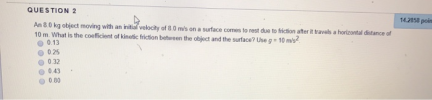 QUESTION 2 14.2858 poin An 8.0 kg object moving with an initial velocity of 8.0 m/s on a surface comes to rest due to friction after it travels a horizontal distance of 10 m. What is the coefficient of kinetic friction between the object and the surface? Use g 0.13 10 m/s 0.25 O 0.32 O 0.43 0.80
1.) A car starting from rest is travelling with a constant acceleration of 30 m/s2. Find...
 1.) A car starting from rest is travelling with a constant acceleration of 30 m/s2. Find its velocity after 5 seconds. Find its position after 5 seconds. Find the time it would reach 600 m/s Find the distance it has traveled upon reaching a speed of 600 m/s 2.) A particle travels from 100 m/s to 1000 m/s. Find its constant acceleration if this was done in 5 seconds. What is the distance traveled during the 5 seconds interval? Find...
A stone thrown downward with an initial velocity of 34.3 m/sec travel a distance of s meters, where: s(t)=4.9t + 34.3t and t is in seconds
A stone thrown downward with an initial velocity of 34.3 m/sec travel a distance of s meters, where:s(t)=4.9t + 34.3t and t is in seconds. If a stone is thrown downward at 34.3m/sec from a height of 294 m, how long will it take the stone to reach the ground?I am putting 294 in for t and trying to solve it that way. Is this correct? If not please let know where I am going wrong.
of 26 2 -0.5+ -1+ t(s The graph above shows the position of an object in...
 of 26 2 -0.5+ -1+ t(s The graph above shows the position of an object in simple harmonic motion as a function of time. What are the first two times after zero at which the object has its maximum acceleration? What is the absolute value of the maximum acceleration? Hints: F = ma and by Hooke's law F = kAx. The period of a mass-spring system in SHM is T = 2(mk). Solve for km, then find a amax m/s2
The cannon on a battleship can fire a shell a maximum distance of 38.0 km. (a) Calculate the initial velocity of the shell. ? m/s (b) What maximum height does it reach? (At its highest, the shell is...
The cannon on a battleship can fire a shell a maximum distance of 38.0 km. (a) Calculate the initial velocity of the shell. ? m/s (b) What maximum height does it reach? (At its highest, the shell is above a substantial part of the atmosphere--but air resistance is not really negligible as assumed to make this problem easier.) ? m (c) The ocean is not flat, since the earth is curved. How many meters lower will its surface be 38.0...
1. a. A truck of mass 2000 kg is moving with a velocity of 20 m/s....
 1. a. A truck of mass 2000 kg is moving with a velocity of 20 m/s. If on applying brakes, the truck stops after coming to a distance of 40 m, find the retarding force? b. A car of mass 1000 kg moving with a velocity of 90 km/h collides with a tree and comes to stop in 10 s. What is the change in momentum of the car? What is the force applied by the tree to stop the...
 Given that s(t) = - 4.9t2 + 125t represents the distance (m) of an object from the ground, t seconds after it was thrown in the air, determine when the object reaches the ground. t= 27.5 s a. t = 20.5 s Ob. t= 25.5 s Oc. t= 26.7 s d. t= 22.5 s Oe. Of. t=23.55 Given that s(t) = -4.9t2 + 132t + 20 represents the distance in meters from the ground t seconds after an object is...
 1. The velocity of an object traveling along the x-axis changes from 20 m/s to 60 m/s in 10 seconds. What was the displacement that occurred during this time? 2. An object moving along the x-axis initially has a velocity of 60 m/s and is slowing rest? down at the rate of 4 m/s per second. How far (in meters) will it travel before coming to 3. An accelerating object travels 12 meters from rest in a certain time. How...
 QUESTION 2 14.2858 poin An 8.0 kg object moving with an initial velocity of 8.0 m/s on a surface comes to rest due to friction after it travels a horizontal distance of 10 m. What is the coefficient of kinetic friction between the object and the surface? Use g 0.13 10 m/s 0.25 O 0.32 O 0.43 0.80
 1.) A car starting from rest is travelling with a constant acceleration of 30 m/s2. Find its velocity after 5 seconds. Find its position after 5 seconds. Find the time it would reach 600 m/s Find the distance it has traveled upon reaching a speed of 600 m/s 2.) A particle travels from 100 m/s to 1000 m/s. Find its constant acceleration if this was done in 5 seconds. What is the distance traveled during the 5 seconds interval? Find...
 of 26 2 -0.5+ -1+ t(s The graph above shows the position of an object in simple harmonic motion as a function of time. What are the first two times after zero at which the object has its maximum acceleration? What is the absolute value of the maximum acceleration? Hints: F = ma and by Hooke's law F = kAx. The period of a mass-spring system in SHM is T = 2(mk). Solve for km, then find a amax m/s2
 1. a. A truck of mass 2000 kg is moving with a velocity of 20 m/s. If on applying brakes, the truck stops after coming to a distance of 40 m, find the retarding force? b. A car of mass 1000 kg moving with a velocity of 90 km/h collides with a tree and comes to stop in 10 s. What is the change in momentum of the car? What is the force applied by the tree to stop the...
Most questions answered within 3 hours.
-
Where is the error in this code sequence?
String s1 = "Hello";
String s2 = "ello";...
asked 10 months ago -
Financial data for Joel de Paris, Inc., for last year
follow:
Joel de Paris, Inc.
Balance...
asked 10 months ago -
Consider this reaction:
Al2(SO4)3 (aq)+ BaCl3
(aq) Al2Cl6 (aq)- +
3BaSO4(s) . What is the...
asked 10 months ago -
Suppose that Savneet is considering increasing her
recent random sample from 20 car rentals to 40...
asked 10 months ago -
Trucks arrive at an unloading terminal at an average rate of 120
per hour.
Trucks arrive...
asked 10 months ago -
Why are methanol and ethanol completely soluble in water while
octanol is not very little soluble....
asked 10 months ago -
A facilities manager at a university reads in a research report
that the mean amount of...
asked 10 months ago -
When the CuSO4 is rehydrated by adding water to the anhydrous
compound, is this an endothermic...
asked 10 months ago -
A ray of sunlight is passing from diamond into crown glass; the
angle of incidence is...
asked 10 months ago -
A block of mass 0.249 kg is placed on top of a light, vertical
spring of...
asked 10 months ago -
how do the kidneys compensate in the presences of acidosis
a) trigger hyperventilate
b) reserve acid...
asked 10 months ago -
Question 501 pts
The rental rate of capital to the firm increases. Which of the
following...
asked 10 months ago