(in C++) What is an overloaded cast operator, what are the rules for its declaration, and...
Homework Answers
C++ already knows how to convert between the built-in data types. However, it does not know how to convert any of our user-defined classes. That’s where overloading the typecast operators comes into play.
User-defined conversions allow us to convert our class into
another data type. Take a look at the following class:
class Cents
{
private:
int m_cents;
public:
Cents(int cents=0)
: m_cents{ cents }
{
}
int getCents() const { return m_cents; }
void setCents(int cents) { m_cents = cents; }
};
This class is pretty simple: it holds some number of cents as an
integer, and provides access functions to get and set the number of
cents. It also provides a constructor for converting an int into a
Cents.
If we can convert an int into a Cents, then doesn’t it also make sense for us to be able to convert a Cents back into an int? In some cases, this might not be true, but in this case, it does make sense.
In the following example, we have to use getCents() to convert
our Cents variable back into an integer so we can print it using
printInt():
void printInt(int value)
{
std::cout << value;
}
int main()
{
Cents cents{ 7 };
printInt(cents.getCents()); // print 7
std::cout << '\n';
return 0;
}
If we have already written a lot of functions that take integers as
parameters, our code will be littered with calls to getCents(),
which makes it more messy than it needs to be.
To make things easier, we can provide a user-defined conversion
by overloading the int typecast. This will allow us to cast our
Cents class directly into an int. The following example shows how
this is done:
class Cents
{
private:
int m_cents;
public:
Cents(int cents=0)
: m_cents{ cents }
{
}
// Overloaded int cast
operator int() const { return m_cents; }
int getCents() const { return m_cents; }
void setCents(int cents) { m_cents = cents; }
};
There are two things to note:
To overload the function that casts our class to an int, we
write a new function in our class called operator int(). Note that
there is a space between the word operator and the type we are
casting to.
User-defined conversions do not take parameters, as there is no way
to pass arguments to them.
User-defined conversions do not have a return type. C++ assumes you
will be returning the correct type.
Now in our example, we can call printInt() like this:
int main()
{
Cents cents{ 7 };
printInt(cents); // print 7
std::cout << '\n';
return 0;
}
The compiler will first note that function printInt takes an
integer parameter. Then it will note that variable cents is not an
int. Finally, it will look to see if we’ve provided a way to
convert a Cents into an int. Since we have, it will call our
operator int() function, which returns an int, and the returned int
will be passed to printInt().
We can now also explicitly cast our Cents variable to an int:
Cents cents{ 7 };
int c{ static_cast<int>(cents) };
You can provide user-defined conversions for any data type you wish, including your own user-defined data types!
Here’s a new class called Dollars that provides an overloaded Cents conversion:
class Dollars
{
private:
int m_dollars;
public:
Dollars(int dollars=0)
: m_dollars{ dollars }
{
}
// Allow us to convert Dollars into Cents
operator Cents() const { return Cents{ m_dollars * 100 }; }
};
This allows us to convert a Dollars object directly into a Cents
object! This allows you to do something like this:
#include <iostream>
class Cents
{
private:
int m_cents;
public:
Cents(int cents=0)
: m_cents{ cents }
{
}
// Overloaded int cast
operator int() const { return m_cents; }
int getCents() const { return m_cents; }
void setCents(int cents) { m_cents = cents; }
};
class Dollars
{
private:
int m_dollars;
public:
Dollars(int dollars=0)
: m_dollars{ dollars }
{
}
// Allow us to convert Dollars into Cents
operator Cents() const { return Cents(m_dollars * 100); }
};
void printCents(Cents cents)
{
std::cout << cents; // cents will be implicitly cast to an
int here
}
int main()
{
Dollars dollars{ 9 };
printCents(dollars); // dollars will be implicitly cast to a Cents
here
std::cout << '\n';
return 0;
}
Consequently, this program will print the value:
900
which makes sense, since 9 dollars is 900 cents!
Add Answer to:
(in C++) What is an overloaded cast operator, what are the
rules for its declaration, and...
C++ questions T/F The compiler will report an error if the + operator is overloaded in...
C++ questions T/F The compiler will report an error if the + operator is overloaded in a way so that it performs subtraction. T/F When a unary operator is overloaded using a member function, it accepts one explicit argument and returns a class object. T/F The size of an operator cannot be overloaded. T/F Operator overloading also allows creation of new operators. T/F To convert a class object to basic data type, a conversion operator needs to be included publicly...
2. C++ plc question When an operator is overloaded in C++ (by writing a function with...
 2. C++ plc question
When an operator is overloaded in C++ (by writing a function with a name such as operator +) what restrictions, if any, does C++ place on the types of the function's parameter(s)?
2. C++ plc question
When an operator is overloaded in C++ (by writing a function with a name such as operator +) what restrictions, if any, does C++ place on the types of the function's parameter(s)?
When enabling a class to work with iostreams by adding overloaded operator<< and operator>> functions, should...
When enabling a class to work with iostreams by adding overloaded operator<< and operator>> functions, should they be friends of the class or member functions, and why?
c++)Which situation would require the operator to be overloaded as a non-member function? provide an example...
c++)Which situation would require the operator to be overloaded as a non-member function? provide an example of your answer choice of when this would occur. a. The overloaded operator is =. b. The left operand is an int. c. The operator returns a reference. d. The left operand must not be a class object (or a reference to a class object).
C++ Questions When the arithmetic assignment operator is overloaded, the object at the ____ side of...
C++ Questions When the arithmetic assignment operator is overloaded, the object at the ____ side of the operator is passed as an argument. A(n) ____ is a special constructor, called whenever a new object is initialized with another objects's data. Conversation of a class object to a basic data type or an object of another class is known as ____. ____ redefines existing C+++ operators.
In c++ What does operator overloading allow us to do ? Why must the << and...
In c++ What does operator overloading allow us to do ? Why must the << and the >> operators be overloaded as friend functions instead of member functions, for a user defined class ? What is the difference between an instance member variable and a static member variable ? How are call to static member functions made ? Describe the difference between reading a file using the >> operator and with the getline function What is inheritance What is a...
URGENT! In the following implementation for an overloaded + operator for English class objects: def _lt_(self,...
 URGENT!
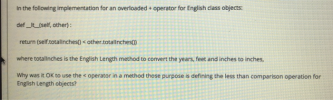
In the following implementation for an overloaded + operator for English class objects: def _lt_(self, other): return (self.totalinches() < other.totalinches() where totalinches is the English Length method to convert the years, feet and inches to inches, Why was it OK to use the operator in a method those purpose is defining the less than comparison operation for English Length objects?
URGENT!
In the following implementation for an overloaded + operator for English class objects: def _lt_(self, other): return (self.totalinches() < other.totalinches() where totalinches is the English Length method to convert the years, feet and inches to inches, Why was it OK to use the operator in a method those purpose is defining the less than comparison operation for English Length objects?
The istream operator here is being overloaded and im not sure what the TODO mean. I...
The istream operator here is being overloaded and im not sure what the TODO mean. I looked up what peek does but i dont know how to use it in this situation. Please help // TODO: Make this read integer values if no '/' is given as a separator. // You may assume that there is no space between the numerator and the // slash. Hint, find and read the reference documentation for istream::peek(). std::istream& operator>>(std::istream& is, Rational& r) {...
Overload a relational operator for the Job class: Assume that this operator is not overloaded for...
Overload a relational operator for the Job class: Assume that this operator is not overloaded for the Salary class. a) Write how the function will be declared in your code. b) Write an external function definition (not inside the class). solve it in C++10 to solve this you nedd question number 1. Create a composition between the classes Job and Salary. Class Salary a. data member: 1. money b. constructors: 1. default constructor 2. user defined constructor with a parameter...
In c++ Consider the following declaration: class strange { . . . }; Write a statement...
In c++ Consider the following declaration: class strange { . . . }; Write a statement that shows the declaration in the class strange to overload the operator >>. Write a statement that shows the declaration in the class strange to overload the operator =. Write a statement that shows the declaration in the class strange to overload the binary operator + as a member function. Write a statement that shows the declaration in the class strange to overload the...
 2. C++ plc question
When an operator is overloaded in C++ (by writing a function with a name such as operator +) what restrictions, if any, does C++ place on the types of the function's parameter(s)?
2. C++ plc question
When an operator is overloaded in C++ (by writing a function with a name such as operator +) what restrictions, if any, does C++ place on the types of the function's parameter(s)?
 URGENT!
In the following implementation for an overloaded + operator for English class objects: def _lt_(self, other): return (self.totalinches() < other.totalinches() where totalinches is the English Length method to convert the years, feet and inches to inches, Why was it OK to use the operator in a method those purpose is defining the less than comparison operation for English Length objects?
URGENT!
In the following implementation for an overloaded + operator for English class objects: def _lt_(self, other): return (self.totalinches() < other.totalinches() where totalinches is the English Length method to convert the years, feet and inches to inches, Why was it OK to use the operator in a method those purpose is defining the less than comparison operation for English Length objects?
Most questions answered within 3 hours.
-
Where is the error in this code sequence?
String s1 = "Hello";
String s2 = "ello";...
asked 10 months ago -
Financial data for Joel de Paris, Inc., for last year
follow:
Joel de Paris, Inc.
Balance...
asked 10 months ago -
Consider this reaction:
Al2(SO4)3 (aq)+ BaCl3
(aq) Al2Cl6 (aq)- +
3BaSO4(s) . What is the...
asked 10 months ago -
Suppose that Savneet is considering increasing her
recent random sample from 20 car rentals to 40...
asked 10 months ago -
Trucks arrive at an unloading terminal at an average rate of 120
per hour.
Trucks arrive...
asked 10 months ago -
Why are methanol and ethanol completely soluble in water while
octanol is not very little soluble....
asked 10 months ago -
A facilities manager at a university reads in a research report
that the mean amount of...
asked 10 months ago -
When the CuSO4 is rehydrated by adding water to the anhydrous
compound, is this an endothermic...
asked 10 months ago -
A ray of sunlight is passing from diamond into crown glass; the
angle of incidence is...
asked 10 months ago -
A block of mass 0.249 kg is placed on top of a light, vertical
spring of...
asked 10 months ago -
how do the kidneys compensate in the presences of acidosis
a) trigger hyperventilate
b) reserve acid...
asked 10 months ago -
Question 501 pts
The rental rate of capital to the firm increases. Which of the
following...
asked 10 months ago