Results of testing Eugenol for the presence of a carbon-carbon double bond using bromine water test,...
Results of testing Eugenol for the presence of a carbon-carbon double bond using bromine water test, and for a phenolic hydroxyl group using FeCl3.
Homework Answers
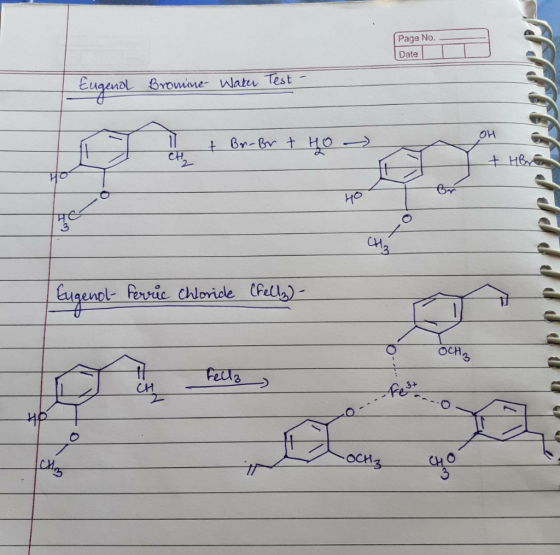
1. Bromine water test for Eugenol
The bromine water test is used for the test of unsaturation in a compound. When we add Bromine to the unsaturated compound, the color of the bromine gets diapered. The two bromine atom gets added across the double bond, so the color of the Bromine gets disappear. This test helps to determine the double bonds hence unsaturation in the compound. The chemical structure of Eugenol is (C10H12O2) 1-Hydroxy-2-methoxy-4-propenylbenzene. This compound has the presence of double bond so this test can be used to determine it.
As Eugenol reacts with the bromine water, 1 Br atom and OH from water gets adds to the double bond, hence color of Bromine water will changes from deep brown to colorless.
C10H12O2 + Br2 + H2O ---------------- C10H13O3Br + HBr
2. FeCl3 test for Eugenol
The ferric Chloride test is used for the determination of phenol structure in the compound. Change in colorations such as turning blue, red , green or phenol show the presence of phenol. Since, Eugenol has a Phenolic structure it will form Blue, Violet, purple-green or the red brown color with the addition of the neutral ferric Chloride solution.
Add Answer to:
Results of testing Eugenol for the presence of a carbon-carbon
double bond using bromine water test,...
analyze results why did the color change of Eugenol when the bromine and ferric test took...
 analyze results
why did the color change of Eugenol when the bromine and ferric
test took place?
please explain the picture and results
explain positive and negative test of bromine and
ferric test
c Bra ells
analyze results
why did the color change of Eugenol when the bromine and ferric
test took place?
please explain the picture and results
explain positive and negative test of bromine and
ferric test
c Bra ells
Bromination of Alkenes - treatment of alkenes with molecular bromine leads to the anti addition of...
 Bromination of Alkenes - treatment of alkenes with molecular bromine leads to the anti addition of the two bromine atoms across the double bond. Br2 CH2CH2 Mechanism Major Product The hinders one face of the molecule forcing the second bromine to add from the opposite face resulting _of the bromine atoms. Halohydrin formation - treatment of alkenes with bromine or chlorine (X) in the presence of water as a solvent leads to addition of OH and X across the double...
Given the following lipids, predict the results for the Solubility and Bromine Tests for various types...
 Given the following lipids, predict the results for the Solubility and Bromine Tests for various types of lipids. Enter your predictions for each What type of lipid? Fatty Acid, Triacylglycerol, Glycerophospholipid, Wax or Steroid Will the lipid be soluble in Water? Yes or No Will the lipid be soluble in CH,CI,? Yes or No . In the Bromine Test, bromine adds to carbon-carbon double bonds in carbon chains. If the bromine reacts, the red-orange color will fade. For each, will...
Cinnamic acid 1. Draw the detailed mechanism on how bromine adds to a double bond using...
Cinnamic acid 1. Draw the detailed mechanism on how bromine adds to a double bond using butene as the alkene.
EXPERIMENT 19 Part A: Physical Properties of Hydrocarbons Observe the results of the ignition test and...
EXPERIMENT 19 Part A: Physical Properties of Hydrocarbons Observe the results of the ignition test and record observations in the table below Draw the structures of each compound and predict its solubility in water Compounds Tested Structure Ignition Test Solubility in Water Methanol Acetone Hexane Cyclohexanol Toluene Part B: Reaction of Bromine with Hydrocarbons Alkenes tend to undergo addition reactions We have learned hydrogenation (addition of hydrogen) and hydration (addition of water) However, alkenes also undergo halogenation (addition of halogen)....
QUESTION 12 According to Saytzeff's rule (dehydration of alcohols) in the major product the double bond...
 QUESTION 12 According to Saytzeff's rule (dehydration of alcohols) in the major product the double bond will go between the the carbon that had the hydroxyl group and the adjacent carbon that has less hydrogens. O True False
5) Iodine is a better leaving group than bromine. But iodine is a better nucleophile than bromine. Why is that? Introdu...
 5) Iodine is a better leaving group than bromine. But iodine is
a better nucleophile than bromine. Why is that?
Introduction Alkyl halides can be prepared from alcohols by reactions with hydrogen halides (HCI, HBr, or HI) via nucleophilic substitution. In this type of reaction, the nucleophile displaces a leaving group from a carbon atom of an organic substrate (here the alcohol once protonated). Both electrons of the new bond to the carbon are provided by the nucleophile while the...
5) Iodine is a better leaving group than bromine. But iodine is
a better nucleophile than bromine. Why is that?
Introduction Alkyl halides can be prepared from alcohols by reactions with hydrogen halides (HCI, HBr, or HI) via nucleophilic substitution. In this type of reaction, the nucleophile displaces a leaving group from a carbon atom of an organic substrate (here the alcohol once protonated). Both electrons of the new bond to the carbon are provided by the nucleophile while the...
Markovnikov regiochemistry results from a. The high kinetic reactivity of 1 carbon of the carbon carbon...
 Markovnikov regiochemistry results from a. The high kinetic reactivity of 1 carbon of the carbon carbon double bond b. A hydride shift c. The reactivity stability of 2 possible cation intermediates d. The efficiency cycloaddition reactions The trans stereochemistry of bromine addition to alkenes results from the formation of a. Cyclonium ion b. Carbocation c, Carbine d. Bromonium ion In the addition of HBr, HCI, HI, CL_2, Br_2 and I_2 to alkenes the pi-electrons function as a. Electrophile b. Nucleophile...
I need help with writing the conclusion for this online lab report Abstract By testing the...
I need help with writing the conclusion for this online lab report Abstract By testing the unknown substance with different chemicals such as NaOH, NaHCO3, FeCl3, HCl, Sodium Nirtite, Methanol, Alchol, Borsches’s reaggent, Schiffs reagent by process of elimation we are able to find out the functional group of the substance. The reactions that occur will help us to distinguish which functional group the unknown substance belongs to Materials: Test Tubes- 6 Gloves Droppers Spoon (for unknown substance) Waterbath -...
A nitrogen atom can undergo sp2 hybridization when it becomes part of a carbon–nitrogen double bond,...
A nitrogen atom can undergo sp2 hybridization when it becomes part of a carbon–nitrogen double bond, as in H2C=NH. (a) Using a sketch, show the electron configuration of sp2 hybridized nitrogen just before the overlapping occurs to make this double bond. (b) Using sketches (and the analogy to the double bond in C2H4), describe the two bonds of the carbon– nitrogen double bond.
 analyze results
why did the color change of Eugenol when the bromine and ferric
test took place?
please explain the picture and results
explain positive and negative test of bromine and
ferric test
c Bra ells
analyze results
why did the color change of Eugenol when the bromine and ferric
test took place?
please explain the picture and results
explain positive and negative test of bromine and
ferric test
c Bra ells
 Bromination of Alkenes - treatment of alkenes with molecular bromine leads to the anti addition of the two bromine atoms across the double bond. Br2 CH2CH2 Mechanism Major Product The hinders one face of the molecule forcing the second bromine to add from the opposite face resulting _of the bromine atoms. Halohydrin formation - treatment of alkenes with bromine or chlorine (X) in the presence of water as a solvent leads to addition of OH and X across the double...
 Given the following lipids, predict the results for the Solubility and Bromine Tests for various types of lipids. Enter your predictions for each What type of lipid? Fatty Acid, Triacylglycerol, Glycerophospholipid, Wax or Steroid Will the lipid be soluble in Water? Yes or No Will the lipid be soluble in CH,CI,? Yes or No . In the Bromine Test, bromine adds to carbon-carbon double bonds in carbon chains. If the bromine reacts, the red-orange color will fade. For each, will...
 QUESTION 12 According to Saytzeff's rule (dehydration of alcohols) in the major product the double bond will go between the the carbon that had the hydroxyl group and the adjacent carbon that has less hydrogens. O True False
 5) Iodine is a better leaving group than bromine. But iodine is
a better nucleophile than bromine. Why is that?
Introduction Alkyl halides can be prepared from alcohols by reactions with hydrogen halides (HCI, HBr, or HI) via nucleophilic substitution. In this type of reaction, the nucleophile displaces a leaving group from a carbon atom of an organic substrate (here the alcohol once protonated). Both electrons of the new bond to the carbon are provided by the nucleophile while the...
5) Iodine is a better leaving group than bromine. But iodine is
a better nucleophile than bromine. Why is that?
Introduction Alkyl halides can be prepared from alcohols by reactions with hydrogen halides (HCI, HBr, or HI) via nucleophilic substitution. In this type of reaction, the nucleophile displaces a leaving group from a carbon atom of an organic substrate (here the alcohol once protonated). Both electrons of the new bond to the carbon are provided by the nucleophile while the...
 Markovnikov regiochemistry results from a. The high kinetic reactivity of 1 carbon of the carbon carbon double bond b. A hydride shift c. The reactivity stability of 2 possible cation intermediates d. The efficiency cycloaddition reactions The trans stereochemistry of bromine addition to alkenes results from the formation of a. Cyclonium ion b. Carbocation c, Carbine d. Bromonium ion In the addition of HBr, HCI, HI, CL_2, Br_2 and I_2 to alkenes the pi-electrons function as a. Electrophile b. Nucleophile...
Most questions answered within 3 hours.
-
Where is the error in this code sequence?
String s1 = "Hello";
String s2 = "ello";...
asked 11 months ago -
Financial data for Joel de Paris, Inc., for last year
follow:
Joel de Paris, Inc.
Balance...
asked 11 months ago -
Consider this reaction:
Al2(SO4)3 (aq)+ BaCl3
(aq) Al2Cl6 (aq)- +
3BaSO4(s) . What is the...
asked 11 months ago -
Suppose that Savneet is considering increasing her
recent random sample from 20 car rentals to 40...
asked 11 months ago -
Trucks arrive at an unloading terminal at an average rate of 120
per hour.
Trucks arrive...
asked 11 months ago -
Why are methanol and ethanol completely soluble in water while
octanol is not very little soluble....
asked 11 months ago -
A facilities manager at a university reads in a research report
that the mean amount of...
asked 11 months ago -
When the CuSO4 is rehydrated by adding water to the anhydrous
compound, is this an endothermic...
asked 11 months ago -
A ray of sunlight is passing from diamond into crown glass; the
angle of incidence is...
asked 11 months ago -
A block of mass 0.249 kg is placed on top of a light, vertical
spring of...
asked 11 months ago -
how do the kidneys compensate in the presences of acidosis
a) trigger hyperventilate
b) reserve acid...
asked 11 months ago -
Question 501 pts
The rental rate of capital to the firm increases. Which of the
following...
asked 11 months ago