In Raman spectroscopy, transitions between vibrational energy levels are caused by: ____________ whereas in infrared spectroscopy,...
In Raman spectroscopy, transitions between vibrational energy levels are caused by: ____________
whereas in infrared spectroscopy, transitions between vibrational energy levels are caused by: ____________
Homework Answers
Raman spectroscopy, transitions between vibrational energy levels are caused by
Answer: change in molecular polarisability of molecule
Explanation : When a molecule is placed in electric field, it undergoes some distortion, the positively charged nucleus(in the molecule) is attracted by the negative pole of the electric field and electrons are attracted by the positive pole of the electric field.
The extent of polarisability is different for different molecule, absororb the energy in different extent.
infrared spectroscopy, transitions between vibrational energy levels are caused by
Answer: change in the electric dipole moment
Explanation: When a molecule having is placed in the electric field, bond abosorb the energy and vibrate with higher amplitude. Each and every molecule has different dipole moment due to
1.Polarity (more the polar molecule has more dipole moment)
2.Atomic mass of atoms connected by a sigma or pi bond (strength of vibration is for heavier atoms)
3. Substituents attached, electron withdrawing and donating effect of substituents. Electron withdrawing group make bond more polar, electron donating group make bond less polar.
Add Answer to:
In Raman spectroscopy, transitions between vibrational energy
levels are caused by: ____________
whereas in infrared spectroscopy,...
use the simplest equations to express the difference in wave numbers between the vibrational energy levels of 1H35Cl and 2H35Cl for the V=0 and V=1 transitions. d) Use the simplest equation(s) to exp...
 use the simplest equations to express the difference in wave
numbers between the vibrational energy levels of 1H35Cl and 2H35Cl
for the V=0 and V=1 transitions.
d) Use the simplest equation(s) to express the difference in wave numbers between the vibrational energy levels of 'H'Cl and 'HCl for the v-0to v 1 transitions.
d) Use the simplest equation(s) to express the difference in wave numbers between the vibrational energy levels of 'H'Cl and 'HCl for the v-0to v 1 transitions.
use the simplest equations to express the difference in wave
numbers between the vibrational energy levels of 1H35Cl and 2H35Cl
for the V=0 and V=1 transitions.
d) Use the simplest equation(s) to express the difference in wave numbers between the vibrational energy levels of 'H'Cl and 'HCl for the v-0to v 1 transitions.
d) Use the simplest equation(s) to express the difference in wave numbers between the vibrational energy levels of 'H'Cl and 'HCl for the v-0to v 1 transitions.
(5 points) Identify two advantages of using Raman spectroscopy over Infrared spectroscopy for chemical analysis.
 (5 points) Identify two advantages of using Raman spectroscopy over Infrared spectroscopy for chemical analysis.
Explain what a selection rule is and give the selection rules for rotational and electronic spectroscopy...
Explain what a selection rule is and give the selection rules for rotational and electronic spectroscopy Explain why Raman scattering and infrared absorption give different spectra despite the fact that they both probe vibrational transitions Please give detailed answer, thanks
Geometry Point Group Reducible Representation For all atomic motions Vibrational modes Infrared-active modes Raman-active modes Number...
Geometry Point Group Reducible Representation For all atomic motions Vibrational modes Infrared-active modes Raman-active modes Number of IR absorptions Number of Raman emissions square planar
a) Describe and sketch the vibrational energy levels observed for diatomic molecules in the harmonic oscillator...
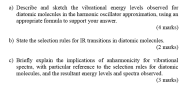 a) Describe and sketch the vibrational energy levels observed for diatomic molecules in the harmonic oscillator approximation, using an appropriate formula to support your answer (4 marks) b) State the selection rules for IR transitions in diatomic molecules. (2 marks) c) Briefly explain the implications of anharmonicity for vibrational spectra, with particular reference to the selection rules for diatomic molecules, and the resultant energy levels and spectra observed. (3 marks)
a) Describe and sketch the vibrational energy levels observed for...
a) Describe and sketch the vibrational energy levels observed for diatomic molecules in the harmonic oscillator approximation, using an appropriate formula to support your answer (4 marks) b) State the selection rules for IR transitions in diatomic molecules. (2 marks) c) Briefly explain the implications of anharmonicity for vibrational spectra, with particular reference to the selection rules for diatomic molecules, and the resultant energy levels and spectra observed. (3 marks)
a) Describe and sketch the vibrational energy levels observed for...
Describe with appropriate diagrams, the concept of Raman scattering spectroscopy. Name 2 primary differences between Raman...
Describe with appropriate diagrams, the concept of Raman scattering spectroscopy. Name 2 primary differences between Raman and Infra-red spectroscopy. What is the fundamental property of a molecule that is probed by Raman scattering? [6 Marks]
9. Raman vibrational spectrum of PPh-BHb. The same basic information is observed in the infrared spectrum...
 9. Raman vibrational spectrum of PPh-BHb. The same basic information is observed in the infrared spectrum (however our infrared spectrometer cannot observe peaks below 650 cm) 60 r 1027 40 1104 26 1131 1160 13 1182 11 13092 1333 1433 50 476 4951 504 1 806 13002 40 616 10 6231478 7028 766 854 919 1 929 2 999 101 30 157216 20 1585 54 10 1600 1500 1400 1300 1200 1100 1000 900 800 700 600 500 400 Wavenumbers...
what is difference between IR and Raman spectroscopy provide with example
what is difference between IR and Raman spectroscopy provide with example
What is the basic difference between rotational, vibrational, rot-vibrational, and electronic spectra in spectroscopy?
What is the basic difference between rotational, vibrational, rot-vibrational, and electronic spectra in spectroscopy?
In infrared spectroscopy, “hot” bands are transitions that originate from excited states that are ther- mally...
In infrared spectroscopy, “hot” bands are transitions that originate from excited states that are ther- mally populated, for example from v = 1 → v =2. Estimate the difference in the hot band intensity using the v =1 population for harmonic vs. anhar- monic oscillator.
 use the simplest equations to express the difference in wave
numbers between the vibrational energy levels of 1H35Cl and 2H35Cl
for the V=0 and V=1 transitions.
d) Use the simplest equation(s) to express the difference in wave numbers between the vibrational energy levels of 'H'Cl and 'HCl for the v-0to v 1 transitions.
d) Use the simplest equation(s) to express the difference in wave numbers between the vibrational energy levels of 'H'Cl and 'HCl for the v-0to v 1 transitions.
use the simplest equations to express the difference in wave
numbers between the vibrational energy levels of 1H35Cl and 2H35Cl
for the V=0 and V=1 transitions.
d) Use the simplest equation(s) to express the difference in wave numbers between the vibrational energy levels of 'H'Cl and 'HCl for the v-0to v 1 transitions.
d) Use the simplest equation(s) to express the difference in wave numbers between the vibrational energy levels of 'H'Cl and 'HCl for the v-0to v 1 transitions.
 (5 points) Identify two advantages of using Raman spectroscopy over Infrared spectroscopy for chemical analysis.
 a) Describe and sketch the vibrational energy levels observed for diatomic molecules in the harmonic oscillator approximation, using an appropriate formula to support your answer (4 marks) b) State the selection rules for IR transitions in diatomic molecules. (2 marks) c) Briefly explain the implications of anharmonicity for vibrational spectra, with particular reference to the selection rules for diatomic molecules, and the resultant energy levels and spectra observed. (3 marks)
a) Describe and sketch the vibrational energy levels observed for...
a) Describe and sketch the vibrational energy levels observed for diatomic molecules in the harmonic oscillator approximation, using an appropriate formula to support your answer (4 marks) b) State the selection rules for IR transitions in diatomic molecules. (2 marks) c) Briefly explain the implications of anharmonicity for vibrational spectra, with particular reference to the selection rules for diatomic molecules, and the resultant energy levels and spectra observed. (3 marks)
a) Describe and sketch the vibrational energy levels observed for...
 9. Raman vibrational spectrum of PPh-BHb. The same basic information is observed in the infrared spectrum (however our infrared spectrometer cannot observe peaks below 650 cm) 60 r 1027 40 1104 26 1131 1160 13 1182 11 13092 1333 1433 50 476 4951 504 1 806 13002 40 616 10 6231478 7028 766 854 919 1 929 2 999 101 30 157216 20 1585 54 10 1600 1500 1400 1300 1200 1100 1000 900 800 700 600 500 400 Wavenumbers...
Most questions answered within 3 hours.
-
Where is the error in this code sequence?
String s1 = "Hello";
String s2 = "ello";...
asked 11 months ago -
Financial data for Joel de Paris, Inc., for last year
follow:
Joel de Paris, Inc.
Balance...
asked 11 months ago -
Consider this reaction:
Al2(SO4)3 (aq)+ BaCl3
(aq) Al2Cl6 (aq)- +
3BaSO4(s) . What is the...
asked 11 months ago -
Suppose that Savneet is considering increasing her
recent random sample from 20 car rentals to 40...
asked 11 months ago -
Trucks arrive at an unloading terminal at an average rate of 120
per hour.
Trucks arrive...
asked 11 months ago -
Why are methanol and ethanol completely soluble in water while
octanol is not very little soluble....
asked 11 months ago -
A facilities manager at a university reads in a research report
that the mean amount of...
asked 11 months ago -
When the CuSO4 is rehydrated by adding water to the anhydrous
compound, is this an endothermic...
asked 11 months ago -
A ray of sunlight is passing from diamond into crown glass; the
angle of incidence is...
asked 11 months ago -
A block of mass 0.249 kg is placed on top of a light, vertical
spring of...
asked 11 months ago -
how do the kidneys compensate in the presences of acidosis
a) trigger hyperventilate
b) reserve acid...
asked 11 months ago -
Question 501 pts
The rental rate of capital to the firm increases. Which of the
following...
asked 11 months ago