Part 1 How does the rotation speed vary as you move outward for a person sitting...
Part 1 How does the rotation speed vary as you move outward for a person sitting on a playground merry go round? How about the force here, how does this change?
Homework Answers


Add Answer to:
Part 1 How does the rotation speed vary as you move outward for
a person sitting...
You are sitting on a merry-go-round of mass 200 kg and radius 2m that is at...
You are sitting on a merry-go-round of mass 200 kg and radius 2m that is at rest (not spinning). Your mass is 50 kg. Your friend pushes the edge of the merry go round with 100 N of force, applied at a 90 deg angle. (hint: the merry-go-round is a disk). a. How much torque did your friend apply? b. What is your angular acceleration if you are sitting in the middle of the merry-go-round? c. What is your angular...
A child sitting 1.90 m from the center of a merry-go-round moves with a speed of...
A child sitting 1.90 m from the center of a merry-go-round moves with a speed of 2.15 m/s . Part A: Calculate the centripetal acceleration of the child. Part B: Calculate the net horizontal force exerted on the child. (mass = 28.5 kg )
A playground merry-go-round has a radius of R = 4.0m and has a moment of inertia...
 A playground merry-go-round has a radius of R = 4.0m and has a moment of inertia I_cm = 7.0 times 10^3 kg middot m^2 about an axis passing through the center of mass. There is negligible friction about its vertical axis. Two children each of mass m = 25kg are standing on opposite sides a distance r_0 = 3.0m from the central axis. The merry-go-round is initially at rest. A person on the ground applies a constant tangential force of...
Part A Max (15 kg) and Maya (12 kg) are riding on a merry-go-round that rotates at a constant speed. Max is sitting on...
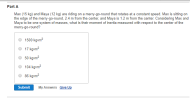 Part A Max (15 kg) and Maya (12 kg) are riding on a merry-go-round that rotates at a constant speed. Max is sitting on the edge of the merry-go-round, 2.4 m from the center, and Maya is 1.2 m from the center. Considering Max and Maya to be one system of masses, what is their moment of inertia measured with respect to the center of the merry-go-round? O 1500 kg.m2 0 17 kg-m2 O50 kg.m2 O 104 kg-m2 86 kg-m2...
A playground merry-go-round has radius 2.50 m and moment of inertia 2000 kg⋅m2 about a vertical...
A playground merry-go-round has radius 2.50 m and moment of inertia 2000 kg⋅m2 about a vertical axle through its center, and it turns with negligible friction. part a A child applies an 23.5 N force tangentially to the edge of the merry-go-round for 22.0 s . If the merry-go-round is initially at rest, what is its angular speed after this 22.0 s interval? part b How much work did the child do on the merry-go-round? part c What is the...
How large must the force of friction be in order to keep a 75kg person in...
How large must the force of friction be in order to keep a 75kg person in place on a merry go round which is revolving one every 4 seconds. The radius of the merry go round is 1.4m. b. If the coefficient of friction is 0.65, how fast would this person have to spin in order to be thrown off the merry go round? (Give your answer in m/s) c. At this speed, what is the period of revolution?
please help part B how do you find delta theta? part C help 1. Two children...
 please help part B how do you find delta theta?
part C help
1. Two children running along the side of a merry-go-round, push on it to spin it faster, as shown to the right. The first child pushes with E 24.0 N, applied tangent to the merry-go-round at its edge. The second child pushes with Fa-13.O N, also applied tangent to the edge of the merry-go-round. The merry-go-round is free to rotate about its center, has a mass of...
please help part B how do you find delta theta?
part C help
1. Two children running along the side of a merry-go-round, push on it to spin it faster, as shown to the right. The first child pushes with E 24.0 N, applied tangent to the merry-go-round at its edge. The second child pushes with Fa-13.O N, also applied tangent to the edge of the merry-go-round. The merry-go-round is free to rotate about its center, has a mass of...
If you move at the speed of light, how does a light beam move relative to...
If you move at the speed of light, how does a light beam move relative to you? Why?
4. A child sitting 2 meters from the center of a merry-go-round moves at a speed...
 4. A child sitting 2 meters from the center of a merry-go-round moves at a speed of 2 m/s. Calculate (A) the centripetal acceleration of the child and (B) the horizontal force exe child (mass 22.5 kg). (A) 1 m/s2 b. 2 m/s2 c. 3 m/s2 d. 4 m/s2 e. 5 m/s2 a. 22.5 N b. 45 N c. 67.5 N d. 90N e. 112.5 N 5. If Earth was moved to a new orbit that was twice as far...
A child pushes her friend (m = 25 kg) located at a radius r = 1.5...
A child pushes her friend (m = 25 kg) located at a radius r = 1.5 m on a merry-go-round (rmgr = 2.0 m, Imgr = 1000 kg*m2) with a constant force F = 90 N applied tangentially to the edge of the merry-go-round (i.e., the force is perpendicular to the radius). The merry-go-round resists spinning with a frictional force of f = 10 N acting at a radius of 1 m and a frictional torque τ = 15 N*m...
 A playground merry-go-round has a radius of R = 4.0m and has a moment of inertia I_cm = 7.0 times 10^3 kg middot m^2 about an axis passing through the center of mass. There is negligible friction about its vertical axis. Two children each of mass m = 25kg are standing on opposite sides a distance r_0 = 3.0m from the central axis. The merry-go-round is initially at rest. A person on the ground applies a constant tangential force of...
 Part A Max (15 kg) and Maya (12 kg) are riding on a merry-go-round that rotates at a constant speed. Max is sitting on the edge of the merry-go-round, 2.4 m from the center, and Maya is 1.2 m from the center. Considering Max and Maya to be one system of masses, what is their moment of inertia measured with respect to the center of the merry-go-round? O 1500 kg.m2 0 17 kg-m2 O50 kg.m2 O 104 kg-m2 86 kg-m2...
 please help part B how do you find delta theta?
part C help
1. Two children running along the side of a merry-go-round, push on it to spin it faster, as shown to the right. The first child pushes with E 24.0 N, applied tangent to the merry-go-round at its edge. The second child pushes with Fa-13.O N, also applied tangent to the edge of the merry-go-round. The merry-go-round is free to rotate about its center, has a mass of...
please help part B how do you find delta theta?
part C help
1. Two children running along the side of a merry-go-round, push on it to spin it faster, as shown to the right. The first child pushes with E 24.0 N, applied tangent to the merry-go-round at its edge. The second child pushes with Fa-13.O N, also applied tangent to the edge of the merry-go-round. The merry-go-round is free to rotate about its center, has a mass of...
 4. A child sitting 2 meters from the center of a merry-go-round moves at a speed of 2 m/s. Calculate (A) the centripetal acceleration of the child and (B) the horizontal force exe child (mass 22.5 kg). (A) 1 m/s2 b. 2 m/s2 c. 3 m/s2 d. 4 m/s2 e. 5 m/s2 a. 22.5 N b. 45 N c. 67.5 N d. 90N e. 112.5 N 5. If Earth was moved to a new orbit that was twice as far...
Most questions answered within 3 hours.
-
Where is the error in this code sequence?
String s1 = "Hello";
String s2 = "ello";...
asked 10 months ago -
Financial data for Joel de Paris, Inc., for last year
follow:
Joel de Paris, Inc.
Balance...
asked 10 months ago -
Consider this reaction:
Al2(SO4)3 (aq)+ BaCl3
(aq) Al2Cl6 (aq)- +
3BaSO4(s) . What is the...
asked 10 months ago -
Suppose that Savneet is considering increasing her
recent random sample from 20 car rentals to 40...
asked 10 months ago -
Trucks arrive at an unloading terminal at an average rate of 120
per hour.
Trucks arrive...
asked 10 months ago -
Why are methanol and ethanol completely soluble in water while
octanol is not very little soluble....
asked 10 months ago -
A facilities manager at a university reads in a research report
that the mean amount of...
asked 10 months ago -
When the CuSO4 is rehydrated by adding water to the anhydrous
compound, is this an endothermic...
asked 10 months ago -
A ray of sunlight is passing from diamond into crown glass; the
angle of incidence is...
asked 10 months ago -
A block of mass 0.249 kg is placed on top of a light, vertical
spring of...
asked 10 months ago -
how do the kidneys compensate in the presences of acidosis
a) trigger hyperventilate
b) reserve acid...
asked 10 months ago -
Question 501 pts
The rental rate of capital to the firm increases. Which of the
following...
asked 10 months ago