I need Help Plz In a tree, the leaves are called external nodes. Accordingly, internal nodes...
I need Help Plz
In a tree, the leaves are called external nodes.
Accordingly, internal nodes are exactly the nodes that are not
external nodes. An edge or connection exists between two nodes if
the two nodes are in `` father-child relationship ''.
A true binary tree is a tree with the property that every internal
node has exactly two children.
Prove the following two sentences for nonempty real
binary trees:
a) A non-empty real binary tree with N internal node has N + 1
external nodes. (Hint: Take advantage of the fact that the
induction requirement applies in particular to true subtrees and
(induced) subtrees of binary trees are themselves binary
again.)
b) A real binary tree with N internal node has 2N edges.
Homework Answers
a) Consider an example for the binary tree containing nodes namely - 8,5,4,6,3.
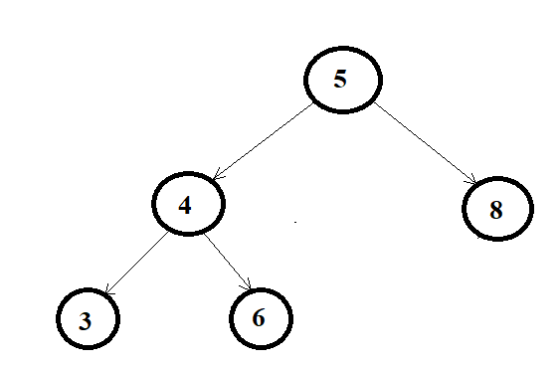
In the above given binary tree, nodes 4 and 5 are the internal nodes, which contains the external nodes 3,6 and 8 respectively.So it satisfies the condition N which contains N + 1 such that total number of internal nodes is n = 2 contains external nodes which is (n + 1) = 2 + 1 = 3.
b) A full binary tree contains exactly less than or equal to 2 child nodes.Thus, it concludes a full binary tree with internal nodes has 2n edges.Since a tree has a one more vertex than it has edges.A full binary tree contains 2n + 1 vertices, n + 1 external nodes and 2n edges.This can also be computed by using the given formulas.
Consider an example with n = 1, which contains 2 edges, 3 vertices and 2 external nodes
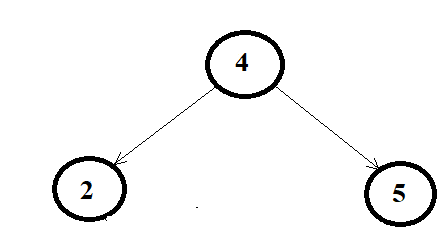
By n = 2 can be calculated by using the formula, has 4 edges, 5 vertices and 3 external nodes.Similarly it can be derived for internal node n = 3,4 and so on.
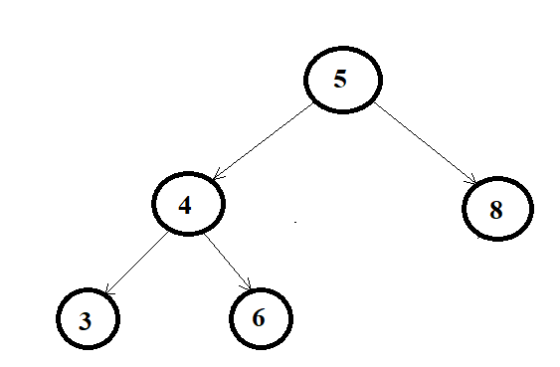
The given example is for internal node n = 2.
Add Answer to:
I need Help Plz
In a tree, the leaves are called external nodes.
Accordingly, internal nodes...
2. A regular binary tree is a binary tree whose internal nodes all have two subtrees...
 2. A regular binary tree is a binary tree whose internal nodes all have two subtrees (left and right). In other words, all their nodes have either zero subtrees (in which case they are leaves) or two subtrees (in which case they are internal nodes). Suppose that you have a boolean function that tells you, for each node of the tree, whether it is a leaf or not (call it: leaf(n), for node n). a) Write a recursive function that...
Recall from Assignment 2 the definition of a binary tree data structure: either an empty tree,...
 Recall from Assignment 2 the definition of a binary tree data structure: either an empty tree, or a node with two children that are trees. Let T(n) denote the number of binary trees with n nodes. For example T(3) 5 because there are five binary trees with three nodes: (a) Using the recursive definition of a binary tree structure, or otherwise, derive a recurrence equation for T(n). (8 marks) A full binary tree is a non-empty binary tree where every...
Trees and Heaps 1. Show that the maximum number of nodes in a binary tree of...
Trees and Heaps 1. Show that the maximum number of nodes in a binary tree of height h is 2h+1 − 1. 2. A full node is a node with two children. Prove that the number of full nodes plus one is equal to the number of leaves in a nonempty binary tree. 3. What is the minimum number of nodes in an AVL tree of height 15? 4. Show the result of inserting 14, 12, 18, 20, 27, 16,...
A binary tree is a complete binary tree if all the internal nodes (including the root...
A binary tree is a complete binary tree if all the internal nodes (including the root node) have exactly two child nodes and all the leaf nodes are at level 'h' corresponding to the height of the tree. Consider the code for the binary tree given to you for this question. Add code in the blank space provided for the member function checkCompleteBinaryTree( ) in the BinaryTree class. This member function should check whether the binary tree input by the...
A rooted binary tree T has 40 leaves. How many nodes in Thas exactly two children?...
 A rooted binary tree T has 40 leaves. How many nodes in Thas exactly two children? (The root is always assumed to have two children.)
2. Write a recursive algorithm which computes the number of nodes in a general tree. 3....
 2. Write a recursive algorithm which computes the number of nodes in a general tree. 3. Show a tree achieving the worst-case running time for algorithm depth. 4. Let T be a tree whose nodes store strings. Give an efficient algorithm that computes and prints, for every node v of T, the string stored at v and the height of the subtree rooted at v. Hin Consider 'decorating' the tree, and add a height field to each node (initialized to...
Fill a tree called Pine with 25 elements from an input file. Traverse the tree using...
Fill a tree called Pine with 25 elements from an input file. Traverse the tree using each of the following methods. Print the smallest element in the binary search tree, Pine. Find the number of edges between the root of the tree and the node that contains the smallest value in the tree. Return the count to the calling unit. Count the number of internal nodes in the original tree, Pine. Print the count and return it to the calling...
The first and second picture are the definition of 2-3 tree,3rd and 4th are the pre-condition...
 The first and second picture are the definition of 2-3
tree,3rd and 4th are the pre-condition and post-condition. Please
use these question to solve problem 8,the last photo.
2-3 Trees: Definition Suppose that E is an ordered type, that is, a nonempty set of values that have a total order. A 2-3-tree, for type E, is a finite rooted tree T (like a binary search tree or a red-black tree) that satisfies the following 2-3 Tree Properties: (a) Every leaf...
The first and second picture are the definition of 2-3
tree,3rd and 4th are the pre-condition and post-condition. Please
use these question to solve problem 8,the last photo.
2-3 Trees: Definition Suppose that E is an ordered type, that is, a nonempty set of values that have a total order. A 2-3-tree, for type E, is a finite rooted tree T (like a binary search tree or a red-black tree) that satisfies the following 2-3 Tree Properties: (a) Every leaf...
1. In a heap, the upper bound on the number of leaves is: (A) O(n) (B)...
1. In a heap, the upper bound on the number of leaves is: (A) O(n) (B) O(1) (C) O(logn) (D) O(nlogn) 2. In a heap, the distance from the root to the furthest leaf is: (A) θ(nlogn) (B) θ(logn) (C) θ(1) (D) θ(n) 3. In a heap, let df be the distance of the furthest leaf from the root and let dc be the analogous distance of the closest leaf. What is df − dc, at most? (A) 1 (C)...
The INORDER traversal output of a binary tree is U,N,I,V,E,R,S,I,T,Y and the POSTORDER traversal output of the same tree is N,U,V,R,E,T,I,S,I,Y
a. The INORDER traversal output of a binary tree is U,N,I,V,E,R,S,I,T,Y and the POSTORDER traversal output of the same tree is N,U,V,R,E,T,I,S,I,Y. Construct the tree and determine the output of the PREORDER traversal output. b. One main difference between a binary search tree (BST) and an AVL (Adelson-Velski and Landis) tree is that an AVL tree has a balance condition, that is, for every node in the AVL tree, the height of the left and right subtrees differ by at most 1....
 2. A regular binary tree is a binary tree whose internal nodes all have two subtrees (left and right). In other words, all their nodes have either zero subtrees (in which case they are leaves) or two subtrees (in which case they are internal nodes). Suppose that you have a boolean function that tells you, for each node of the tree, whether it is a leaf or not (call it: leaf(n), for node n). a) Write a recursive function that...
 Recall from Assignment 2 the definition of a binary tree data structure: either an empty tree, or a node with two children that are trees. Let T(n) denote the number of binary trees with n nodes. For example T(3) 5 because there are five binary trees with three nodes: (a) Using the recursive definition of a binary tree structure, or otherwise, derive a recurrence equation for T(n). (8 marks) A full binary tree is a non-empty binary tree where every...
 A rooted binary tree T has 40 leaves. How many nodes in Thas exactly two children? (The root is always assumed to have two children.)
 2. Write a recursive algorithm which computes the number of nodes in a general tree. 3. Show a tree achieving the worst-case running time for algorithm depth. 4. Let T be a tree whose nodes store strings. Give an efficient algorithm that computes and prints, for every node v of T, the string stored at v and the height of the subtree rooted at v. Hin Consider 'decorating' the tree, and add a height field to each node (initialized to...
 The first and second picture are the definition of 2-3
tree,3rd and 4th are the pre-condition and post-condition. Please
use these question to solve problem 8,the last photo.
2-3 Trees: Definition Suppose that E is an ordered type, that is, a nonempty set of values that have a total order. A 2-3-tree, for type E, is a finite rooted tree T (like a binary search tree or a red-black tree) that satisfies the following 2-3 Tree Properties: (a) Every leaf...
The first and second picture are the definition of 2-3
tree,3rd and 4th are the pre-condition and post-condition. Please
use these question to solve problem 8,the last photo.
2-3 Trees: Definition Suppose that E is an ordered type, that is, a nonempty set of values that have a total order. A 2-3-tree, for type E, is a finite rooted tree T (like a binary search tree or a red-black tree) that satisfies the following 2-3 Tree Properties: (a) Every leaf...
Most questions answered within 3 hours.
-
Where is the error in this code sequence?
String s1 = "Hello";
String s2 = "ello";...
asked 11 months ago -
Financial data for Joel de Paris, Inc., for last year
follow:
Joel de Paris, Inc.
Balance...
asked 11 months ago -
Consider this reaction:
Al2(SO4)3 (aq)+ BaCl3
(aq) Al2Cl6 (aq)- +
3BaSO4(s) . What is the...
asked 11 months ago -
Suppose that Savneet is considering increasing her
recent random sample from 20 car rentals to 40...
asked 11 months ago -
Trucks arrive at an unloading terminal at an average rate of 120
per hour.
Trucks arrive...
asked 11 months ago -
Why are methanol and ethanol completely soluble in water while
octanol is not very little soluble....
asked 11 months ago -
A facilities manager at a university reads in a research report
that the mean amount of...
asked 11 months ago -
When the CuSO4 is rehydrated by adding water to the anhydrous
compound, is this an endothermic...
asked 11 months ago -
A ray of sunlight is passing from diamond into crown glass; the
angle of incidence is...
asked 11 months ago -
A block of mass 0.249 kg is placed on top of a light, vertical
spring of...
asked 11 months ago -
how do the kidneys compensate in the presences of acidosis
a) trigger hyperventilate
b) reserve acid...
asked 11 months ago -
Question 501 pts
The rental rate of capital to the firm increases. Which of the
following...
asked 11 months ago