Give an informal description of a deterministic Turing machine for the language L = {x ∈...
Give an informal description of a deterministic Turing machine for the language L = {x ∈ {0, 1}* | x is not of the form 0w1w for w ∈ {0, 1}*}.
Homework Answers
This problem is simple to evaluate using multitape deterministic Turing machine, which will accept string x by rejecting the string x if it is in the form of 0w1w and accept otherwise. The Turing machine will work as follows:-
1. On input string x, if the starting symbol is not 0 then accept because it cannot be in the form of 0w10.
2. If starting input is 0, then consume this 0, and then find the middle element of remaining string. Now if the input left on input tape is w1w then the middle element must be 1.
3. If the middle element is 0 then accept the input, otherwise copy the content of substring following middle input 1 into the second tape. Also remove the middle 1 as well as all the substring following 1 from the input tape.
4. Now check if the string on the input tape and string on second tape are same, this happen only when input is of the form 0w1w. If they are same then reject the string since the original input is then 0w1w and if they are not same then accept the input.
Hence by creating deterministic TM using above steps we will be able to recognize L.
Please comment for any clarification.
Add Answer to:
Give an informal description of a deterministic Turing machine
for the language L = {x ∈...
Give an informal description of a deterministic Turing machine for the language L = {w ∈...
Give an informal description of a deterministic Turing machine for the language L = {w ∈ {0, 1}* | w is not of the form (01)^n (10)^n for n ≥ 0}.
(a) Give a high level description of a single-tape deterministic Turing machine that decides the language...
(a) Give a high level description of a single-tape deterministic Turing machine that decides the language L = {w#x#y | w ∈ {0, 1} ∗ , x ∈ {0, 1} ∗ , y ∈ {0, 1} ∗ , and |w| > |x| > |y|}, where the input alphabet is Σ = {0, 1}. (b) What is the running time (order notation) of your Turing machine? Justify your answer.
Specify in detail a (deterministic) a Turing machine that accepts the language L = a* ba*...
 Specify in detail a (deterministic) a Turing machine that accepts the language L = a* ba* (your Turing machine must halt on input w if, and only if, w € L). Remember: since your machine is deterministic, it must have a well-defined behavior for any possible symbol of the input alphabet, i.e, a, b, and #, in each state, except that you only need to ensure that your Turing machine behaves correctly when started in the configuration (s, #w#). Thus,...
1) Given language L = {a"62"n >0} a) Give an informal english description of a PDA...
 1) Given language L = {a"62"n >0} a) Give an informal english description of a PDA for L b) Give a PDA for L
Introduce a Turing machine to decide the languages to follow. You must Algorithmic description, but with...
Introduce a Turing machine to decide the languages to follow. You must Algorithmic description, but with a sufficient level of detail. You can use the variants of the original model of the Turing machine. {w w^R w | where w is a word formed by 0's and 1's} {w ∈ {a, b}∗| w is a palindrome and has the same number of a's and b's}. Please describe which variant of Turing whether it is with a tape or multi tape....
What is the language of accepted strings by the below Turing machine? {a*b*} {ambn | m,...
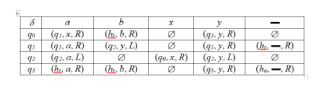 What is the language of accepted strings by the below Turing
machine?
{a*b*}
{ambn | m, n ≥ 0}
{ambm | m ≥ 0}
{ambnam | m,
n ≥ 0}
This Turing machine is non-deterministic, so it cannot accept a
deterministic language.
( R) go 9 q 93 (9,X, R) (91a, R) (qa, a, L) (hra, R) (h. b, R) (92. y, L) Ø (h. 6, R) 0 0 (qox, R) 0 (93, y, R) (. y, R) (92 y,...
What is the language of accepted strings by the below Turing
machine?
{a*b*}
{ambn | m, n ≥ 0}
{ambm | m ≥ 0}
{ambnam | m,
n ≥ 0}
This Turing machine is non-deterministic, so it cannot accept a
deterministic language.
( R) go 9 q 93 (9,X, R) (91a, R) (qa, a, L) (hra, R) (h. b, R) (92. y, L) Ø (h. 6, R) 0 0 (qox, R) 0 (93, y, R) (. y, R) (92 y,...
Give an informal description (in plain English) of a Turing machine with three tapes that receives as input two non-negative integers x and y
Give an informal description (in plain English) of a Turing machine with three tapes that receives as input two non-negative integers x and y, and returns as output the integer xy. Integers are represented as binary strings.Start of the computation: The first tape contains the binary representation of x and its head is on the rightmost symbol of x. The second tape contains the binary representation of y and its head is on the rightmost symbol of y. The third...
Give the implementation-level description of a Turing machine that decides the following language over the alphabet...
 Give the implementation-level description of a Turing machine that decides the following language over the alphabet a, b, c^. You are encouraged but not required to use a multi- tape and/or nondeterministic Turing Machine. Lan n s a positive integer )
determine if the language is regular, context-free, Turing-decidable, or undecidable. For languages that are regular, give...
 determine if the language is regular, context-free, Turing-decidable, or undecidable. For languages that are regular, give a DFA that accepts the language, a regular expression that generates the language, and a maximal list of strings that are pairwise distinguishable with respect to the language. For languages that are context-free but not regular, prove that the language is not regular and either give a context- free grammar that generates the language or a pushdown automaton that accepts the language. You need...
Give the state diagram for a single-tape Turing machine for the following language. L = {a#b#c...
Give the state diagram for a single-tape Turing machine for the following language. L = {a#b#c | a, b, c ∈ { 0 , 1 }∗ and a,b,c all have the same number of zeroes} Assume Σ = { 0 , 1 }
 Specify in detail a (deterministic) a Turing machine that accepts the language L = a* ba* (your Turing machine must halt on input w if, and only if, w € L). Remember: since your machine is deterministic, it must have a well-defined behavior for any possible symbol of the input alphabet, i.e, a, b, and #, in each state, except that you only need to ensure that your Turing machine behaves correctly when started in the configuration (s, #w#). Thus,...
 1) Given language L = {a"62"n >0} a) Give an informal english description of a PDA for L b) Give a PDA for L
 What is the language of accepted strings by the below Turing
machine?
{a*b*}
{ambn | m, n ≥ 0}
{ambm | m ≥ 0}
{ambnam | m,
n ≥ 0}
This Turing machine is non-deterministic, so it cannot accept a
deterministic language.
( R) go 9 q 93 (9,X, R) (91a, R) (qa, a, L) (hra, R) (h. b, R) (92. y, L) Ø (h. 6, R) 0 0 (qox, R) 0 (93, y, R) (. y, R) (92 y,...
What is the language of accepted strings by the below Turing
machine?
{a*b*}
{ambn | m, n ≥ 0}
{ambm | m ≥ 0}
{ambnam | m,
n ≥ 0}
This Turing machine is non-deterministic, so it cannot accept a
deterministic language.
( R) go 9 q 93 (9,X, R) (91a, R) (qa, a, L) (hra, R) (h. b, R) (92. y, L) Ø (h. 6, R) 0 0 (qox, R) 0 (93, y, R) (. y, R) (92 y,...
 Give the implementation-level description of a Turing machine that decides the following language over the alphabet a, b, c^. You are encouraged but not required to use a multi- tape and/or nondeterministic Turing Machine. Lan n s a positive integer )
 determine if the language is regular, context-free, Turing-decidable, or undecidable. For languages that are regular, give a DFA that accepts the language, a regular expression that generates the language, and a maximal list of strings that are pairwise distinguishable with respect to the language. For languages that are context-free but not regular, prove that the language is not regular and either give a context- free grammar that generates the language or a pushdown automaton that accepts the language. You need...
Most questions answered within 3 hours.
-
Where is the error in this code sequence?
String s1 = "Hello";
String s2 = "ello";...
asked 10 months ago -
Financial data for Joel de Paris, Inc., for last year
follow:
Joel de Paris, Inc.
Balance...
asked 10 months ago -
Consider this reaction:
Al2(SO4)3 (aq)+ BaCl3
(aq) Al2Cl6 (aq)- +
3BaSO4(s) . What is the...
asked 10 months ago -
Suppose that Savneet is considering increasing her
recent random sample from 20 car rentals to 40...
asked 10 months ago -
Trucks arrive at an unloading terminal at an average rate of 120
per hour.
Trucks arrive...
asked 10 months ago -
Why are methanol and ethanol completely soluble in water while
octanol is not very little soluble....
asked 10 months ago -
A facilities manager at a university reads in a research report
that the mean amount of...
asked 10 months ago -
When the CuSO4 is rehydrated by adding water to the anhydrous
compound, is this an endothermic...
asked 10 months ago -
A ray of sunlight is passing from diamond into crown glass; the
angle of incidence is...
asked 10 months ago -
A block of mass 0.249 kg is placed on top of a light, vertical
spring of...
asked 10 months ago -
how do the kidneys compensate in the presences of acidosis
a) trigger hyperventilate
b) reserve acid...
asked 10 months ago -
Question 501 pts
The rental rate of capital to the firm increases. Which of the
following...
asked 10 months ago