11. Demonstrate the tax increase using the closed AD-AS model, ceteris paribus, after the initial short-run...
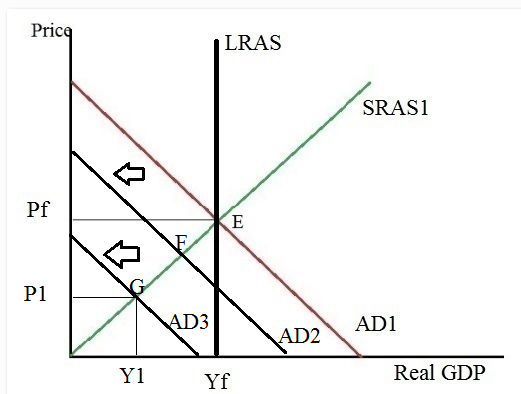
11. Demonstrate the tax increase using the closed AD-AS model, ceteris paribus, after the initial short-run shock (i.e., decrease in wealth), but before the nominal wages and prices are fully flexible. [Note: this is the counterfactual version.]
[Sub-questions 11-12 are connected.]
After the tax increase, _______ shifts_______.
A. the aggregate demand curve; leftward
B. the aggregate demand curve; rightward
C. the short-run aggregate supply curve; leftward
D. the short-run aggregate supply curve; rightward
E. the long-run aggregate supply curve; leftward
F. the long-run aggregate supply curve; rightward
G. both the short-run aggregate supply curve and long-run aggregate supply curve; leftward
H. both the short-run aggregate supply curve and long-run
12. The resulting equilibrium results in a _______ price level, a _______ real GDP, indicating a _______.
A. lower; lower; worsening recessionary gap
B. lower; higher; worsening inflationary gap
C. higher; lower; improved recessionary gap
D. higher; higher; improved inflationary gap
E. lower; lower; return to long-run equilibrium
F. lower; higher; return to long-run equilibrium
G. higher; lower; return to long-run equilibrium
H. higher; higher; return to long-run equilibrium
Homework Answers
Economy begins at E at its long run equilibrium level. A decrease in wealth is a demand shock that shifts the AD down. Prices are sticky in the short run so SRAS is upward sloping. Economy moves to F where output is reduced resulting in a recessionary gap and the price level also declines. Now there is a tax increase which reduces disposable income and consumption. AD further shifts to the left and real GDP and price level both decline at G.
11) Option A
12) Option A
Add Answer to:
11. Demonstrate the tax increase using the
closed AD-AS model, ceteris paribus, after the initial
short-run...
6. Demonstrate the decrease in wealth using the closed AD-AS model, ceteris paribus, in both the...
6. Demonstrate the decrease in wealth using the closed AD-AS model, ceteris paribus, in both the short-run and long-run. Assumptions: (1) start in long-run equilibrium; (2) prices are sticky; (3) nominal wages are fixed in the short-run. [Note: this is the self-correcting version.] [Sub-questions 6-10 are connected.] In the short-run, _______ shifts _______. A. the aggregate demand curve; leftward B. the aggregate demand curve; rightward C. the short-run aggregate supply curve; leftward D. the short-run aggregate supply curve; rightward E....
()-run equilibrium occurs at the intersection of the aggregate demand curve, AD, and the short-run aggregate...
()-run equilibrium occurs at the intersection of the aggregate demand curve, AD, and the short-run aggregate supply curve, SRAS.() ▼ Long Short -run equilibrium occurs at the intersection of AD and the long-run aggregate supply curve, LRAS. Any unanticipated shifts in aggregate demand or supply are called aggregate demand or aggregate supply() ▼ shocks externalities . When aggregate demand decreases while aggregate supply is stable,() ▼ a recessionary an inflationary gap can occur, defined as the difference between how much...
Assuming ceteris paribus, a decrease in consumer expenditure will result in Group of answer choices a...
Assuming ceteris paribus, a decrease in consumer expenditure will result in Group of answer choices a rightward shift of the aggregate supply curve. an increase in the MPS. an increase in taxes. a leftward shift of the aggregate demand curve.
1) If the economy exhibits a recessionary gap in the short run, the real wage rate...
1) If the economy exhibits a recessionary gap in the short run, the real wage rate will __________________ (fall, rise), and short-run aggregate supply curve will shift __________________ (leftward, rightward). 2) If the economy exhibits an expansionary gap in the short run, the real wage rate will __________________ (fall, rise), and short-run aggregate supply curve will shift __________________ (leftward, rightward).
Unit 3: Aggregate Demand, Aggregate Supply, and Fiscal Policy AD, AS, and LRAS Short Run vs....
 Unit 3: Aggregate Demand, Aggregate Supply, and Fiscal Policy AD, AS, and LRAS Short Run vs. Long Run Aggregate Supply Draw the economy at full employment 1. In the short run, wages and resource prices will as price levels increase 2. In the long run, wages and resource prices will as price levels increase Shifters of AD and AS Shifters of Aggregate Demand Shifters of Aggregate Supply imi Recessionary Gap Draw an economy in a recession Inflationary Gap Draw an...
Econ hw please help thank you! NAN Print Last Name, First Name 6. In a self-regulating...
 Econ hw please help thank you!
NAN Print Last Name, First Name 6. In a self-regulating economy, inflationary gaps are automatically eliminated in the le run by: a. decreases in wage rates that cause short-run aggregate supply to shift rightwo decreases in wage rates that cause short-run aggregate supply to shift left word increases in wage rates that cause short-run aggregate supply to shift rightward increases in wage rates that cause short-run aggregate supply to shift leftward Assume the economy...
Econ hw please help thank you!
NAN Print Last Name, First Name 6. In a self-regulating economy, inflationary gaps are automatically eliminated in the le run by: a. decreases in wage rates that cause short-run aggregate supply to shift rightwo decreases in wage rates that cause short-run aggregate supply to shift left word increases in wage rates that cause short-run aggregate supply to shift rightward increases in wage rates that cause short-run aggregate supply to shift leftward Assume the economy...
29.An increase in oil prices to a country that is a net importer of oil shifts...
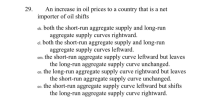 29.An increase in oil prices to a country that is a net importer of oil shifts ek. both the short-run aggregate supply and long-run el. both the short-run aggregate supply and long-run em. the short-run aggregate supply curve leftward but leaves en. the long-run aggregate supply curve rightward but leaves eo. the short-run aggregate supply curve leftward but shifts aggregate supply curves rightward. aggregate supply curves leftward. the long-run aggregate supply curve unchanged. the short-run aggregate supply curve unchanged. the...
Ceteris Paribus, an increase in the price of a complement will cause which of the following...
Ceteris Paribus, an increase in the price of a complement will cause which of the following to occur: a. our demand curve to shift to the left and a higher equilibrium price b. our demand curve to shift to the right and a lower equilibrium price c. our demand curve to shift to the left and a lower equilibrium price d. our demand curve to shift to the right and a higher equilibrium price e. our quantity demand at the...
50. Ceteris paribus, the total demand for money curve will increase (shift rightward): A. if interest...
 50. Ceteris paribus, the total demand for money curve will increase (shift rightward): A. if interest rates increase. B. if nominal GDP decreases. C. if the price level decreases. D. if nominal GDP increases. 51. Ceteris paribus, the total demand for money curve will decrease (shift leftward): A. if interest rates increase. B. if nominal GDP decreases. C. if the price level increases. D. if nominal GDP increases. 52. Which of the following is correct? A. The asset (speculative) demand...
Real GDP demanded Real GDP supplied Short run Long run (dollars) (dollars) Price level (dollars) 700...
 Real GDP demanded Real GDP supplied Short run Long run (dollars) (dollars) Price level (dollars) 700 90 300 600 100 600 400 600 110 500 500 600 120 400 600 600 The table above gives the aggregate demand and aggregate supply schedules in Lotus Land. In short -run equilibrium, there is __---- 1) an inflationary gap of $100 2) a recessionary gap of $100 3) a recessionary gap of $200 4) an inflationary gap of $200
 Unit 3: Aggregate Demand, Aggregate Supply, and Fiscal Policy AD, AS, and LRAS Short Run vs. Long Run Aggregate Supply Draw the economy at full employment 1. In the short run, wages and resource prices will as price levels increase 2. In the long run, wages and resource prices will as price levels increase Shifters of AD and AS Shifters of Aggregate Demand Shifters of Aggregate Supply imi Recessionary Gap Draw an economy in a recession Inflationary Gap Draw an...
 Econ hw please help thank you!
NAN Print Last Name, First Name 6. In a self-regulating economy, inflationary gaps are automatically eliminated in the le run by: a. decreases in wage rates that cause short-run aggregate supply to shift rightwo decreases in wage rates that cause short-run aggregate supply to shift left word increases in wage rates that cause short-run aggregate supply to shift rightward increases in wage rates that cause short-run aggregate supply to shift leftward Assume the economy...
Econ hw please help thank you!
NAN Print Last Name, First Name 6. In a self-regulating economy, inflationary gaps are automatically eliminated in the le run by: a. decreases in wage rates that cause short-run aggregate supply to shift rightwo decreases in wage rates that cause short-run aggregate supply to shift left word increases in wage rates that cause short-run aggregate supply to shift rightward increases in wage rates that cause short-run aggregate supply to shift leftward Assume the economy...
 29.An increase in oil prices to a country that is a net importer of oil shifts ek. both the short-run aggregate supply and long-run el. both the short-run aggregate supply and long-run em. the short-run aggregate supply curve leftward but leaves en. the long-run aggregate supply curve rightward but leaves eo. the short-run aggregate supply curve leftward but shifts aggregate supply curves rightward. aggregate supply curves leftward. the long-run aggregate supply curve unchanged. the short-run aggregate supply curve unchanged. the...
 50. Ceteris paribus, the total demand for money curve will increase (shift rightward): A. if interest rates increase. B. if nominal GDP decreases. C. if the price level decreases. D. if nominal GDP increases. 51. Ceteris paribus, the total demand for money curve will decrease (shift leftward): A. if interest rates increase. B. if nominal GDP decreases. C. if the price level increases. D. if nominal GDP increases. 52. Which of the following is correct? A. The asset (speculative) demand...
 Real GDP demanded Real GDP supplied Short run Long run (dollars) (dollars) Price level (dollars) 700 90 300 600 100 600 400 600 110 500 500 600 120 400 600 600 The table above gives the aggregate demand and aggregate supply schedules in Lotus Land. In short -run equilibrium, there is __---- 1) an inflationary gap of $100 2) a recessionary gap of $100 3) a recessionary gap of $200 4) an inflationary gap of $200
Most questions answered within 3 hours.
-
Where is the error in this code sequence?
String s1 = "Hello";
String s2 = "ello";...
asked 11 months ago -
Financial data for Joel de Paris, Inc., for last year
follow:
Joel de Paris, Inc.
Balance...
asked 11 months ago -
Consider this reaction:
Al2(SO4)3 (aq)+ BaCl3
(aq) Al2Cl6 (aq)- +
3BaSO4(s) . What is the...
asked 11 months ago -
Suppose that Savneet is considering increasing her
recent random sample from 20 car rentals to 40...
asked 11 months ago -
Trucks arrive at an unloading terminal at an average rate of 120
per hour.
Trucks arrive...
asked 11 months ago -
Why are methanol and ethanol completely soluble in water while
octanol is not very little soluble....
asked 11 months ago -
A facilities manager at a university reads in a research report
that the mean amount of...
asked 11 months ago -
When the CuSO4 is rehydrated by adding water to the anhydrous
compound, is this an endothermic...
asked 11 months ago -
A ray of sunlight is passing from diamond into crown glass; the
angle of incidence is...
asked 11 months ago -
A block of mass 0.249 kg is placed on top of a light, vertical
spring of...
asked 11 months ago -
how do the kidneys compensate in the presences of acidosis
a) trigger hyperventilate
b) reserve acid...
asked 11 months ago -
Question 501 pts
The rental rate of capital to the firm increases. Which of the
following...
asked 11 months ago