A. In October 2009, NASA crashed a 2000 kg rocket into the Moon. The speed upon...
A. In October 2009, NASA crashed a 2000 kg rocket into the Moon. The speed upon impact was 9000 km/h. At what speed did the moon recoil?
B. How much kinetic energy was lost in the collision?
Mass of the Moon = 7.35 x 10^22 kg
Homework Answers

Add Answer to:
A. In October 2009, NASA crashed a 2000 kg rocket into the Moon.
The speed upon...
The mass of the Moon is 7.35 x 10²² kg, and its radius is 1.737 x...
 The mass of the Moon is 7.35 x 10²² kg, and its radius is 1.737 x 10⁹ km. What is the escape velocity for the Moon? (Assume gravitational potential energy and kinetic energy at infinity both equal o.) Select one: a. 2.38 km/sec b. 11.4 km/sec c. 75 m/sec d. 11.4 m/sec
1. The moon's orbital speed around Earth is 3.680 x 10⁹ km/h. Suppose the moon suffers...
 1. The moon's orbital speed around Earth is 3.680 x 10⁹ km/h. Suppose the moon suffers a perfectly elastic collision with a comet whose mass is 50.0 percent that of the moon. (A partially inelastic collision would be a much Problem G DATE CLASS more realistic event.) After the collision, the moon moves with a speed of -4.40 x 10² km/h, while the comet moves away from the moon at 5.740 x 10⁹ km/h. What is the comet's speed before...
Part B please (13% Problem 1: The Moon's craters are remnants of meteorite collisions. Suppose a...
 Part B please
(13% Problem 1: The Moon's craters are remnants of meteorite collisions. Suppose a fairly large asteroid that has a mass of 5.25 x 10² kg (such an asteroid is about a kilometer across) strikes the Moon at a speed of 14 km/s relative to the Moon 50% Part (a) At what speed, in meters per second, does the Moon recoil after the perfectly inelastic collision? The mass of the Moon is 7.36 x 10² kg 9.986 10...
Part B please
(13% Problem 1: The Moon's craters are remnants of meteorite collisions. Suppose a fairly large asteroid that has a mass of 5.25 x 10² kg (such an asteroid is about a kilometer across) strikes the Moon at a speed of 14 km/s relative to the Moon 50% Part (a) At what speed, in meters per second, does the Moon recoil after the perfectly inelastic collision? The mass of the Moon is 7.36 x 10² kg 9.986 10...
An object has a kinetic energy of 234 J and a momentum of magnitude 29.0 kg...
An object has a kinetic energy of 234 J and a momentum of magnitude 29.0 kg · m/s. (a) Find the speed of the object. ____m/s (b) Find the mass of the object. ____kg A rifle with a weight of 20 N fires a 5.3-g bullet with a speed of 260 m/s. (a) Find the recoil speed of the rifle. m/s (b) If a 675-N man holds the rifle firmly against his shoulder, find the recoil speed of the man...
At what speed does a 2000 kg compact car have the same kinetic energy as a...
 At what speed does a 2000 kg compact car have the same kinetic energy as a 15000 kg truck going 22 km/hr ? Express your answer using two significant figures. km/hr Submit Request Answer
Constants Pe A 975-kg two-stage rocket is traveling at a speed of 6.30x10 m/s away from...
 Constants Pe A 975-kg two-stage rocket is traveling at a speed of 6.30x10 m/s away from Earth when a predesigned explosion separates the rocket into two sections of equal mass that then move with a speed of 3.00x10⁹ m/s relative to each other along the original line of motion Part A What is the speed of each section (relative to Earth) after the explosion? Enter your answers numerically separated by a comma. να ΑΣΦ 2 x xVx x x x...
Problem 2 A 1.0 kg cannonball is fired horizontally with a speed of 200 rn/s at...
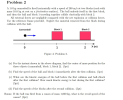 Problem 2 A 1.0 kg cannonball is fired horizontally with a speed of 200 rn/s at two blocks (each with mass 10.0 kg at rest on a frictionless surface). The ball embeds itself in the first block, and then the ball and block 1 traveling together collide elastically with block 2. All external forces are negligible compared with the net explosion or collision forces. Use the reference frame provided. Neglect the material removed from the block during collision with the...
Assume that the density of an average asteroid is 3.1 kg/L, and that the craters on...
 Assume that the density of an average asteroid is 3.1 kg/L, and that the craters on the Moon are roughly 15 times the size of the impacting body. a. What was the diameter of the asteroid that created the 240-km-diameter Clavius crater? D= 16 km Using the density of an average asteroid, calculate the mass of this asteroid. m= *10 15 kg b. Calculate the kinetic energy of this impact if the speed of the asteroid was 22 km/sec relative...
1-Dimensional INELASTIC Collision: A 1-kg mass traveling from left to right at 10.0 m/s hits and...
1-Dimensional INELASTIC Collision: A 1-kg mass traveling from left to right at 10.0 m/s hits and STICKS to a 6.00 kg mass that was travelling from right to left at 10.0 m/s. a) What is the final velocity (speed and direction) of the combined mass after the collision? b) How much KINETIC ENERGY has been LOST in this collision? c) Where did that lost energy go?
A rocket in outer space has a payload of 5055.6 kg and 1.542 . 105 kg...
 A rocket in outer space has a payload of 5055.6 kg and 1.542 . 105 kg of fuel. The rocket can expel propellant at a speed of 5.580 km/s. Assume that the rocket starts from rest, accelerates to its final velocity, and then begins its trip. How long will it take the rocket to travel a distance of 3.82. 103 km (approximately the distance between Earth and Moon)? Question A fire hose 4.54 cm in diameter is capable of spraying...
 The mass of the Moon is 7.35 x 10²² kg, and its radius is 1.737 x 10⁹ km. What is the escape velocity for the Moon? (Assume gravitational potential energy and kinetic energy at infinity both equal o.) Select one: a. 2.38 km/sec b. 11.4 km/sec c. 75 m/sec d. 11.4 m/sec
 1. The moon's orbital speed around Earth is 3.680 x 10⁹ km/h. Suppose the moon suffers a perfectly elastic collision with a comet whose mass is 50.0 percent that of the moon. (A partially inelastic collision would be a much Problem G DATE CLASS more realistic event.) After the collision, the moon moves with a speed of -4.40 x 10² km/h, while the comet moves away from the moon at 5.740 x 10⁹ km/h. What is the comet's speed before...
 Part B please
(13% Problem 1: The Moon's craters are remnants of meteorite collisions. Suppose a fairly large asteroid that has a mass of 5.25 x 10² kg (such an asteroid is about a kilometer across) strikes the Moon at a speed of 14 km/s relative to the Moon 50% Part (a) At what speed, in meters per second, does the Moon recoil after the perfectly inelastic collision? The mass of the Moon is 7.36 x 10² kg 9.986 10...
Part B please
(13% Problem 1: The Moon's craters are remnants of meteorite collisions. Suppose a fairly large asteroid that has a mass of 5.25 x 10² kg (such an asteroid is about a kilometer across) strikes the Moon at a speed of 14 km/s relative to the Moon 50% Part (a) At what speed, in meters per second, does the Moon recoil after the perfectly inelastic collision? The mass of the Moon is 7.36 x 10² kg 9.986 10...
 At what speed does a 2000 kg compact car have the same kinetic energy as a 15000 kg truck going 22 km/hr ? Express your answer using two significant figures. km/hr Submit Request Answer
 Constants Pe A 975-kg two-stage rocket is traveling at a speed of 6.30x10 m/s away from Earth when a predesigned explosion separates the rocket into two sections of equal mass that then move with a speed of 3.00x10⁹ m/s relative to each other along the original line of motion Part A What is the speed of each section (relative to Earth) after the explosion? Enter your answers numerically separated by a comma. να ΑΣΦ 2 x xVx x x x...
 Problem 2 A 1.0 kg cannonball is fired horizontally with a speed of 200 rn/s at two blocks (each with mass 10.0 kg at rest on a frictionless surface). The ball embeds itself in the first block, and then the ball and block 1 traveling together collide elastically with block 2. All external forces are negligible compared with the net explosion or collision forces. Use the reference frame provided. Neglect the material removed from the block during collision with the...
 Assume that the density of an average asteroid is 3.1 kg/L, and that the craters on the Moon are roughly 15 times the size of the impacting body. a. What was the diameter of the asteroid that created the 240-km-diameter Clavius crater? D= 16 km Using the density of an average asteroid, calculate the mass of this asteroid. m= *10 15 kg b. Calculate the kinetic energy of this impact if the speed of the asteroid was 22 km/sec relative...
 A rocket in outer space has a payload of 5055.6 kg and 1.542 . 105 kg of fuel. The rocket can expel propellant at a speed of 5.580 km/s. Assume that the rocket starts from rest, accelerates to its final velocity, and then begins its trip. How long will it take the rocket to travel a distance of 3.82. 103 km (approximately the distance between Earth and Moon)? Question A fire hose 4.54 cm in diameter is capable of spraying...
Most questions answered within 3 hours.
-
Where is the error in this code sequence?
String s1 = "Hello";
String s2 = "ello";...
asked 10 months ago -
Financial data for Joel de Paris, Inc., for last year
follow:
Joel de Paris, Inc.
Balance...
asked 10 months ago -
Consider this reaction:
Al2(SO4)3 (aq)+ BaCl3
(aq) Al2Cl6 (aq)- +
3BaSO4(s) . What is the...
asked 10 months ago -
Suppose that Savneet is considering increasing her
recent random sample from 20 car rentals to 40...
asked 10 months ago -
Trucks arrive at an unloading terminal at an average rate of 120
per hour.
Trucks arrive...
asked 10 months ago -
Why are methanol and ethanol completely soluble in water while
octanol is not very little soluble....
asked 10 months ago -
A facilities manager at a university reads in a research report
that the mean amount of...
asked 10 months ago -
When the CuSO4 is rehydrated by adding water to the anhydrous
compound, is this an endothermic...
asked 10 months ago -
A ray of sunlight is passing from diamond into crown glass; the
angle of incidence is...
asked 10 months ago -
A block of mass 0.249 kg is placed on top of a light, vertical
spring of...
asked 10 months ago -
how do the kidneys compensate in the presences of acidosis
a) trigger hyperventilate
b) reserve acid...
asked 10 months ago -
Question 501 pts
The rental rate of capital to the firm increases. Which of the
following...
asked 10 months ago