If TC=(1/20)q^3+200 Calculate the price at which the firm would break even (zero profit). What is...
Homework Answers

Add Answer to:
If
TC=(1/20)q^3+200
Calculate the price at which the firm would break even (zero
profit). What is...
2. (54 points) Short-run costs. Suppose w 1, r 10 and K 20. C )q3 +200 a) (5 points) We have TC = WG) q3 + rK = On one graph (with q on the horizontal axis), graph the Total Cost, Variable Cost, and...
 2. (54 points) Short-run costs. Suppose w 1, r 10 and K 20. C )q3 +200 a) (5 points) We have TC = WG) q3 + rK = On one graph (with q on the horizontal axis), graph the Total Cost, Variable Cost, and Fixed Cost functions. Pay attention to the shape of the curves, where they intercept the axes and each other (if they do), and the position of the curves relative to each other b) (9 points) Using...
(10 pts) A firm has the following relationship between output (Q) and total cost (TC): Q...
(10 pts) A firm has the following relationship between output (Q) and total cost (TC): Q TC 0 $100 1 110 2 130 3 160 4 200 5 250 6 310 7 380 8 460 9 550 10 650 Say the firm is a perfect competitor. If the market price for its product is $ 80, at what output level will this firm produce at (as a profit maximizer)? At the output level in (a), are firms in this industry...
A firm has the following total costs, where Q is output and TC is total cost:...
A firm has the following total costs, where Q is output and TC is total cost: Q TC 0 $ 100 1 110 2 130 3 160 4 200 5 250 6 310 7 380 8 460 9 550 10 650 11 760 Say the firm is in a perfectly competitive market. If the current market (equilibrium) price is $ 70, at what output level will the firm as a profit maximizer produce at? Say the market price rises to...
12. Consider a price-taking firm with cost function C(q) = 9+q2. What is the break-even price,...
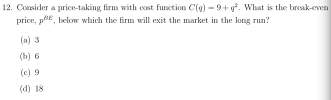 12. Consider a price-taking firm with cost function C(q) = 9+q2. What is the break-even price, pBE, below which the firm will exit the market in the long run? (a) 3 (b) 6 (c) 9 (d) 18
The market price is p=50 3. Consider a competitive firm with total costs given by TC(q)...
 The market price is p=50
3. Consider a competitive firm with total costs given by TC(q) = 100 + 10q+q? (e) Graph the ATC, AVC, MC, and MR curves in a single graph, and indicate the profit maximizing level of output. If there are profits, shade the region corre- sponding to profit and label it. (f) If fixed costs increase from 100 to 500, what happens to the profit maximizing level of output, TR, TC, and a? (g) If fixed...
The market price is p=50
3. Consider a competitive firm with total costs given by TC(q) = 100 + 10q+q? (e) Graph the ATC, AVC, MC, and MR curves in a single graph, and indicate the profit maximizing level of output. If there are profits, shade the region corre- sponding to profit and label it. (f) If fixed costs increase from 100 to 500, what happens to the profit maximizing level of output, TR, TC, and a? (g) If fixed...
Often a firm will calculate the break-even point for a price. That is, if we set...
 Often a firm will calculate the break-even point for a
price. That is, if we set the price at $X, then how many units will
we need to sell to cover costs (that is, our break-even point).
Work through the following data and questions to gain a better
understanding of this approach.
QUESTIONS
Start by completing the table below under the assumption that
the product will be sold for $20. (It will be easiest to use Excel
to complete the...
Often a firm will calculate the break-even point for a
price. That is, if we set the price at $X, then how many units will
we need to sell to cover costs (that is, our break-even point).
Work through the following data and questions to gain a better
understanding of this approach.
QUESTIONS
Start by completing the table below under the assumption that
the product will be sold for $20. (It will be easiest to use Excel
to complete the...
Consider a competitive firm with total costs given by TC(q) = 100 + 10q + q...
Consider a competitive firm with total costs given by TC(q) = 100 + 10q + q 2 The firm faces a market price p = 50. (d) Find the profit-maximizing level of output q^*. At this level of output, what are TR, TC, ATC, and π? (e) Graph the ATC, AVC, MC, and MR curves in a single graph, and indicate the profit-maximizing level of output. If there are profits, shade the region corresponding to profit and label it.
1) Assume that a firm faces the following cost function: TC(q) = 980 + 10q2 –...
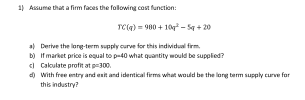 1) Assume that a firm faces the following cost function: TC(q) = 980 + 10q2 – 5q + 20 a) Derive the long-term supply curve for this individual firm. b) If market price is equal to p=40 what quantity would be supplied? c) Calculate profit at p=300. d) with free entry and exit and identical firms what would be the long term supply curve for this industry?
Consider a competitive firm with total costs given by TC(q) = 100 + 10q + q 2 The firm faces a market price p = 50. (f)...
Consider a competitive firm with total costs given by TC(q) = 100 + 10q + q 2 The firm faces a market price p = 50. (f) If fixed costs increase from 100 to 500, what happens to the profit-maximizing level of output, TR, TC, and π? (g) If fixed costs increase from 100 to 500, should the firm continue to operate in the short-run? What about the long-run?
Two duopoly firms each have a cost function: TC (Q) 600 Market Inverse Demand is: Po (Q)-824 0.6Q After the duopoli...
 Two duopoly firms each have a cost function: TC (Q) 600 Market Inverse Demand is: Po (Q)-824 0.6Q After the duopolists meet secretly and agree to evenly split the profit-maximizing output, Firm 1 decides to break the monopoly-splitting agreement and change its output to maximize its own profit. What will be the reduction in price for both firms to the nearest dollar? (Subtract the new price from the monopoly price]
Two duopoly firms each have a cost function: TC (Q)...
Two duopoly firms each have a cost function: TC (Q) 600 Market Inverse Demand is: Po (Q)-824 0.6Q After the duopolists meet secretly and agree to evenly split the profit-maximizing output, Firm 1 decides to break the monopoly-splitting agreement and change its output to maximize its own profit. What will be the reduction in price for both firms to the nearest dollar? (Subtract the new price from the monopoly price]
Two duopoly firms each have a cost function: TC (Q)...
 2. (54 points) Short-run costs. Suppose w 1, r 10 and K 20. C )q3 +200 a) (5 points) We have TC = WG) q3 + rK = On one graph (with q on the horizontal axis), graph the Total Cost, Variable Cost, and Fixed Cost functions. Pay attention to the shape of the curves, where they intercept the axes and each other (if they do), and the position of the curves relative to each other b) (9 points) Using...
 12. Consider a price-taking firm with cost function C(q) = 9+q2. What is the break-even price, pBE, below which the firm will exit the market in the long run? (a) 3 (b) 6 (c) 9 (d) 18
 The market price is p=50
3. Consider a competitive firm with total costs given by TC(q) = 100 + 10q+q? (e) Graph the ATC, AVC, MC, and MR curves in a single graph, and indicate the profit maximizing level of output. If there are profits, shade the region corre- sponding to profit and label it. (f) If fixed costs increase from 100 to 500, what happens to the profit maximizing level of output, TR, TC, and a? (g) If fixed...
The market price is p=50
3. Consider a competitive firm with total costs given by TC(q) = 100 + 10q+q? (e) Graph the ATC, AVC, MC, and MR curves in a single graph, and indicate the profit maximizing level of output. If there are profits, shade the region corre- sponding to profit and label it. (f) If fixed costs increase from 100 to 500, what happens to the profit maximizing level of output, TR, TC, and a? (g) If fixed...
 Often a firm will calculate the break-even point for a
price. That is, if we set the price at $X, then how many units will
we need to sell to cover costs (that is, our break-even point).
Work through the following data and questions to gain a better
understanding of this approach.
QUESTIONS
Start by completing the table below under the assumption that
the product will be sold for $20. (It will be easiest to use Excel
to complete the...
Often a firm will calculate the break-even point for a
price. That is, if we set the price at $X, then how many units will
we need to sell to cover costs (that is, our break-even point).
Work through the following data and questions to gain a better
understanding of this approach.
QUESTIONS
Start by completing the table below under the assumption that
the product will be sold for $20. (It will be easiest to use Excel
to complete the...
 1) Assume that a firm faces the following cost function: TC(q) = 980 + 10q2 – 5q + 20 a) Derive the long-term supply curve for this individual firm. b) If market price is equal to p=40 what quantity would be supplied? c) Calculate profit at p=300. d) with free entry and exit and identical firms what would be the long term supply curve for this industry?
 Two duopoly firms each have a cost function: TC (Q) 600 Market Inverse Demand is: Po (Q)-824 0.6Q After the duopolists meet secretly and agree to evenly split the profit-maximizing output, Firm 1 decides to break the monopoly-splitting agreement and change its output to maximize its own profit. What will be the reduction in price for both firms to the nearest dollar? (Subtract the new price from the monopoly price]
Two duopoly firms each have a cost function: TC (Q)...
Two duopoly firms each have a cost function: TC (Q) 600 Market Inverse Demand is: Po (Q)-824 0.6Q After the duopolists meet secretly and agree to evenly split the profit-maximizing output, Firm 1 decides to break the monopoly-splitting agreement and change its output to maximize its own profit. What will be the reduction in price for both firms to the nearest dollar? (Subtract the new price from the monopoly price]
Two duopoly firms each have a cost function: TC (Q)...
Most questions answered within 3 hours.
-
Where is the error in this code sequence?
String s1 = "Hello";
String s2 = "ello";...
asked 11 months ago -
Financial data for Joel de Paris, Inc., for last year
follow:
Joel de Paris, Inc.
Balance...
asked 11 months ago -
Consider this reaction:
Al2(SO4)3 (aq)+ BaCl3
(aq) Al2Cl6 (aq)- +
3BaSO4(s) . What is the...
asked 11 months ago -
Suppose that Savneet is considering increasing her
recent random sample from 20 car rentals to 40...
asked 11 months ago -
Trucks arrive at an unloading terminal at an average rate of 120
per hour.
Trucks arrive...
asked 11 months ago -
Why are methanol and ethanol completely soluble in water while
octanol is not very little soluble....
asked 11 months ago -
A facilities manager at a university reads in a research report
that the mean amount of...
asked 11 months ago -
When the CuSO4 is rehydrated by adding water to the anhydrous
compound, is this an endothermic...
asked 11 months ago -
A ray of sunlight is passing from diamond into crown glass; the
angle of incidence is...
asked 11 months ago -
A block of mass 0.249 kg is placed on top of a light, vertical
spring of...
asked 11 months ago -
how do the kidneys compensate in the presences of acidosis
a) trigger hyperventilate
b) reserve acid...
asked 11 months ago -
Question 501 pts
The rental rate of capital to the firm increases. Which of the
following...
asked 11 months ago