Write a function called printStars. The function receives a parameter containing an integer value. If the...
Write a function called printStars. The function receives a parameter containing an integer value. If the parameter is positive, the funciton prints (to standard output) the given number of asterisks. Otherwise the function does nothing. The function does not return a value. Thus, if printStars(8) is called, ******** (8 asterisks) will be printed. The function must not use a loop of any kind (for, while, do-while) to accomplish its job. Instead, it should examine its parameter, returning if the parameters value is not positive. If the parameter is positive, it:
- prints a single asterisk (and no other characters)
- then crecursively calls itself to print the remaining asterisks
This is what I got, but it says my standard output is incorrect and starcount was modified.
def printStars(n):
if n>0:
print ('*', end="")
printStars(n-1)
starCount = 10
printStars(starCount)
Homework Answers
def printStars(n):
if n>0:
print ('*', end="")
printStars(n-1)
elif n<0:
return
starCount = -3
printStars(starCount)
print()
*************************************************************** SCREENSHOT ************************************************************
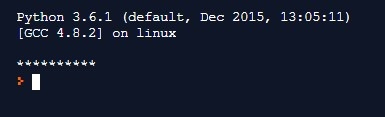
When starCount = 10:
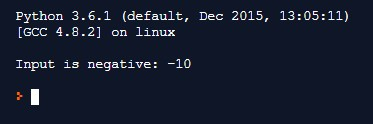
When starCount = -10:
Add Answer to:
Write a function called printStars. The function receives a
parameter containing an integer value. If the...
Assume the availability of a function called printStars. The function receives an integer value as an...
Assume the availability of a function called printStars. The function receives an integer value as an argument. If the argument is positive, the function prints (to standard output) the given number of asterisks. Thus, if printStars(8) is called, ******** (8 asterisks) will be printed. Assume further that the variable starCount has been declared and initialized to contain a positive integer value. Write some code that prints starCount asterisks to standard output by: first printing a single asterisk and no other characters...
Written in python programming for MyProLab :) Please use simple code Assume the availability of a...
Written in python programming for MyProLab :) Please use simple code Assume the availability of a function called printStars. The function receives an integer value as an argument. If the argument is positive, the function prints (to standard output) the given number of asterisks. Thus, if printStars(8) is called, ******** (8 asterisks) will be printed. Assume further that the variable starCount has been declared and initialized with an integer value, possibly negative or zero. Write some code that does nothing...
Using MatLab Write a function called PrimeFinder that receives an integer n as an input argument,...
Using MatLab Write a function called PrimeFinder that receives an integer n as an input argument, and provides an output argument called Primes that is a vector containing all prime numbers between 2 and n, inclusive. Verify the correctness of your code with inserting 13 as the input argument, and check that your output is Primes = [2,3,5,7,11,13]. You are NOT allowed to use any directly relevant MATLAB built-in function such as divisors, etc. NOTE: A prime number is a...
Write a function which accepts one parameter, and prints out the value of this parameter plus...
Write a function which accepts one parameter, and prints out the value of this parameter plus 5. ie. if the parameter contained a 10, the function would print 15. in python
PYTHON 1- Write a function that receives a string value as a parameter, converts its first...
PYTHON 1- Write a function that receives a string value as a parameter, converts its first character to uppercase and returns the first character. 2- Test your function by writing a main, which calls your function and prints its return value. 3- Save your program in a file called firstChar.py and use the following link to submit your file.
# function: horizontal_line # input: a width value (integer) # processing: prints a single horizontal line...
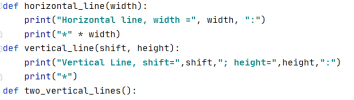 # function:
horizontal_line
# input:
a width value (integer)
# processing:
prints a single horizontal line of the desired size
# output:
does not return anything
# function:
vertical_line
# input:
a shift value and a height value (both integers)
# processing:
generates a single vertical line of the desired height. The line
is offset from the left side of the screen using the shift
value
# output:
does not return anything
# function:
two_vertical_lines
# input:
a width value...
# function:
horizontal_line
# input:
a width value (integer)
# processing:
prints a single horizontal line of the desired size
# output:
does not return anything
# function:
vertical_line
# input:
a shift value and a height value (both integers)
# processing:
generates a single vertical line of the desired height. The line
is offset from the left side of the screen using the shift
value
# output:
does not return anything
# function:
two_vertical_lines
# input:
a width value...
C++ 2. (a) Write a function, printdixisors, that takes a single integer parameter and prints all...
 C++
2. (a) Write a function, printdixisors, that takes a single integer parameter and prints all the numbers less that the parameter that are divisors of the parameter (i.e. divides it without a remainder) including 1. So printdivisors(6) will print 1,2,3. Note you may use a wrapper function or default parameters. (b) Write a function, sumdixisors, that takes a single integer parameter and returns the sum of all the divisors of the parameter (including 1). So sumdivisors(6) will return 6...
C++
2. (a) Write a function, printdixisors, that takes a single integer parameter and prints all the numbers less that the parameter that are divisors of the parameter (i.e. divides it without a remainder) including 1. So printdivisors(6) will print 1,2,3. Note you may use a wrapper function or default parameters. (b) Write a function, sumdixisors, that takes a single integer parameter and returns the sum of all the divisors of the parameter (including 1). So sumdivisors(6) will return 6...
1. Define the draw_histogram() function which is passed a Python dictionary as a parameter. The keys...
1. Define the draw_histogram() function which is passed a Python dictionary as a parameter. The keys of the dictionary are single letters and the corresponding values are integers, e.g., {'b': 5, 'a': 6, 'c': 3}. For each key:value pair in the dictionary the function prints the key, followed by ": ", followed by a series of stars. The number of stars printed is given by the value corresponding to the key. The keys are printed in alphabetical order. Note that...
Define a function called repeat_middle which receives as parameter one string (with at least one character),...
Define a function called repeat_middle which receives as parameter one string (with at least one character), and it should return a new string which will have the middle character/s in the string repeated as many times as the length of the input (original) string. Notice that if the original string has an odd number of characters there is only one middle character. If, on the other hand, if the original string has an even number of characters then there will...
c++ Write a function Count_m_z that takes a string as an input parameter argument and counts...
c++ Write a function Count_m_z that takes a string as an input parameter argument and counts the number of m, n, o, ... z characters in it. The function returns an integer value for the number of times those 14 lowercase letters appear in the input string. Your function should be named Count_m_z Your function should take one string parameter Your function should return the number of m, n, o, ... z characters as an integer Your function should not...
 # function:
horizontal_line
# input:
a width value (integer)
# processing:
prints a single horizontal line of the desired size
# output:
does not return anything
# function:
vertical_line
# input:
a shift value and a height value (both integers)
# processing:
generates a single vertical line of the desired height. The line
is offset from the left side of the screen using the shift
value
# output:
does not return anything
# function:
two_vertical_lines
# input:
a width value...
# function:
horizontal_line
# input:
a width value (integer)
# processing:
prints a single horizontal line of the desired size
# output:
does not return anything
# function:
vertical_line
# input:
a shift value and a height value (both integers)
# processing:
generates a single vertical line of the desired height. The line
is offset from the left side of the screen using the shift
value
# output:
does not return anything
# function:
two_vertical_lines
# input:
a width value...
 C++
2. (a) Write a function, printdixisors, that takes a single integer parameter and prints all the numbers less that the parameter that are divisors of the parameter (i.e. divides it without a remainder) including 1. So printdivisors(6) will print 1,2,3. Note you may use a wrapper function or default parameters. (b) Write a function, sumdixisors, that takes a single integer parameter and returns the sum of all the divisors of the parameter (including 1). So sumdivisors(6) will return 6...
C++
2. (a) Write a function, printdixisors, that takes a single integer parameter and prints all the numbers less that the parameter that are divisors of the parameter (i.e. divides it without a remainder) including 1. So printdivisors(6) will print 1,2,3. Note you may use a wrapper function or default parameters. (b) Write a function, sumdixisors, that takes a single integer parameter and returns the sum of all the divisors of the parameter (including 1). So sumdivisors(6) will return 6...
Most questions answered within 3 hours.
-
Where is the error in this code sequence?
String s1 = "Hello";
String s2 = "ello";...
asked 11 months ago -
Financial data for Joel de Paris, Inc., for last year
follow:
Joel de Paris, Inc.
Balance...
asked 11 months ago -
Consider this reaction:
Al2(SO4)3 (aq)+ BaCl3
(aq) Al2Cl6 (aq)- +
3BaSO4(s) . What is the...
asked 11 months ago -
Suppose that Savneet is considering increasing her
recent random sample from 20 car rentals to 40...
asked 11 months ago -
Trucks arrive at an unloading terminal at an average rate of 120
per hour.
Trucks arrive...
asked 11 months ago -
Why are methanol and ethanol completely soluble in water while
octanol is not very little soluble....
asked 11 months ago -
A facilities manager at a university reads in a research report
that the mean amount of...
asked 11 months ago -
When the CuSO4 is rehydrated by adding water to the anhydrous
compound, is this an endothermic...
asked 11 months ago -
A ray of sunlight is passing from diamond into crown glass; the
angle of incidence is...
asked 11 months ago -
A block of mass 0.249 kg is placed on top of a light, vertical
spring of...
asked 11 months ago -
how do the kidneys compensate in the presences of acidosis
a) trigger hyperventilate
b) reserve acid...
asked 11 months ago -
Question 501 pts
The rental rate of capital to the firm increases. Which of the
following...
asked 11 months ago