-When light of wavelength λ illuminates the surface of Metal 1, the stopping voltage is V....
-When light of wavelength λ illuminates the surface of Metal 1, the stopping voltage is V. In terms of V, what will be the stopping voltage if the same wavelength is used to illuminate the surface of Metal 2? The work function of Metal 1 is 5.7 eV and the work function of Metal 2 is 2.1 eV.
1-V – 3.6 volts
2-3.6 volts – V
3-2.1 volts – V
4-V + 3.6 volts
5-5.7 volts – V
Homework Answers

 --(1)
--(1)
 ---(2)
from (1)
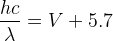
substituting the above result in (2), we get,

OPTION 4) is the right answer
Add Answer to:
-When light of wavelength λ illuminates the surface of Metal 1,
the stopping voltage is V....
Question 7 1 pts When light of wavelength , illuminates the surface of Metal 1, the...
 Question 7 1 pts When light of wavelength , illuminates the surface of Metal 1, the stopping voltage is V. In terms of V, what will be the stopping voltage if the same wavelength is used to illuminate the surface of Metal 2? The work function of Metal 1 is 5.7 eV and the work function of Metal 2 is 2.1 eV. 3.6 volts - V O V-3.6 volts OV+3.6 volts 2.1 volts - V 5.7 volts - V Consider...
A light source of wavelength, (λ), illuminates a metal and ejects photoelectrons with a maximum kinetic...
A light source of wavelength, (λ), illuminates a metal and ejects photoelectrons with a maximum kinetic energy of 1.00 eV. A second light source of wavelength (λ/2) ejects photoelectrons with a maximum kinetic energy of 5.60 eV. What is the work function of the metal?
A light source of wavelength λ illuminates a metal and ejects photoelectrons with a maximum kinetic...
A light source of wavelength λ illuminates a metal and ejects photoelectrons with a maximum kinetic energy of 1.28 eV. A second light source of wavelength λ/2 ejects photoelectrons with a maximum kinetic energy of 7.40 eV. What is the work function of the metal?
When violet light of wavelength 430 nm illuminates a metal surface, the maximum kinetic energy of...
 When violet light of wavelength 430 nm illuminates a metal surface, the maximum kinetic energy of the photoelectrons is 2.45 eV. (a) What is the work function, (b) What is the maximum speed of photoelectrons when a light beam of wavelength 520 nm illuminates the metal surface? 8 %
In a photoelectric effect experiment you illuminate a metal with light of an unknown wavelength and...
In a photoelectric effect experiment you illuminate a metal with light of an unknown wavelength and measure the maximum kinetic energy of the photoelectrons to be .75 eV. Then you illuminate the same metal with light of a wavelength known to be 2/3 of the first wavelength and measure a maximum kinetic energy of 2.4 eV for the photoelectrons. a) Find the first wavelength, in nanometers. b) Find the metal's work function, in electron volts.
1) Light of wavelength 310nm is shined on a metal with work function = 1 eV....
1) Light of wavelength 310nm is shined on a metal with work function = 1 eV. What will be the maximum kinetic energy of the emitted electrons? 2) Light is shined on a metal with work function 2.0 eV, and electrons are emitted creating a photocurrent. When a decelerating voltage of magnitude 1.0 V is applied, the current goes to zero (i.e. the magnitude of the stopping voltage is 1V). What is the wavelength (in nm) of the incoming light?...
Light of wavelength 400 nm is incident on a metal surface. The stopping potential for the...
 Light of wavelength 400 nm is incident on a metal
surface. The stopping
potential for the resulting electrons is 0.91 V.
a) What is the work function of the metal?
b) Identify the metal. (Use the Table)
c) What is the cut-off frequency for this target?
76 Chapter 3 Waves and Particles 1: Electromagnetic Radia TABLE 3.1 Metal Work Function in eV) Cesium Potassium Sodium Magnesium 19 2.2 2.3 3.7 are ejected if the intensi surable time might be ne...
Light of wavelength 400 nm is incident on a metal
surface. The stopping
potential for the resulting electrons is 0.91 V.
a) What is the work function of the metal?
b) Identify the metal. (Use the Table)
c) What is the cut-off frequency for this target?
76 Chapter 3 Waves and Particles 1: Electromagnetic Radia TABLE 3.1 Metal Work Function in eV) Cesium Potassium Sodium Magnesium 19 2.2 2.3 3.7 are ejected if the intensi surable time might be ne...
A) Light with a wavelength of 395 nm illuminates a metal cathode. The maximum kinetic energy...
A) Light with a wavelength of 395 nm illuminates a metal cathode. The maximum kinetic energy of the emitted electrons is 0.61 eV. What is the longest wavelength of light that will cause electrons to be emitted from this cathode? B) What is the kinetic energy, in eV, of an electron with a de Broglie wavelength of 2.1 nm?
When ultraviolet light with a wavelength of 400 nm falls on a certain metal surface, the...
When ultraviolet light with a wavelength of 400 nm falls on a certain metal surface, the maximum kinetic energy of the emitted photoelectrons is 1.10 eV . What is the maximum kinetic energy K0 of the photoelectrons when light of wavelength 340 nm falls on the same surface? Use h = 6.63×10^−34 J⋅s for Planck's constant and c = 3.00×10^8 m/s for the speed of light and express your answer in electron volts. K0= eV
4. Light of a given wavelength is used to illuminate the surface of a metal, however,...
4. Light of a given wavelength is used to illuminate the surface of a metal, however, no photoelectrons are emitted. In order to cause electrons to be ejected from the surface of this metal you should (A) use light of a longer wavelength. (B) use light of a shorter wavelength. (C) use light of the same wavelength but increase its intensity. (D) use light of the same wavelength but decrease its intensity.
 Question 7 1 pts When light of wavelength , illuminates the surface of Metal 1, the stopping voltage is V. In terms of V, what will be the stopping voltage if the same wavelength is used to illuminate the surface of Metal 2? The work function of Metal 1 is 5.7 eV and the work function of Metal 2 is 2.1 eV. 3.6 volts - V O V-3.6 volts OV+3.6 volts 2.1 volts - V 5.7 volts - V Consider...
 When violet light of wavelength 430 nm illuminates a metal surface, the maximum kinetic energy of the photoelectrons is 2.45 eV. (a) What is the work function, (b) What is the maximum speed of photoelectrons when a light beam of wavelength 520 nm illuminates the metal surface? 8 %
 Light of wavelength 400 nm is incident on a metal
surface. The stopping
potential for the resulting electrons is 0.91 V.
a) What is the work function of the metal?
b) Identify the metal. (Use the Table)
c) What is the cut-off frequency for this target?
76 Chapter 3 Waves and Particles 1: Electromagnetic Radia TABLE 3.1 Metal Work Function in eV) Cesium Potassium Sodium Magnesium 19 2.2 2.3 3.7 are ejected if the intensi surable time might be ne...
Light of wavelength 400 nm is incident on a metal
surface. The stopping
potential for the resulting electrons is 0.91 V.
a) What is the work function of the metal?
b) Identify the metal. (Use the Table)
c) What is the cut-off frequency for this target?
76 Chapter 3 Waves and Particles 1: Electromagnetic Radia TABLE 3.1 Metal Work Function in eV) Cesium Potassium Sodium Magnesium 19 2.2 2.3 3.7 are ejected if the intensi surable time might be ne...
Most questions answered within 3 hours.
-
Where is the error in this code sequence?
String s1 = "Hello";
String s2 = "ello";...
asked 10 months ago -
Financial data for Joel de Paris, Inc., for last year
follow:
Joel de Paris, Inc.
Balance...
asked 10 months ago -
Consider this reaction:
Al2(SO4)3 (aq)+ BaCl3
(aq) Al2Cl6 (aq)- +
3BaSO4(s) . What is the...
asked 10 months ago -
Suppose that Savneet is considering increasing her
recent random sample from 20 car rentals to 40...
asked 10 months ago -
Trucks arrive at an unloading terminal at an average rate of 120
per hour.
Trucks arrive...
asked 10 months ago -
Why are methanol and ethanol completely soluble in water while
octanol is not very little soluble....
asked 10 months ago -
A facilities manager at a university reads in a research report
that the mean amount of...
asked 10 months ago -
When the CuSO4 is rehydrated by adding water to the anhydrous
compound, is this an endothermic...
asked 10 months ago -
A ray of sunlight is passing from diamond into crown glass; the
angle of incidence is...
asked 10 months ago -
A block of mass 0.249 kg is placed on top of a light, vertical
spring of...
asked 10 months ago -
how do the kidneys compensate in the presences of acidosis
a) trigger hyperventilate
b) reserve acid...
asked 10 months ago -
Question 501 pts
The rental rate of capital to the firm increases. Which of the
following...
asked 10 months ago