Describe bulk flow and include the capillary wall structure and the Starling forces which determine rate...
Describe bulk flow and include the capillary wall structure and the Starling forces which determine rate and direction of bulk flow?
Answer in dot points
Homework Answers
Bulk Flow: Filtration and Reabsorption
- Bulk flow is a passive process in which large numbers of ions, molecules, or particles in a fluid move together in the same direction.
- The substances move at rates far greater than can be accounted for by diffusion alone.
- Bulk flow occurs from an area of higher pressure to an area of lower pressure, and it continues as long as a pressure difference exists.
- Diffusion is more important for solute exchange between blood and interstitial fluid, but bulk flow is more important for regulation of the relative volumes of blood and interstitial fluid.
- Pressure-driven movement of fluid and solutes from blood capillaries into interstitial fluid is called filtration.
- Pressure-driven movement from interstitial fluid into blood capillaries is called reabsorption.
- Two pressures promote filtration: blood hydrostatic pressure (BHP), the pressure generated by the pumping action of the heart, and interstitial fluid osmotic pressure.
- The main pressure promoting reabsorption of fluid is blood colloid osmotic pressure. The balance of these pressures, called net filtration pressure (NFP), determines whether the volumes of blood and interstitial fluid remain steady or change.
- Overall, the volume of fluid and solutes reabsorbed normally is almost as large as the volume filtered. This near equilibrium is known as Starling’s law of the capillaries.
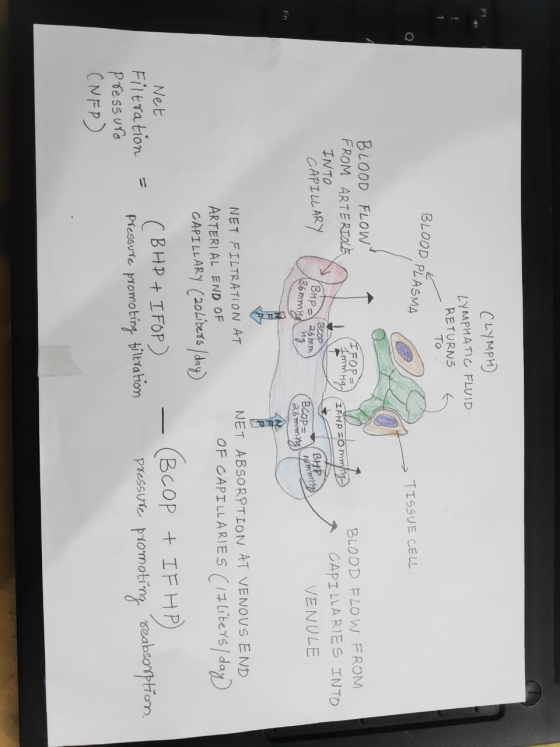
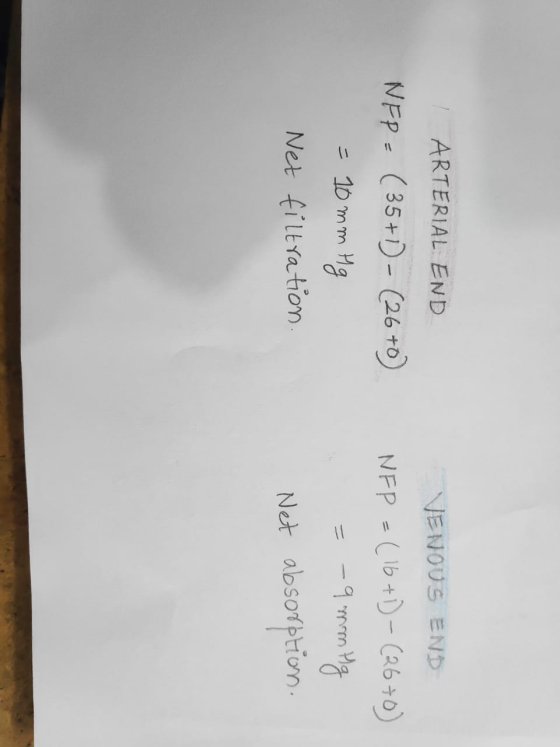
- How these hydrostatic and osmotic pressures balance- Within vessels, the hydrostatic pressure is due to the pressure that water in blood plasma exerts against blood vessel walls. The blood hydrostatic pressure (BHP) is about 35 millimeters of mercury (mmHg) at the arterial end of a capillary, and about 16 mmHg at the capillary’s venous end (Figure mentioned down below).
- BHP “pushes” fluid out of capillaries into interstitial fluid.
- The opposing pressure of the interstitial fluid, called interstitial fluid hydrostatic pressure (IFHP),“pushes” fluid from interstitial spaces back into capillaries.
- However, IFHP is close to zero. (IFHP is difficult to measure, and its reported values vary from small positive values to small negative values.) For our discussion we assume that IFHP equals 0 mmHg all along the capillaries.
- The difference in osmotic pressure across a capillary wall is due almost entirely to the presence in blood of plasma proteins, which are too large to pass through either fenestrations or gaps between endothelial cells.
- Blood colloid osmotic pressure (BCOP) is a force caused by the colloidal suspension of these large proteins in plasma that averages 26 mmHg in most capillaries.
- The effect of BCOP is to “pull” fluid from interstitial spaces into capillaries.
- Opposing BCOP is interstitial fluid osmotic pressure (IFOP),which “pulls” fluid out of capillaries into interstitial fluid.
- Normally, IFOP is very small—0.1–5 mmHg— because only tiny amounts of protein are present in interstitial fluid. The small amount of protein that leaks from blood plasma into interstitial fluid does not accumulate there because it passes into lymph in lymphatic capillaries and is eventually returned to the blood.
- For discussion, we can use a value of 1 mmHg for IFOP. Whether fluids leave or enter capillaries depends on the balance of pressures. If the pressures that push fluid out of capillaries exceed the pressures that pull fluid into capillaries, fluid will move from capillaries into interstitial spaces (filtration). If, however, the pressures that push fluid out of interstitial spaces into capillaries exceed the pressures that pull fluid out of capillaries, then fluid will move from interstitial spaces into capillaries (reabsorption). The net filtration pressure (NFP), which indicates the direction of fluid movement, is calculated as follows:
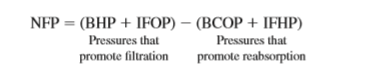
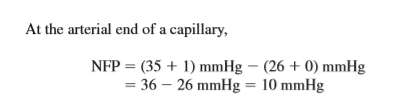
- Thus, at the arterial end of a capillary, there is a net outward pressure of 10 mmHg, and fluid moves out of the capillary into interstitial spaces (filtration).
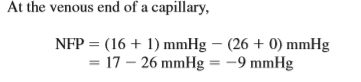
- At the venous end of a capillary, the negative value (-9 mmHg) represents a net inward pressure, and fluid moves into the capillary from tissue spaces (reabsorption).
- On average, about 85% of the fluid filtered out of capillaries is reabsorbed. The excess filtered fluid and the few plasma proteins that do escape from blood into interstitial fluid enter lymphatic capillaries.
- As lymph drains into the junction of the jugular and subclavian veins in the upper thorax, these materials return to the blood. Every day about 20 liters of fluid filter out of capillaries in tissues throughout the body. Of this fluid, 17 liters are reabsorbed and 3 liters enter lymphatic capillaries (excluding filtration during urine formation).
KEY FOR THE DIAGRAM-
- BHP = BLOOD HYDROSTATIC PRESSURE
- IFHP = INTERSTITIAL FLUID HYDROSTATIC PRESSURE
- BCOP = BLOOD COLLOID OSMOTIC PRESSURE
- IFOP = INTERSTITIAL FLUID OSMOTIC PRESSURE
- NFP = NET FILTRATION PRESSURE
Add Answer to:
Describe bulk flow and include the capillary wall structure and
the Starling forces which determine rate...
Mass movement of water along pressure gradients is known as bulk flow. Describe how capillary action...
Mass movement of water along pressure gradients is known as bulk flow. Describe how capillary action helps/hurts this concept.
Describe in physical terms the forces acting on segment of the tube wall in pulsatile flow...
Describe in physical terms the forces acting on segment of the tube wall in pulsatile flow through a compliant tube.
Gas transfer systems in complex animals rely on the two processes of diffusion and bulk flow...
Gas transfer systems in complex animals rely on the two processes of diffusion and bulk flow to move O2 from the environment into the mitochondria of cells. Define and contrast these two transport mechanisms and describe at which points in the process of gas transfer (from the environment to the mitochondria) they are utilized in a vertebrate. Be sure to include a description of the forces behind each of these two mechanisms.
In the adjoining diagram, show (on the illustration) the directions for the tour forces (P: hydrodynamic;I:...
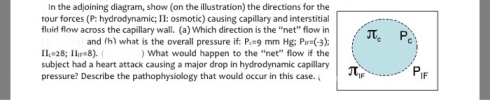 In the adjoining diagram, show (on the illustration) the directions for the tour forces (P: hydrodynamic;I: osmotic) causing capillary and interstitial fluid flow across the capillary wall. (a) Which direction is the "net" flow in and (h) what is the overall pressure if: P 9 mm Hg; Pi (3);cc I 28; I 8). subject had a heart attack causing a major drop in hydrodynamic capillary pressure? Describe the pathophysiology that would occur in this case. ( What would happen to...
Part 4: Viscous Flow Concepts (10 points,5 each) The flow through a duct is fully-developed, with...
 Part 4: Viscous Flow Concepts (10 points,5 each) The flow through a duct is fully-developed, with a velocity profile as shown in the figure. has a rectangular cross section, and the velocity profile is uniform in the z-direction (it does not change going into the page) If we wish to determine the mass flow rate through the duct, which differential area would we use? Why? If we wish to determine the forced caused by shear stress on the bottom wall,...
Determine whether the structure, location, and functions describe proteoglycans, peptidoglycan, glycoproteins, or glycolipids. GlcNAc is N-acetylglucosamine;...
 Determine whether the structure, location, and functions describe proteoglycans, peptidoglycan, glycoproteins, or glycolipids. GlcNAc is N-acetylglucosamine; MurNAc is N-acetylmuramic acid. Proteoglycans Peptidoglycan Glycoproteins Glycolipids Structure Location part of proteins at outer surface of plasma membrane, in extracellular matrix, and in blood Functions many functions, including cell adhesion strength for cell envelope Answer Bank glycosaminoglycan covalently joined to a protein at a Ser residue many functions, including acting as hormones bacterial cell wall extracellular matrix; some are integral membrane proteins outer...
Can someome explain to me how he knew which forces to uses for the moments of...
 Can someome explain to me how he knew which forces to uses for
the moments of A? I am having a problem understanding how it came
to it. Is there a logical and easier way to understand how it came
and why he uses to specific forces for future refrences. Thank
You
ll. PR M 200 N 1.) Determine the internal loadings that act on the section shown at point A. Be sure to include a free body diagram showing...
Can someome explain to me how he knew which forces to uses for
the moments of A? I am having a problem understanding how it came
to it. Is there a logical and easier way to understand how it came
and why he uses to specific forces for future refrences. Thank
You
ll. PR M 200 N 1.) Determine the internal loadings that act on the section shown at point A. Be sure to include a free body diagram showing...
3. Parallel wires carrying currents will exert forces on each other. 2098 Each wire produces a...
 3. Parallel wires carrying currents will exert forces on each other. 2098 Each wire produces a magnetic field, which influences the other wire. When the currents in both wires flow in the same direction, then the force is attractive. When the currents flow in opposite directions, then the force is repulsive. You can see this in the You Tube video. Two parallel wires that are 14 mm apart each have a current of 2.8 amps. Part Description Answer Chk History...
c)Draw the chemical structure of sodium benzoate and include all charges. d)Circle and label the region...
c)Draw the chemical structure of sodium benzoate and include all charges. d)Circle and label the region of the molecule that exhibits polar behavior. e) What is the strongest intermolecular force with which sodium benzoate will interact with the solvent water? In general, I am taking Organic Chemistry and I have no idea how to answer questions such as, " what are the intermolecular forces present in the non polar region of the molecule". Can someone help me with a guide...
which structure contributes most to the resonance hybrid? left, right, or middle? 6. Determine the hybridization...
 which structure contributes most to the resonance hybrid?
left, right, or middle?
6. Determine the hybridization and molecular geometry for the indicated atoms of the given resonance contributor. Draw the two most significant resonance contributors for the molecule given that make up its resonance structure. Indicate which resonance contributor contributes most to the resonance hybrid for the molecule and answer a question about the Nitrogen atom. (14 points) hybridization: Sp 3 molecular geometry: +r igonalayramidal hybridization: Spa molecular geometry: +yriqunalplanar...
which structure contributes most to the resonance hybrid?
left, right, or middle?
6. Determine the hybridization and molecular geometry for the indicated atoms of the given resonance contributor. Draw the two most significant resonance contributors for the molecule given that make up its resonance structure. Indicate which resonance contributor contributes most to the resonance hybrid for the molecule and answer a question about the Nitrogen atom. (14 points) hybridization: Sp 3 molecular geometry: +r igonalayramidal hybridization: Spa molecular geometry: +yriqunalplanar...
 In the adjoining diagram, show (on the illustration) the directions for the tour forces (P: hydrodynamic;I: osmotic) causing capillary and interstitial fluid flow across the capillary wall. (a) Which direction is the "net" flow in and (h) what is the overall pressure if: P 9 mm Hg; Pi (3);cc I 28; I 8). subject had a heart attack causing a major drop in hydrodynamic capillary pressure? Describe the pathophysiology that would occur in this case. ( What would happen to...
 Part 4: Viscous Flow Concepts (10 points,5 each) The flow through a duct is fully-developed, with a velocity profile as shown in the figure. has a rectangular cross section, and the velocity profile is uniform in the z-direction (it does not change going into the page) If we wish to determine the mass flow rate through the duct, which differential area would we use? Why? If we wish to determine the forced caused by shear stress on the bottom wall,...
 Determine whether the structure, location, and functions describe proteoglycans, peptidoglycan, glycoproteins, or glycolipids. GlcNAc is N-acetylglucosamine; MurNAc is N-acetylmuramic acid. Proteoglycans Peptidoglycan Glycoproteins Glycolipids Structure Location part of proteins at outer surface of plasma membrane, in extracellular matrix, and in blood Functions many functions, including cell adhesion strength for cell envelope Answer Bank glycosaminoglycan covalently joined to a protein at a Ser residue many functions, including acting as hormones bacterial cell wall extracellular matrix; some are integral membrane proteins outer...
 Can someome explain to me how he knew which forces to uses for
the moments of A? I am having a problem understanding how it came
to it. Is there a logical and easier way to understand how it came
and why he uses to specific forces for future refrences. Thank
You
ll. PR M 200 N 1.) Determine the internal loadings that act on the section shown at point A. Be sure to include a free body diagram showing...
Can someome explain to me how he knew which forces to uses for
the moments of A? I am having a problem understanding how it came
to it. Is there a logical and easier way to understand how it came
and why he uses to specific forces for future refrences. Thank
You
ll. PR M 200 N 1.) Determine the internal loadings that act on the section shown at point A. Be sure to include a free body diagram showing...
 3. Parallel wires carrying currents will exert forces on each other. 2098 Each wire produces a magnetic field, which influences the other wire. When the currents in both wires flow in the same direction, then the force is attractive. When the currents flow in opposite directions, then the force is repulsive. You can see this in the You Tube video. Two parallel wires that are 14 mm apart each have a current of 2.8 amps. Part Description Answer Chk History...
 which structure contributes most to the resonance hybrid?
left, right, or middle?
6. Determine the hybridization and molecular geometry for the indicated atoms of the given resonance contributor. Draw the two most significant resonance contributors for the molecule given that make up its resonance structure. Indicate which resonance contributor contributes most to the resonance hybrid for the molecule and answer a question about the Nitrogen atom. (14 points) hybridization: Sp 3 molecular geometry: +r igonalayramidal hybridization: Spa molecular geometry: +yriqunalplanar...
which structure contributes most to the resonance hybrid?
left, right, or middle?
6. Determine the hybridization and molecular geometry for the indicated atoms of the given resonance contributor. Draw the two most significant resonance contributors for the molecule given that make up its resonance structure. Indicate which resonance contributor contributes most to the resonance hybrid for the molecule and answer a question about the Nitrogen atom. (14 points) hybridization: Sp 3 molecular geometry: +r igonalayramidal hybridization: Spa molecular geometry: +yriqunalplanar...
Most questions answered within 3 hours.
-
Where is the error in this code sequence?
String s1 = "Hello";
String s2 = "ello";...
asked 11 months ago -
Financial data for Joel de Paris, Inc., for last year
follow:
Joel de Paris, Inc.
Balance...
asked 11 months ago -
Consider this reaction:
Al2(SO4)3 (aq)+ BaCl3
(aq) Al2Cl6 (aq)- +
3BaSO4(s) . What is the...
asked 11 months ago -
Suppose that Savneet is considering increasing her
recent random sample from 20 car rentals to 40...
asked 11 months ago -
Trucks arrive at an unloading terminal at an average rate of 120
per hour.
Trucks arrive...
asked 11 months ago -
Why are methanol and ethanol completely soluble in water while
octanol is not very little soluble....
asked 11 months ago -
A facilities manager at a university reads in a research report
that the mean amount of...
asked 11 months ago -
When the CuSO4 is rehydrated by adding water to the anhydrous
compound, is this an endothermic...
asked 11 months ago -
A ray of sunlight is passing from diamond into crown glass; the
angle of incidence is...
asked 11 months ago -
A block of mass 0.249 kg is placed on top of a light, vertical
spring of...
asked 11 months ago -
how do the kidneys compensate in the presences of acidosis
a) trigger hyperventilate
b) reserve acid...
asked 11 months ago -
Question 501 pts
The rental rate of capital to the firm increases. Which of the
following...
asked 11 months ago